Canadian Study Permit
Canadian Study Permit Overview 2026-2027
For many international students, studying in Canada is the first step toward the “Canadian Dream”—a life defined by safety, diversity, and economic opportunity. However, securing a Canadian Study Permit involves navigating complex regulations and strict documentation.
The process is rigorous, but it does not have to be overwhelming. At Dara Immigration Services, we specialize in turning complex immigration policies into clear pathways. Whether you are aiming for a university degree or a specialized trade, this guide is your roadmap to understanding, applying for, and securing your status in Canada.
Key Takeaways (Quick Summary):
- Permit vs. Visa: A Canadian study permit allows you to stay in Canada; a visa allows you to enter. You likely need both.
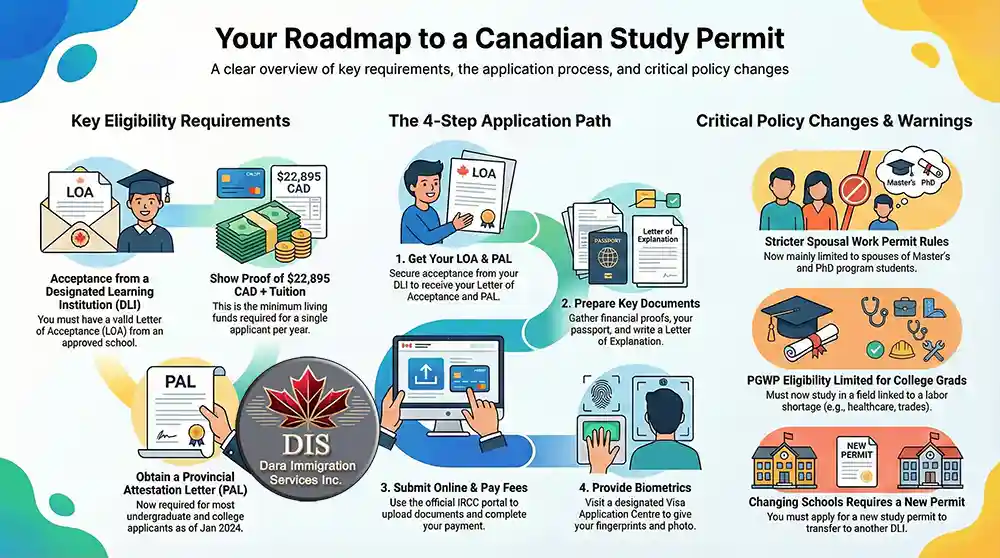
- Financial Requirement (2025/2026): You must show $22,895 CAD + tuition for a single applicant.
- Changing Schools: As of Nov 8, 2024, you must apply for a new study permit if you change your DLI.
PGWP Warning: College graduates must now study in specific “labor shortage” fields to qualify for a work permit.
What is a Canadian Study Permit?
A Canadian Study Permit is a document issued by Immigration, Refugees, and Citizenship Canada (IRCC) that authorizes foreign nationals to study at Designated Learning Institutions (DLIs) in Canada.
It is crucial to understand the difference between a permit and a visa:
- The Permit: Grants you status to stay and study inside Canada.
- The Visa (TRV) or eTA: Grants you permission to enter Canada at the border.
- Visa-Exempt Countries: You need an electronic Travel Authorization (eTA).
- Non-Visa Exempt Countries: You will be issued a Visitor Visa (TRV) automatically upon permit approval.
Why Study in Canada?
- Work Rights: Most students can work part-time (24 hours/week) during semesters and full-time during breaks.
- Spousal Support: Your spouse may be eligible for an Open Work Permit. Note: As of recent updates, eligibility is generally restricted to spouses of students in Master’s (16+ months), Doctoral, or professional programs. Spouses of college diploma students are typically ineligible.
- Post-Graduation Work Permit (PGWP): Eligible graduates can work in Canada after their studies, gaining valuable points for Permanent Residence (Express Entry). Important: College graduates (non-degree) must now study in specific fields linked to labor shortages (e.g., healthcare, trades) to qualify.
Eligibility Requirements for a Canadian Study Permit
To ensure a successful Canadian study permit application, you must meet specific criteria set by the IRCC.
Acceptance at a Designated Learning Institution (DLI)
You must hold a valid Letter of Acceptance (LOA) from a school approved by the provincial government to host international students.
The Provincial Attestation Letter (PAL)
As of January 2024, most undergraduate applicants must also provide a Provincial Attestation Letter (PAL).
- Purpose: To prove the application falls within the province’s allocation cap.
- Exemptions: Master’s degree students, PhD students, and K-12 students are currently exempt.
Proof of Financial Support
You must demonstrate that you have sufficient funds to support yourself and any accompanying family members.
Minimum Funds Required (2025 Estimates)
In addition to your first year of tuition, you must show proof of living expenses:
- Single Student: $22,895 CAD per year.
- First Family Member: Additional $5,055 CAD.
- Second Family Member: Additional $5,893 CAD.
Admissibility and Background Checks
- Police Clearance: You may need to provide a police certificate to prove you have no criminal record.
- Medical Exam: If you have lived in certain countries for more than 6 months in the past year, or are entering a field involving public health (e.g., nursing), an Immigration Medical Exam (IME) is required.
Fees, Costs, and Processing Times (2025 Estimates)
Note: These figures are estimates and subject to change by IRCC.
| Category | Fee / Metric | Notes |
| Government Application Fee | $150 CAD | Payable to the Receiver General for Canada. |
| Biometrics Fee | $85 CAD | Required once every 10 years. |
| Minimum Living Funds | $22,895 CAD + Tuition | For a single student (excludes family members). |
| Estimated Processing Time | 8 – 14 Weeks | Varies significantly by country of residence. |
| Permit Validity | Program Length + 90 Days | The extra days allow time to prepare for departure or apply for a PGWP. |
Canadian Study Permit Application Process: Step-by-Step
Securing your Canadian Study Permit requires a methodical approach.
1. Select a Designated Learning Institution (DLI)
Ensure your school is on the official DLI list. If you plan to work in Canada after graduation, verify that the program is PGWP-eligible.
2. Obtain Your LOA and PAL
Apply to the school. Once accepted, you will receive a Letter of Acceptance (LOA). The school will also assist you in obtaining the Provincial Attestation Letter (PAL) if required.
3. Prepare Your Supporting Documents
- Proof of Financial Support: Bank statements (past 4 months), GIC certificate, or student loan proof.
- Letter of Explanation: A detailed letter explaining your study plan and career goals.
- Identity Documents: Valid passport and photos.
4. Submit Your Application Online
Create a secure account on the IRCC portal, upload your documents in PDF format, and pay the fees.
5. Biometrics and Medicals
After submission, you will receive a Biometrics Instruction Letter. Visit a Visa Application Centre (VAC) promptly. Complete your medical exam if requested by an officer.
Working While Studying
Once you arrive, you must adhere to the conditions of your permit. You may be eligible to work without a separate work permit if you hold a valid study permit and are enrolled full-time.
- On-Campus: Unlimited hours.
- Off-Campus: Up to 24 hours per week during regular academic sessions.
- Scheduled Breaks: Full-time work is permitted during winter and summer holidays.
Canadian Study Permit Risks and Refusals
Refusals are common but often preventable. Understanding why permits are rejected is the first step to approval.
Common Reasons for Refusal
- Financial Instability: The officer is not convinced funds are liquid or accessible.
- Purpose of Visit: The study plan is vague or does not align with the applicant’s previous education or employment history.
- Family Ties: The applicant has failed to demonstrate sufficient ties to their home country, leading the officer to believe they will not leave Canada.
Restoration of Status
If your study permit expires, you lose your status immediately.
- 90-Day Window: You have 90 days to apply for “Restoration of Status.”
- Condition: You cannot study or work until the status is restored and a new permit is issued.
Changing Schools (DLI Transfer)
Important Update (November 8, 2024): If you choose to transfer to a different Designated Learning Institution, the process has changed.
The New Rule
You must apply for a new Canadian study permit before you can begin studying at the new school.
- Old Rule: You could simply notify IRCC via a web form.
- New Rule: A formal application for a new permit is required.
Frequently Asked Questions (FAQ)
1. Can I work while studying in Canada?
Yes. Most study permits allow full-time students to work up to 24 hours per week off-campus during academic sessions and full-time during scheduled academic breaks (e.g., summer holidays).
2. Do I need a Provincial Attestation Letter (PAL)?
Yes, most applicants for undergraduate degrees (bachelor’s) and college diplomas must include a PAL to prove they fit within the provincial cap. Master’s and Doctoral degree students are currently exempt.
3. Can my spouse get an Open Work Permit?
Eligibility is now restricted. Generally, your spouse is only eligible for a Spousal Open Work Permit (SOWP) if you are studying in a Master’s (16+ months), Doctoral, or professional program. Spouses of college diploma students are typically ineligible.
4. What is the difference between a Study Permit and a Visa?
A Study Permit grants you the legal status to stay and study inside Canada. A Visa (TRV) or eTA allows you to enter Canada at the border. You typically need both, but they are issued together.
5. Will I be eligible for a Post-Graduation Work Permit (PGWP)?
It depends on your program. University graduates are generally eligible. However, college graduates must now graduate from a program linked to a labor shortage (e.g., healthcare, trades) to qualify for a PGWP under the new “Field of Study” rules.
Professional Immigration Assistance
The path to a Canadian education is rewarding, but the regulations are strict. A single error in your financial proofs or study plan can result in significant delays or refusals.
Don’t navigate the complex IRCC policies alone. Contact Dara Immigration Services today for a professional assessment.
Disclaimer: This article provides general information regarding the Canadian Study Permit and does not constitute legal advice. Immigration policies change frequently.
Download:
Download the bulletin of Canadian Study Permit as a PDF.
Download “Canadian-Study-Permit-Bulletin-2026-2027.pdf” Canadian-Study-Permit-Bulletin-2026-2027.pdf – Downloaded 1894 times – 1.69 MB