Canadian Startup Visa
Canadian Startup Visa Overview 2026-2027
For ambitious founders, the Canadian Startup Visa (SUV) has long been the premier pathway to launching a global business in North America. It offered what few other visas could: direct Permanent Residence for up to five co-founders and their families, with no condition attached to the business’s success.

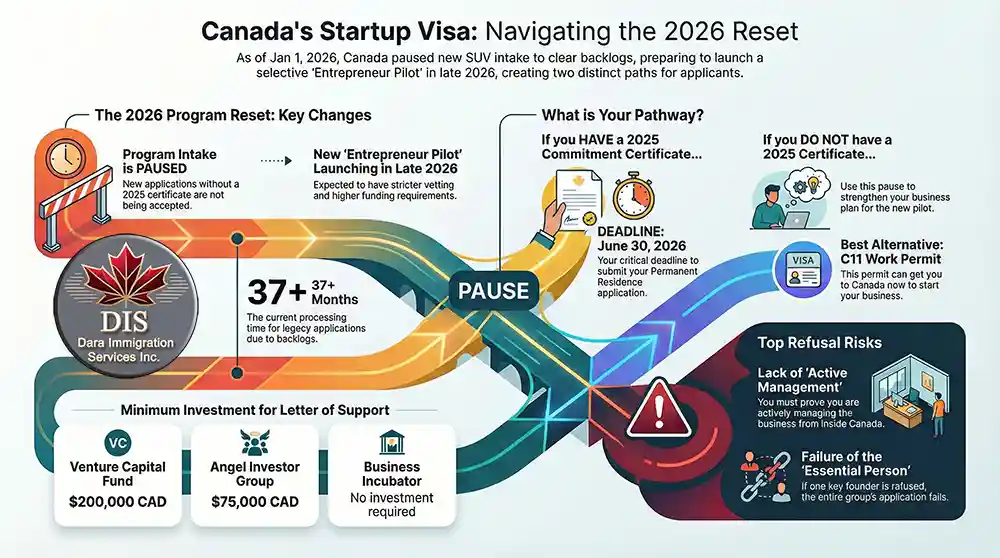
However, 2026 marks a massive shift. As of January 1, 2026, IRCC has paused new intake for the legacy Startup Visa program to clear the backlog and prepare for the launch of a new, targeted Entrepreneur Pilot later this year.
If you already hold a valid 2025 Commitment Certificate, the clock is ticking—you have until June 30, 2026, to submit your application. If you do not, you must prepare for the new pilot rules.
At Dara Immigration Services, we do not sell false hope. We help you navigate this transition period, ensuring your business concept is “shovel-ready” for the new pilot or pivoting you to alternative investor pathways like the C11 Work Permit.
Key Takeaways (Quick Summary):
- Program Status (2026): New intake is PAUSED for applicants without a Commitment Certificate issued before Dec 31, 2025.
- The “Grace Period”: If you have a valid 2025 Certificate, you must apply for PR by June 30, 2026.
- New Pilot Coming: A redesigned Entrepreneur Pilot is expected to launch in mid-to-late 2026 with stricter vetting.
- Work Permits: New “Optional Work Permits” for overseas Canadian Startup Visa applicants are currently restricted.
What is the Canadian Startup Visa
The Canadian Startup Visa is currently in a “reset” phase. It is crucial to understand where you stand in this timeline.
Navigating Two Distinct Pathways
The Startup Visa landscape has effectively split into two parallel tracks for 2026. Your immigration strategy now depends entirely on a single critical factor: whether you obtained your Commitment Certificate before the 2026 cut-off date. It is vital to identify which category you fall into to avoid missing a strict deadline or applying to a closed stream.
1. The Legacy Program (For Existing Certificate Holders)
If you secured a Letter of Support and Commitment Certificate from a Designated Organization (Angel, VC, or Incubator) before December 31, 2025, you are “grandfathered” in.
- Action: You must submit your complete Permanent Residence application before the June 2026 deadline.
2. The Future: 2026 Entrepreneur Pilot
IRCC is redesigning the program to prioritize active investment and reduce backlogs.
- Expected Changes: Stricter criteria for “Active Management,” higher funding requirements for incubators, and a capped intake system similar to Express Entry.
Why Is This Happening?
The program became a victim of its own success, with processing times ballooning to 3+ years. The pause allows IRCC to process the backlog and launch a faster, more efficient model.
Canadian Startup Visa Eligibility Requirements
Note: These are the standard criteria for the Canadian Startup Visa. We expect the 2026 Pilot to mirror these but with tighter enforcement.
1. The Letter of Support (The “Golden Ticket”)
You cannot apply without a Commitment Certificate from a designated organization.
- Venture Capital Funds: Must invest at least $200,000.
- Angel Investor Groups: Must invest at least $75,000.
- Business Incubators: No investment required, but you must be accepted into their program. (Note: This stream faced the highest scrutiny).
2. Ownership Requirements
- Individual: Each applicant must hold at least 10% of the voting rights.
- Total: Applicants + the Designated Organization must hold more than 50% of the total voting rights.
3. Language Proficiency
- Requirement: Minimum CLB 5 in English or French (Reading, Writing, Listening, Speaking).
- Reality: This is a low barrier compared to other economic programs.
4. Settlement Funds
You must prove you have enough money to support yourself and your family (independent of the business investment).
- Amount: Approx. $15,143 for a single applicant (updated annually).
Costs, Fees & Timelines (2026 Estimates)
Note: The “Processing Time” below reflects the current backlog for the legacy program.
| Category | Fee / Metric | Notes |
| PR Processing Fee | $2,385 CAD | Includes Principal Applicant fee ($1,810) + RPRF ($575). |
| Spouse Fee | $1,525 CAD | If accompanying. |
| Dependent Child | $260 CAD | Per child. |
| Biometrics Fee | $85 CAD | Required once every 10 years. |
| Processing Time | 37+ Months | For legacy applications (non-priority). |
| Intake Status | PAUSED | For new applicants without a 2025 Certificate. |
| Peer Review | Variable | IRCC may request an independent audit of your business. |
Since you cannot currently “apply” for a new certificate, your strategy must shift to preparation or alternatives.
Scenario A: You Have a 2025 Certificate
Step 1: Audit Your Documents
Ensure your language tests (CLB 5) and police certificates are valid.
Step 2: Submit PR Application (Deadline: June 30, 2026)
Do not wait. Submit your eAPR through the Permanent Residence Portal.
Scenario B: You Do NOT Have a Certificate
Step 1: Refine Your Pitch Deck
Use this pause to build a stronger business case. The new pilot will likely favor “shovel-ready” businesses with revenue or market validation.
Step 2: Explore the “C11 Significant Benefit” Work Permit
This is the best alternative right now.
- How it works: You apply for a work permit as an entrepreneur who will bring “significant economic benefit” to Canada.
- Benefit: It gets you to Canada now to start your business. Once the new Pilot launches, you will be well-positioned to apply.
Step 3: Monitor Designated Organizations
Keep in touch with incubators. They will be the first to know when they can issue new certificates under the new pilot rules.
Canadian Startup Visa Risks and Refusals
The Startup Visa has a high refusal rate for “passive” founders.
1. “Active Management” Failure
- The Rule: You must actively manage the business from inside Canada (once you arrive).
- The Refusal: If you stay in your home country while your “co-founders” run the show in Canada, IRCC will refuse your PR for failing the active management condition.
2. The “Shell Company” (Incubator Stream)
- The Issue: Paying a fee to an incubator but doing no real work.
- The Refusal: IRCC uses “Peer Reviews” to audit suspicious cases. If they find no genuine business activity, everyone in the group is refused.
3. Group Linkage
- The Risk: If the “Essential Person” (usually the CEO/CTO) is refused, all other members of the group are automatically refused. Choose your co-founders wisely.
Frequently Asked Questions (FAQ)
- Is the Startup Visa cancelled?
No, it is paused for a reset. The government is transitioning to a new “Entrepreneur Pilot” to fix the backlog. Existing applications are still being processed.
- Can I still get a work permit?
If you have a 2025 Commitment Certificate, yes. If you do not, you cannot get a specific Canadian Startup Visa work permit right now. You should look at the C11 Entrepreneur Work Permit instead.
- When will the new program open?
IRCC has not given a firm date, but industry experts expect the new pilot to launch in late 2026.
- Can I bring my family?
Yes. Successful applicants get Permanent Residence for themselves, their spouse, and dependent children (under 22).
- Do I need to invest my own money?
The program rules do not strictly require a personal investment amount, but you must have enough settlement funds to live. However, for the C11 alternative or the upcoming pilot, showing personal capital investment strongly increases your credibility.
Professional Immigration Assistance
The Canadian Startup Visa landscape is more complex in 2026 than ever before. Applying with outdated forms or missing the June deadline will result in an immediate return of your application.
Whether you are rushing to meet the June 30 deadline or preparing a strategy for the new Pilot, Dara Immigration Services is your strategic partner.
Disclaimer: This article provides general information regarding the Canadian Startup Visa and does not constitute legal advice. Policies change frequently.
Download:
Download the bulletin of Canadian Startup Visa as a PDF.
Download “Canadian-Startup-Visa-Bulletin-2026-2027.pdf” Canadian-Startup-Visa-Bulletin-2026-2027.pdf – Downloaded 1696 times – 1.52 MB