Visa of Canada
Visa of Canada Overview 2026-2027
To obtain a Visa of Canada is to unlock the door to one of the world’s most stable, safe, and prosperous nations. Whether you are a tourist seeking to explore the Rockies, a student aiming for a world-class degree, or a skilled worker looking to build a permanent life, the correct visa is the foundation of your journey.

However, the immigration landscape in 2026 is digital, strict, and highly categorized. A Visa of Canada is not a “one-size-fits-all” document; applying for the wrong category—or failing to distinguish between a “Visa” (for entry) and a “Permit” (for status)—is the most common reason for refusal.
At Dara Immigration Services, we simplify the bureaucracy. This guide is your strategic map to the Visa of Canada system, helping you identify exactly which document you need to cross the border with confidence.
The Visa of Canada System
The Canadian immigration system is bifurcated into two main streams: Temporary Residence and Permanent Residence.
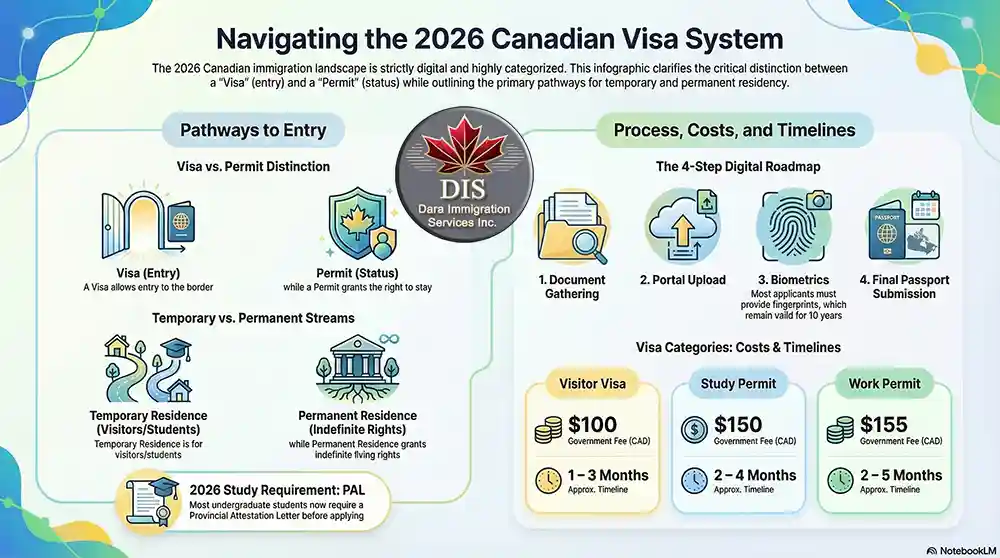
A Visa of Canada (officially called a Temporary Resident Visa or TRV) is strictly a travel document that allows you to travel to a Canadian port of entry. It does not guarantee entry, nor does it give you the right to work or study. To do those things, you need a “Permit” issued alongside your visa.
Quick Facts: Visa of Canada at a Glance
- Primary Decision Maker: Immigration, Refugees and Citizenship Canada (IRCC).
- Standard Visitor Fee: $100 CAD.
- Biometrics: Mandatory for almost all applicants (Valid for 10 years).
- Processing Time: Varies by country (2 weeks to 4 months).
- Key Distinction: A Visa gets you to the border; a Permit allows you to stay and do specific activities.
Category Breakdown: Choosing the Right Visa of Canada
To succeed, you must align your application with your true intent. Here are the primary categories for a Visa of Canada.
1. Temporary Resident Visa (Visitor Visa)
This is the standard Visa of Canada for tourists, family visits, and business meetings.
- Target Audience: Tourists, family members, and business visitors.
- Validity: Up to 10 years (or until passport expiry).
- Key Condition: You cannot work or study (programs over 6 months) on this visa.
- The Super Visa: A special sub-category for parents and grandparents allowing stays of up to 5 years per visit.
2. Study Visa & Permit
For international students, the Visa of Canada is just the sticker in the passport; the Study Permit is the document that matters.
- Target Audience: Students at Designated Learning Institutions (DLIs).
- 2026 Requirement: Most undergraduate students now require a Provincial Attestation Letter (PAL) before applying.
- Work Rights: Allows up to 24 hours of work per week off-campus during school terms.
3. Work Visa & Permit
This is the most complex category. A work-based Visa of Canada is usually tied to a specific employer or an open work scheme.
- Closed Work Permits: Tied to one employer. Requires a Labour Market Impact Assessment (LMIA).
- Open Work Permits: Allows you to work for almost any employer (e.g., PGWP, Spousal Open Work Permit).
- Business Visas: For entrepreneurs (C11, Intra-Company Transfers) entering to run their own business.
4. Permanent Residence (PR) Visas
This is the “Immigrant Visa” that grants you the right to live in Canada indefinitely.
- Express Entry: For skilled workers (Federal Skilled Worker, CEC).
- Provincial Nominee Program (PNP): For workers selected by a specific province like Ontario or BC.
- Family Sponsorship: For spouses and children of Canadian citizens.
Fees & Timelines for a Visa of Canada (2026)
Use this table to budget for your application. Note that “Service Fees” for professional representation are separate from government fees.
| Visa Category | Government Fee (CAD) | Biometrics Fee | Approx. Timeline |
| Visitor Visa | $100 | $85 | 1 – 3 Months |
| Study Permit | $150 | $85 | 2 – 4 Months |
| Work Permit | $155 | $85 | 2 – 5 Months |
| Super Visa | $100 | $85 | 3 – 5 Months |
| Permanent Residence | $1,525+ | $85 | 6 – 12+ Months |
Note: Processing times for a Visa of Canada vary significantly by your country of residence.
How-To Guide: Applying for a Visa of Canada
The era of paper applications is over. Here is the digital roadmap.
Step 1: Document Gathering
Scan your passport, proof of funds, and letters of explanation. Ensure they are high-quality PDFs. If applying for a specialized Visa of Canada (like Study or Work), gather your acceptance letters or job offers.
Step 2: The Portal Application
Create a secure account on the IRCC portal. Upload your documents. The system will generate a customized checklist based on your answers.
Step 3: Biometrics & Exam
After submitting and paying the fee, you will receive a Biometrics Instruction Letter (BIL). You must visit a Visa Application Centre (VAC) in person to give your fingerprints.
Step 4: Passport Request
If your Visa of Canada is approved, you will be asked to submit your physical passport to the VAC for stamping.
Visa of Canada Refusals
Securing a Visa of Canada is a privilege, not a right.
Challenge #1: “Purpose of Visit”
- The Reality: The officer does not believe you will leave Canada when your visa expires.
- The Strategy: Provide a clear itinerary and return ticket. Show strong “ties to your home country” (job, property, family).
Challenge #2: Financial Insufficiency
- The Reality: Applying with a bank account that shows a sudden, large deposit (“borrowed money”) is a major red flag.
- The Strategy: Show 4-6 months of consistent banking history. Explain large transactions.
Frequently Asked Questions (FAQ)
- What is the difference between a Visa and a Permit?
A Visa of Canada (TRV) allows you to travel to the border. A Permit (Study or Work) allows you to stay and perform a specific activity. You often need both.
- Can I convert a Visitor Visa to a Work Visa inside Canada?
Generally, no. You cannot simply “swap” statuses. You usually need to apply for a work permit from outside Canada, unless you meet specific exceptions (like spouses of skilled workers).
- Do US Citizens need a Visa to Canada?
No. US citizens are visa-exempt. However, if they are coming to work or study, they still need to apply for the appropriate Permit at the port of entry.
- How long is a Visitor Visa valid for?
A standard visitor Visa of Canada is usually issued for multiple entries for up to 10 years (or until your passport expires). However, each individual stay is limited to 6 months.
- Why was my Visa to Canada refused?
Common reasons include lack of funds, weak ties to your home country, or an unclear purpose of travel. A refusal remains on your permanent record, making future applications harder.
Professional Immigration Assistance
A refused application for a Visa of Canada stays on your record forever. Whether you are planning a simple vacation or a complex corporate transfer, the paperwork must be flawless to satisfy the strict requirements of 2026.
Don’t navigate the IRCC maze alone. Contact Dara Immigration Services today for an initial assessment and let us pave your path to Canada.
Disclaimer: This article provides general information regarding the Visa of Canada system. It does not constitute legal advice.
Download:
Download the bulletin of Visa of Canada as a PDF.