Live in Canada
Live in Canada Overview 2026-2027
To live in Canada is to secure a future defined by stability, safety, and one of the world’s most robust social safety nets. For the 450,000+ newcomers arriving this year, the decision to move is often driven by a desire for a better quality of life—clean air, safe streets, and government-backed support for families.

However, the reality of daily life in 2026 involves navigating complex systems. From understanding the Canada Child Benefit (CCB) to accessing universal healthcare, successful settlement requires more than just a visa; it requires a deep understanding of your rights and entitlements.
At Dara Immigration Services, we believe that your journey does not end at the border. This guide is your blueprint to live in Canada successfully, ensuring you maximize the benefits available to you and your family.
Strategic Overview: The Canadian Standard of Living
Canada consistently ranks among the top nations globally for quality of life, driven by its commitment to multiculturalism, public safety, and environmental stewardship. Unlike many countries where social services are minimal, to live in Canada is to be supported by a “social floor” that protects residents from extreme poverty and instability.
Quick Facts: Live in Canada at a Glance
- Population: Approx. 42 Million (2026 Estimate).
- Life Expectancy: 82+ Years.
- Global Safety Rank: Consistently in the Top 10 Safest Countries.
- Key Benefit: Universal Healthcare (Provincial).
- Official Languages: English and French.
What Does it Mean to Live in Canada?
To truly understand what it means to live in Canada, we must examine the three core pillars that define the daily experience: The Social Safety Net, Public Safety, and The Environment.
The Social Safety Net
Canada’s government assistance programs are designed to support residents through every stage of life, from raising children to retirement.
Financial Support for Families
- Program: Canada Child Benefit (CCB).
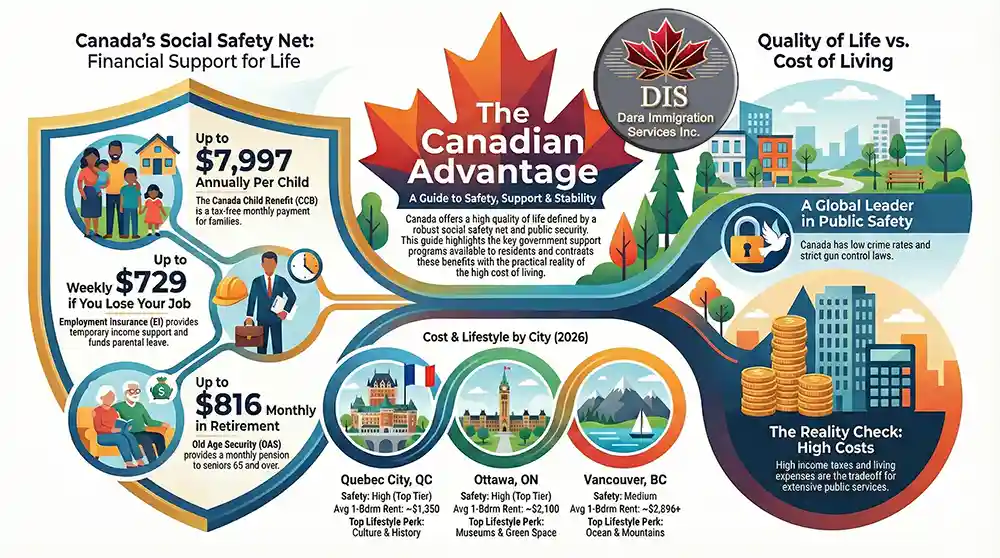
- Benefit Structure: The CCB is a tax-free monthly payment made to eligible families. In the 2025-2026 benefit year, the maximum annual benefit is approx. $7,997 for each child under age 6, and $6,748 for each child aged 6 to 17.
- Eligibility: You must file your taxes every year to receive this, even if you have no income. The amount reduces as your family income exceeds approx. $37,487.
Employment Security
- Program: Employment Insurance (EI).
- The Safety Net: If you lose your job through no fault of your own, EI provides temporary financial assistance.
- 2026 Maximums: For 2026, the Maximum Insurable Earnings have increased to $68,900. This means the maximum weekly benefit you can receive is approximately $729.
- Parental Leave: EI also funds maternity and parental leave, allowing parents to take up to 18 months off work (at a reduced rate) to care for a newborn.
Retirement Security
- Program: Old Age Security (OAS) & Canada Pension Plan (CPP).
- Guaranteed Income: OAS is a monthly payment available to most seniors aged 65+ who meet residency requirements. In 2026, the maximum monthly payment is approx. $742.31 for those aged 65-74, and $816.54 for those 75+.
- Cost of Living Adjustment: These pensions are indexed to inflation, ensuring that your purchasing power is protected as you age to live in Canada comfortably.
Safety & Security
Canada is globally recognized for its low crime rates and strict gun control laws, creating a secure environment for families.
Crime & Law Enforcement
- Global Standing: Canada’s crime rate is significantly lower than that of its southern neighbor, the USA. Violent crime is rare in most residential areas.
- Safest Cities (2025/2026): Cities like Ottawa, Barrie, and Quebec City consistently rank as the safest urban centers in the country, with Crime Severity Index (CSI) scores well below the national average.
Gun Control
- Regulations: Canada categorizes firearms into Non-Restricted, Restricted, and Prohibited. Handguns are heavily restricted, and carrying a weapon for self-defense is illegal.
- Impact: These strict laws contribute to a high sense of public safety, allowing children to play outside and residents to walk at night with peace of mind.
Environment & Lifestyle
To live in Canada is to have unparalleled access to nature.
Natural Landscapes
- Parks & Recreation: From Banff National Park in Alberta to the coastal trails of BC, the country is a playground for outdoor enthusiasts.
- Air Quality: Canada has some of the cleanest air on the planet. Strict environmental regulations limit industrial pollution, directly contributing to better respiratory health for residents.
Quality of Life by Region (2026)
While federal benefits apply to everyone, the cost to live in Canada varies by province. Use this table to balance lifestyle against budget.
| City / Region | Safety Index (Low Crime) | Avg 1-Bdrm Rent | Top Lifestyle Perk |
| Ottawa, ON | High (Top Tier) | ~$2,100 | Museums & Green Space |
| Quebec City, QC | High (Top Tier) | ~$1,350 | Culture & History |
| Calgary, AB | Medium-High | ~$1,690 | Proximity to Rockies |
| Barrie, ON | High (Top Tier) | ~$1,900 | Safe & Family Friendly |
| Vancouver, BC | Medium | ~$2,896+ | Ocean & Mountains |
| Halifax, NS | High | ~$2,064 | Coastal Community |
Note: Safety Index reflects 2025 Crime Severity Index data trends. Rents are 2026 estimates.
How to Prepare to Live in Canada
Settling in is a process. Follow these steps to secure your foundation.
Pre-Arrival Preparation
- Understand Your Rights: Read about the Canadian Charter of Rights and Freedoms. It guarantees fundamental freedoms to everyone who chooses to live in Canada.
- Budget for Winter: If arriving between November and March, allocate $300-$500 per person for proper winter gear (parkas, boots).
Your First Week
- Apply for Government ID: Visit a Service Ontario/BC/Alberta registry to get your provincial photo ID.
- Register for Schools: If you have children, contact your local school board immediately. Public education is free for residents.
Long-Term Success
- Access Settlement Services: Organizations funded by IRCC provide free language classes (LINC) and job search workshops.
- File Your Taxes: You cannot receive the Canada Child Benefit or GST Credits unless you file a tax return, even if you earned $0 in your first year.
The Reality Check: The Cost of Quality
To live in Canada offers immense benefits, but it comes at a price.
Challenge #1: High Taxation
- The Reality: To fund universal healthcare and programs like the CCB, taxes are high. Income tax can take 20-50% of your earnings depending on your bracket.
- The Strategy: Utilize tax-sheltered accounts like the RRSP (Registered Retirement Savings Plan) and FHSA (First Home Savings Account) to reduce your taxable income.
Challenge #2: Cost of Living
- The Reality: Inflation has stabilized, but prices remain high. Groceries and utilities in 2026 are significantly more expensive than in 2020.
- The Strategy: Budget carefully. Use apps to track spending and consider living in mid-sized cities (like Winnipeg or Quebec City) where your dollar goes further.
Frequently Asked Questions (FAQ)
- Is healthcare free for everyone?
Yes, for permanent residents and citizens. However, most provinces have a waiting period (often 3 months) before coverage begins. You should buy private insurance for this gap.
- Can I receive the Canada Child Benefit if I am on a Work Permit?
Yes, but only after you have lived in Canada for 18 months and file your taxes. Permanent Residents are eligible immediately upon arrival.
- Is Canada safe for raising a family?
Yes. Canada is consistently ranked as one of the best countries in the world for raising children due to its low crime rates, high-quality public education, and government financial support.
- How much money do I need to retire in Canada?
It varies, but the maximum OAS and CPP payments (approx. $2,000/month combined) are rarely enough to live on alone. You should supplement this with personal savings (RRSP).
- Do I need to speak French to live in Canada?
Only in Quebec. In the rest of Canada, English is the primary language. However, learning French can open up more job opportunities in the federal government.
Professional Immigration Assistance
Deciding to live in Canada is a life-changing choice that offers safety, stability, and growth. However, accessing these benefits starts with obtaining the right status. A rejected visa application can delay your family’s future by years.
Ensure your path to Canada is secure. Contact Dara Immigration Services today for a comprehensive strategy session.
Disclaimer: This article provides general information regarding living conditions and benefits in Canada. It does not constitute legal or financial advice.
Download:
Download the bulletin of Live in Canada as a PDF.
Download “Live-in-Canada-Bulletin-2026-2027.pdf” Live-in-Canada-Bulletin-2026-2027.pdf – Downloaded 1641 times – 1.51 MB