New Brunswick
New Brunswick Overview 2026-2027
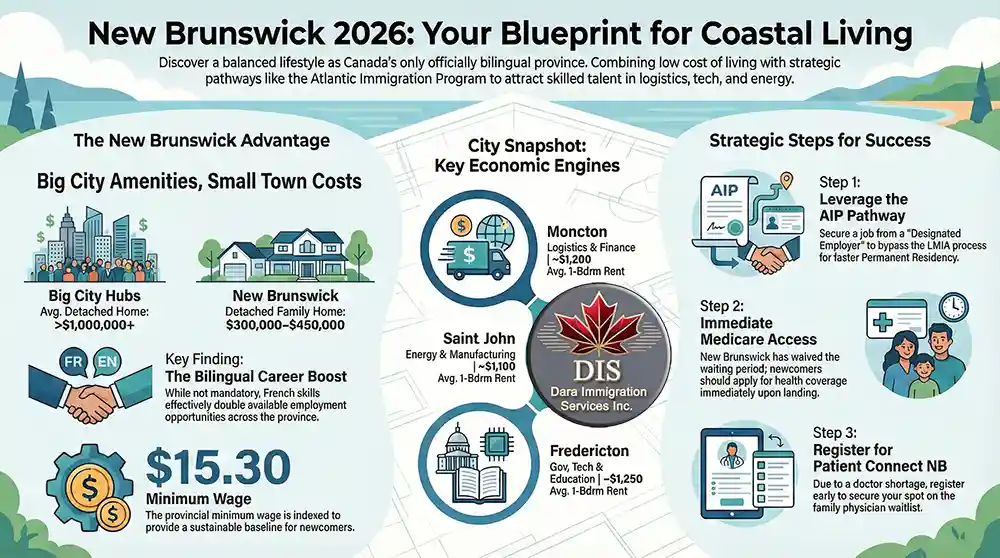
To choose New Brunswick is to embrace a balanced lifestyle in Canada’s only officially bilingual province. For the thousands of newcomers arriving in 2026, New Brunswick offers a compelling alternative to the big cities: affordable coastal living, traffic-free commutes, and a welcoming community spirit.
With the Atlantic Immigration Program (AIP) streamlining the path to Permanent Residence, employers in New Brunswick are actively recruiting skilled workers to fill gaps in healthcare, logistics, and forestry. Whether you prefer the “Hub City” energy of Moncton or the historic charm of Fredericton, this province allows you to own a home and build a future without the crushing debt found elsewhere.
At Dara Immigration Services, we help you navigate the unique opportunities of the East Coast. This guide is your blueprint to settling in New Brunswick successfully, ensuring your move is as strategic as it is exciting.
New Brunswick Overview: Economy & Lifestyle
New Brunswick sits on Canada’s east coast and is the logistics hub of the Atlantic region. Its economy is built on a mix of modern sectors like cybersecurity and traditional industries like forestry, fishing, and energy (Irving Oil).
For immigrants, the standout feature is the province’s affordability and its bilingual nature. While you do not need to speak French to live here (unless in government jobs), having French skills opens up double the employment opportunities.
Quick Facts: New Brunswick at a Glance
- Capital City: Fredericton.
- Largest City: Moncton (The “Hub City”).
- Population: Approx. 860,000+ (2026 Estimate).
- Taxation: 15% Harmonized Sales Tax (HST).
- Key Immigration Stream: NBPNP & Atlantic Immigration Program (AIP).
- Minimum Wage: $15.30+ per hour (Indexed).
- Official Languages: English and French (Constitutionally Bilingual).
Cities & Economic Zones in New Brunswick
To succeed in New Brunswick, you must choose the city that fits your professional profile, as each has a distinct economic engine.
Moncton
Known as the “Hub City,” Moncton is the fastest-growing urban center in the Maritimes, centrally located to serve the entire region.
Economy & Labour Market
- Key Industries: Transportation & Logistics, Finance/Insurance (Blue Cross, Tangerine), and Retail.
- Employment Outlook: Excellent for bilingual candidates. The city is a major call-center and back-office hub for national corporations.
- Lifestyle & Culture: A truly bilingual city (roughly 35% Francophone). It offers big-city amenities like the Avenir Centre arena without the congestion.
- Cost of Living: Affordable. One-bedroom rents average $1,200, and the housing market remains accessible for middle-income families.
Saint John
The industrial powerhouse of the province, Saint John is located on the Bay of Fundy and has a gritty, historic character.
Economy & Labour Market
- Key Industries: Energy (Irving Oil Refinery), Port Logistics, and Manufacturing.
- Employment Outlook: High demand for skilled trades, engineers, and industrial workers.
- Lifestyle & Culture: “Uptown” Saint John is a cultural gem, filled with brick architecture, pubs, and galleries. It feels like a miniature version of Boston or Dublin.
- Cost of Living: Very Low. Rents are among the cheapest in urban Canada, often hovering around $1,100 for a one-bedroom.
Fredericton
The provincial capital is a white-collar city known for its universities, government jobs, and growing tech scene.
Economy & Labour Market
- Key Industries: Public Administration (Government), Higher Education (UNB, St. Thomas), and Cybersecurity (Siemens, IBM).
- Employment Outlook: Stable. It has the highest per-capita income in the province due to the concentration of government and tech jobs.
- Lifestyle & Culture: Intellectual and green. The city is defined by the St. John River and an extensive trail network. It is quiet, safe, and family-focused.
- Cost of Living: Moderate. Rents average $1,250, reflecting the steady demand from students and professionals.
Cost of Living & Climate (2026)
Use this table to see how New Brunswick compares to the rest of Canada.
| City / Region | Avg Rent (1-Bdrm) | Key Industry | Avg Winter Low (Jan) | Notes |
| Moncton | ~$1,200 | Logistics / Finance | -13°C | Fastest Growing |
| Saint John | ~$1,100 | Energy / Port | -11°C | Industrial Hub |
| Fredericton | ~$1,250 | Gov / Tech | -15°C | Tech Capital |
| Dieppe | ~$1,300 | Retail / Aviation | -13°C | Majority Francophone |
| Miramichi | ~$950 | Forestry / Payroll | -14°C | Rural AIP Focus |
Note: Winter temperatures are milder on the coast (Saint John) but snowier inland.
“How-To” Guide: Settling in New Brunswick
Your transition to New Brunswick is supported by friendly communities, but requires logistical planning.
Pre-Arrival: The AIP Advantage
- Secure a Designated Employer: The Atlantic Immigration Program (AIP) is employer-driven. You need a job offer from a “Designated Employer” to qualify. This exempts you from the LMIA process.
- Language Testing: Even for English jobs, taking a French test (TEF/TCF) can boost your profile in the NBPNP Express Entry stream.
Your First Week: Essential Setup
- Apply for Medicare: Good news—New Brunswick recently waived the waiting period for most newcomers. Apply for your Medicare card immediately with your proof of landing.
- Get a Driver’s License: Public transit exists but is limited compared to Toronto. Most residents drive. Visit Service New Brunswick (SNB) to swap your license.
Long-Term: Integration
- Embrace Winter: Buy winter tires for your car by November. They are not legally mandatory but are essential for safety on icy maritime roads.
- Bilingualism: Enroll in free French or English classes. Being bilingual effectively “unlocks” 100% of the job market.
Challenges for Newcomers in New Brunswick
To succeed in New Brunswick, you must be realistic about the pace of life and services.
Challenge #1: The Doctor Shortage
- The Reality: Like much of Atlantic Canada, the waitlist for a family doctor is long (often years).
- The Strategy: Register with “Patient Connect NB” immediately upon arrival. Rely on “Tele-Care 811” and after-hours clinics for non-urgent needs.
Challenge #2: Employment Limitations
- The Reality: While the cost of living is low, salaries are also lower than in Toronto or Calgary. Career advancement in niche sectors (like high finance or fashion) is limited.
- The Strategy: Focus on industries where the province is a leader (Cybersecurity, Energy, Logistics) or remote work opportunities that allow you to earn a national salary while living in NB.
Frequently Asked Questions (FAQ)
- Do I need to speak French to live in New Brunswick?
No. While it is the only officially bilingual province, the majority of daily life (especially in Moncton, Saint John, and Fredericton) operates in English. However, French is a massive asset for government jobs.
- What is the Atlantic Immigration Program (AIP)?
The AIP is a federal immigration program that helps employers in Atlantic Canada hire foreign skilled workers and international graduates. It is faster and more flexible than many other streams but requires a job offer.
- Is public transit good in New Brunswick?
It is basic. Moncton, Saint John, and Fredericton have bus systems (Codiac Transpo, Saint John Transit), but frequency is low compared to big cities. A car is highly recommended for freedom of movement.
- Is housing really that cheap?
Yes. You can still buy a detached family home with a yard for $300,000 – $450,000 in many areas. This is often the price of a parking spot in downtown Toronto.
- How cold are the winters?
They are snowy. New Brunswick often gets heavy snowstorms (“Nor’easters”). Temperatures average -10°C to -15°C, which is colder than Vancouver but warmer than the Prairies.
Professional Immigration Assistance
New Brunswick offers a high quality of life for those who value community over chaos. However, programs like the AIP and NBPNP have strict employer requirements and “Connection to New Brunswick” criteria that must be documented perfectly.
Don’t risk your maritime dream on a technicality. Contact Dara Immigration Services today to build your strategy.
Disclaimer: This article provides general information regarding settlement and immigration in New Brunswick. It does not constitute legal advice.
Download:
Download the bulletin of New Brunswick as a PDF.
Download “New-Brunswick-Bulletin-2026-2027.pdf” New-Brunswick-Bulletin-2026-2027.pdf – Downloaded 1777 times – 1.75 MB