To choose Nunavut is to choose life at the edge of the world. As Canada’s newest and largest territory, it offers an experience unlike anywhere else: a land of glaciers, polar bears, and the Midnight Sun. For the adventurous few arriving in 2026, Nunavut offers the highest minimum wage in Canada and a chance to fast-track their financial goals in a region hungry for skilled talent.
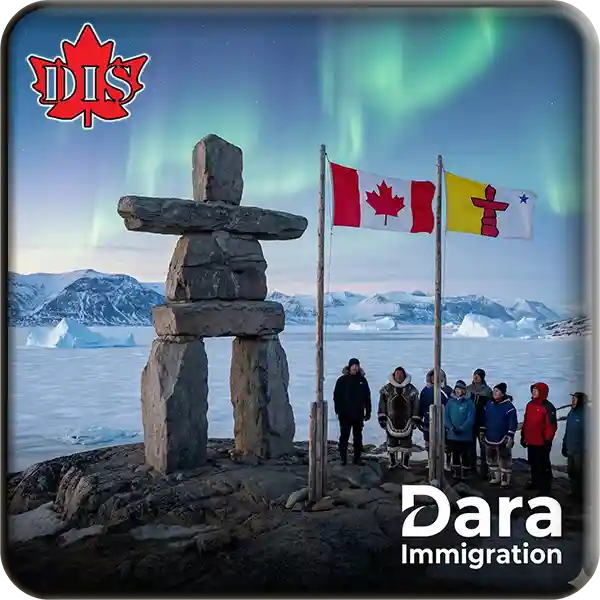
However, moving “North of 60” is not a decision to be made lightly. The cost of living is extreme—a carton of milk can cost $15—and the housing shortage is critical. Success here requires a specific mindset: you are not just moving to a new city; you are joining a tight-knit community that survives together in one of the harshest climates on Earth.
At Dara Immigration Services, we help you weigh the high risks against the high rewards. This guide is your blueprint to settling in Nunavut successfully, ensuring your Arctic adventure is safe, legal, and financially prosperous.
Nunavut is not a province; it is a territory that covers one-fifth of Canada’s landmass but is home to only 40,000 people, mostly Inuit. Its economy is driven almost entirely by mining (Gold/Iron/Diamonds), government administration, and traditional arts.
For immigrants, the most important fact is that Nunavut has no Provincial Nominee Program (PNP). Instead, it relies on federal streams and a growing “Nunavut Nominee Program” pilot (still in development stages) or employer-driven federal pathways like the Rural and Northern Immigration Pilot (RNIP) equivalents if applicable, or standard Work Permits supported by LMIAs. Employers often pay large “retention bonuses” and provide subsidized housing to attract staff.
Quick Facts: Nunavut at a Glance
- Capital City: Iqaluit.
- Population: Approx. 41,000 (2026 Estimate).
- Taxation: 5% Federal GST (No Provincial Sales Tax).
- Minimum Wage: $19.00 per hour (Highest in Canada).
- Key Benefit: Northern Residents Deduction (Tax Break).
- Geography: No roads connect Nunavut to the rest of Canada; you must fly or ship by sea.
Nunavut is too vast to govern centrally, so it is divided into three administrative regions, each with a central hub.
Qikiqtaaluk Region (Baffin)
Home to the capital and the majority of the population, this is the political and logistics hub.
Iqaluit
- Economy & Labour Market: Government (Government of Nunavut), Healthcare, and Transportation.
- Employment Outlook: High demand for nurses, teachers, and administrative staff. The new deep-sea port has expanded logistics jobs.
- Lifestyle & Culture: A “big city” in the Arctic. It has paved roads, grocery stores, and the famous “Toonik Tyme” spring festival.
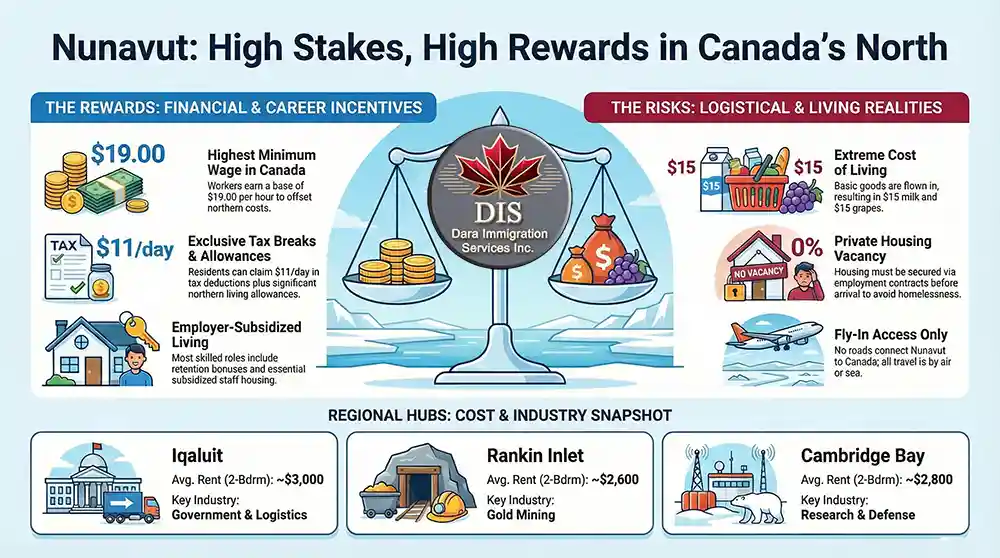
- Cost of Living: Extremely High. A two-bedroom apartment rents for $2,800+ per month, and vacancies are near zero. Staff housing is essential.
Kivalliq Region
Located on the west coast of Hudson Bay, this region is a mining powerhouse.
Rankin Inlet
- Economy & Labour Market: Mining (Agnico Eagle Mines) and Art.
- Employment Outlook: Excellent opportunities for heavy equipment operators, mechanics, and tradespeople supporting the nearby gold mines.
- Lifestyle & Culture: Known for its world-class Inuit ceramics and carvings. It is a major hub for artists.
- Cost of Living: High, but mining jobs often come with “fly-in, fly-out” rotations that cover housing and food.
Kitikmeot Region
The most remote region, located in the central Arctic coast.
Cambridge Bay
- Economy & Labour Market: Research (Canadian High Arctic Research Station), Defense, and Government.
- Employment Outlook: Growing demand for scientists, researchers, and technical support staff for Arctic sovereignty missions.
- Lifestyle & Culture: Quiet and traditional. The landscape is flat tundra, perfect for snowmobiling and hunting.
- Cost of Living: Very High. All goods are flown in, making groceries 2-3x more expensive than in the south.
Cost of Living & Climate (2026)
Use this table to understand the financial reality of the North.
| Region / Community | Avg Rent (2-Bdrm) | Key Industry | Climate (Jan) | Flight to Major City |
| Iqaluit | ~$3,000 | Gov / Logistics | -27°C | 3 hrs to Ottawa |
| Rankin Inlet | ~$2,600 | Gold Mining | -30°C | 2.5 hrs to Winnipeg |
| Cambridge Bay | ~$2,800 | Research / Gov | -32°C | 2 hrs to Yellowknife |
| Baker Lake | ~$2,400 | Mining Services | -31°C | Remote Access |
| Pond Inlet | ~$2,500 | Tourism | -33°C | Remote Access |
Note: Rents are often subsidized by employers. “Market rent” is rarely paid by skilled workers.
Moving to Nunavut requires more preparation than moving to any other jurisdiction.
Pre-Arrival: Secure the Basics
- Negotiate Housing: Never accept a job offer in Nunavut without a guarantee of housing. There is effectively 0% vacancy for private rentals. Ensure “Staff Housing” is written in your contract.
- Check Medical Clearance: Some remote communities have limited healthcare (nurse stations only). You may need a medical exam to prove you do not require frequent specialist care.
Your First Week: Essential Setup
- Get Your Nunavut Health Card: Apply immediately. Coverage typically begins on the first day of the third month, so bring private insurance for the gap.
- Open a PO Box: There is no door-to-door mail delivery. You must go to the Canada Post office to get a box for your bills and packages (Amazon Prime takes 1-2 weeks).
Long-Term: Financial Strategy
- Northern Residents Deduction: This federal tax credit allows you to deduct a significant portion of your income ($11/day basic + travel benefits), saving you thousands in taxes annually.
- Food Strategy: Join a “Seacan” group. Locals pool money to ship a shipping container of dry goods (pasta, rice, cans) up by barge in the summer to save money.
To succeed in Nunavut, you must be resilient to isolation and cost.
Challenge #1: Food Insecurity
- The Reality: Prices are shocked. A bag of grapes can cost $15. Fresh food is flown in and spoils quickly.
- The Strategy: Eat “country food” (Arctic char, caribou) if possible, and rely on frozen vegetables. Use “Amazon Subscribe & Save” for dry goods (if shipping rates apply).
Challenge #2: The Housing Crisis
- The Reality: Overcrowding is a major social issue. You cannot just “look for an apartment” on Craigslist.
- The Strategy: Your employer is your landlord. If you lose your job, you often lose your house. Maintain good standing at work at all costs.
Frequently Asked Questions (FAQ)
- Can I drive to Nunavut?
No. There are no roads connecting Nunavut to the rest of Canada. You must fly (usually from Ottawa, Winnipeg, or Montreal) or ship your car by sea-lift barge in the summer.
- Is healthcare free in Nunavut?
Yes. The Nunavut Health Care Plan covers medically necessary services. However, if you need a specialist or surgery, you will be medically evacuated (flown) to a southern hospital (like Ottawa or Winnipeg), which is covered by the territory.
- What is the “Northern Living Allowance”?
This is an extra payment added to your salary by many employers (especially the government) to help cover the high cost of rent and utilities. It can range from $15,000 to $30,000+ per year depending on the community.
- Is it always dark?
In winter, yes. Communities like Grise Fiord experience 24-hour darkness for months. In summer, however, they have 24-hour sunlight (the Midnight Sun).
- How do I immigrate to Nunavut without a PNP?
You typically use the federal Express Entry system or the Temporary Foreign Worker Program. Employers in Nunavut can support your application for Permanent Residence by offering a valid job offer that adds 50-200 points to your CRS score.
Professional Immigration Assistance
Nunavut is a high-reward destination for those with the right skills, but the lack of a Provincial Nominee Program makes the legal pathway unique. You need a strategy that uses federal streams leveraged by local employment.
Ensure your northern strategy is secure. Contact Dara Immigration Services today for a specialized consultation.
Disclaimer: This article provides general information regarding settlement and immigration in Nunavut. It does not constitute legal advice.
Download:
Download the bulletin of Nunavut as a PDF.
Download “Nunavut-Bulletin-2026-2027.pdf” Nunavut-Bulletin-2026-2027.pdf – Downloaded 1321 times – 1.58 MB