Healthcare in Canada
Healthcare in Canada Overview 2026-2027
To understand Healthcare in Canada is to understand one of the country’s most cherished values: that medical care is based on need, not the ability to pay. For the thousands of newcomers arriving under the 2026 Immigration Levels Plan, Canada’s publicly funded system (known as “Medicare”) is a major draw, promising security and peace of mind.
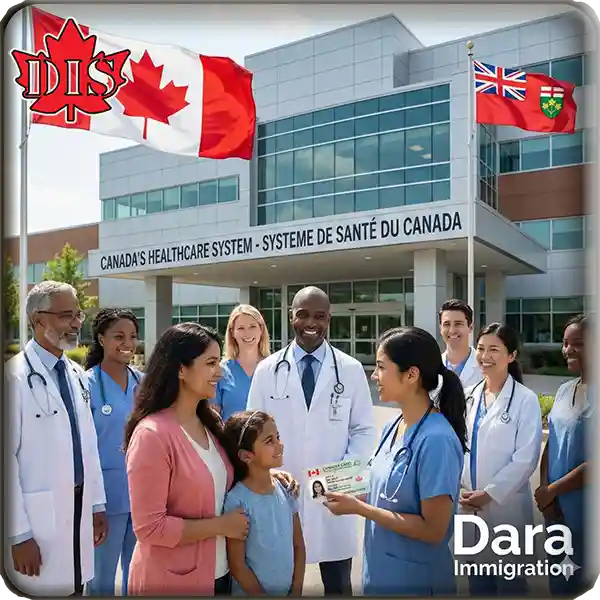
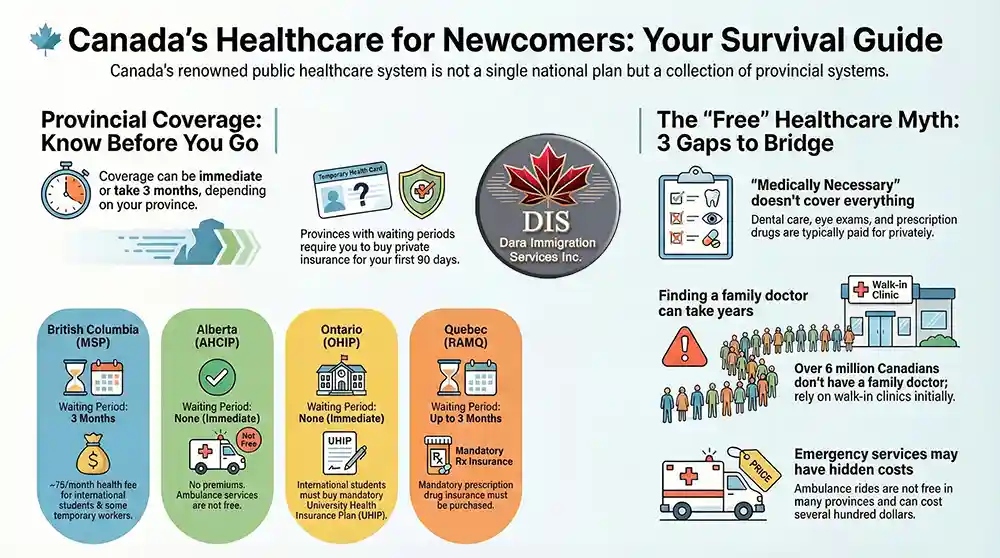
However, “Universal Coverage” does not mean “Instant Coverage.” The system is decentralized, meaning your access depends entirely on which province you settle in. From the 3-month waiting period in British Columbia to the mandatory drug insurance in Quebec, navigating these rules is essential to avoiding massive medical bills in your first months.
At Dara Immigration Services, we know that your health is your foundation. This guide is your blueprint to navigating Healthcare in Canada successfully, ensuring you and your family are protected from day one.
Strategic Overview: How Medicare Works
Canada does not have a single national healthcare plan. Instead, it has 13 distinct provincial and territorial health insurance plans that share common federal standards. These plans cover all “medically necessary” services—doctors’ visits and hospital stays—at no direct cost to you.
However, relying solely on the public system is a mistake. Services like dentistry, optometry, and prescription drugs are generally not covered, meaning most Canadians rely on a mix of public coverage and private insurance (usually through an employer).
Quick Facts: Healthcare in Canada at a Glance
- System Type: Publicly funded, privately delivered (Single Payer).
- Cost: Free at the point of service (paid via taxes).
- Eligibility: Permanent Residents and Workers on valid permits (6+ months).
- Key Gap: Prescription drugs and dental are usually private.
- Emergency Access: 911 (Nationwide).
Regional Breakdown: Provincial Health Plans
To access Healthcare in Canada, you must apply for a health card in your specific province.
Ontario & Central Canada
Ontario has the most accessible healthcare for newcomers, with waiting periods recently waived.
Ontario (OHIP)
- Plan Name: Ontario Health Insurance Plan (OHIP).
- Coverage & Eligibility: Covers all doctor visits and hospital care. Permanent Residents and workers with permits valid for 6+ months are eligible immediately upon arrival.
- Private Needs: OHIP does not cover prescription drugs for those aged 25-64. You must pay out-of-pocket or have private insurance.
- Student Reality: International students are not eligible for OHIP and must purchase the University Health Insurance Plan (UHIP).
Quebec (RAMQ)
- Plan Name: Régie de l’assurance maladie du Québec (RAMQ).
- Mandatory Drug Insurance: Quebec is unique; it forces all residents to have drug coverage. If you don’t have a private plan through work, you must enroll in the Public Prescription Drug Insurance Plan and pay a premium.
- Waiting Period: There is often a waiting period of up to 3 months for new arrivals, though exceptions exist for citizens of countries with social security agreements (e.g., France).
- Cost: Residents without private group insurance pay an annual premium on their tax return.
British Columbia & The West
BC offers excellent care but charges monthly premiums for certain temporary residents.
British Columbia (MSP)
- Plan Name: Medical Services Plan (MSP).
- The “Sunshine Tax”: International students and some temporary workers must pay a monthly health fee (approx. $75/month).
- Waiting Period: Strict 3-month wait for all newcomers. You must buy private “gap coverage” (like Blue Cross or Allianz) for your first 90 days, or risk paying thousands for an emergency room visit.
- Coverage: Covers medically necessary services. Supplementary benefits (chiropractic, massage) are generally not covered.
The Prairies (Alberta, Saskatchewan, Manitoba)
The Prairie provinces offer some of the most generous immediate coverage for newcomers.
Alberta (AHCIP)
- Plan Name: Alberta Health Care Insurance Plan (AHCIP).
- Eligibility: Coverage begins on the date of arrival for Permanent Residents and eligible work permit holders (permits 6+ months or longer).
- Cost: No monthly premiums for residents.
- Private Needs: Ambulance services are not free in Alberta; you will receive a bill for transport unless you have private insurance.
Atlantic Canada
The Maritimes offer friendly care but face significant challenges with doctor shortages.
Nova Scotia (MSI)
- Plan Name: Medical Services Insurance (MSI).
- Eligibility: Coverage begins on the first day of the third month following your arrival (e.g., arrive in July, covered Oct 1).
- Doctor Access: The region has a long waitlist for family doctors (the “Need a Family Practice” registry). Newcomers often rely on walk-in clinics for non-urgent care.
Healthcare Coverage Comparison (2026)
Use this table to plan your first months. If your province has a wait period, buy private insurance.
| Province | Plan Name | Waiting Period | Int’l Student Fee? | Drug Coverage? |
| Ontario | OHIP | None (Immediate) | UHIP Required | No (Age 25-64) |
| British Columbia | MSP | 3 Months | Yes (~$75/mo) | No (PharmaCare deductible) |
| Quebec | RAMQ | Up to 3 Months | Private Required | Mandatory (Public/Private) |
| Alberta | AHCIP | None (Immediate) | Free | No |
| Manitoba | Manitoba Health | None (Immediate) | Free | No |
| Nova Scotia | MSI | ~3 Months | Private Required | No |
How to Access Healthcare in Canada
Navigating the system of Healthcare in Canada effectively requires three key steps.
Pre-Arrival: Bridge the Gap
- Check Your Status: Confirm if your visa type allows for public health coverage. Visitor visas never qualify.
- Buy Travel Insurance: If heading to BC, Quebec, or Nova Scotia, purchase 90 days of private medical insurance before you fly. A broken leg without insurance can cost $5,000+.
Your First Week: Apply for the Card
- Visit the Registry: Go to a Service Ontario, ICBC (BC), or Registry Agent (Alberta) with your passport and Confirmation of Permanent Residence (COPR) or Work Permit.
- Get the Number: You will receive a Personal Health Number (PHN). Keep this safe; you need it for every clinic visit.
Long-Term: Finding a “Medical Home”
- Find a Family Doctor: This is the hardest part of Healthcare in Canada. Use provincial registries (like Health Care Connect in Ontario) to get on a waitlist immediately.
- Use Walk-In Clinics: While waiting for a family doctor, use Walk-In Clinics for prescriptions and minor ailments.
Challenges of Healthcare in Canada
While Healthcare in Canada is high-quality, it is under strain in 2026.
Challenge #1: The Family Doctor Shortage
- The Reality: Over 6 million Canadians do not have a family doctor. You may rely on “Walk-In Clinics” or “Virtual Care” apps (like Maple or Telus Health) for years.
- The Strategy: Register on provincial waitlists immediately. Ask friends for referrals. Be persistent.
Challenge #2: “Free” Doesn’t Mean “Everything”
- The Reality: Newcomers are often shocked that dental cleanings, eye exams, and prescription drugs cost money.
- The Strategy: Look for jobs that offer “Benefits Packages.” These employer-sponsored plans typically cover 80% of dental and drug costs.
Frequently Asked Questions (FAQ)
- Is dental care free in Canada?
No. For the majority of Canadians, dental care is a private cost. A government dental benefit exists for children and low-income seniors, but most adults pay out-of-pocket or use employer insurance.
- What happens if I have a medical emergency before I get my health card?
If you do not have private insurance, you will be billed directly by the hospital. Costs can range from $1,000 for a minor visit to $10,000+ for surgery. Always buy travel insurance for your first 3 months.
- Can I pay to see a private doctor faster?
Generally, no. For medically necessary services (like heart surgery), it is illegal for doctors to charge patients directly for faster access. However, private clinics exist for non-essential services like MRI scans or cosmetic surgery.
- Are prescription drugs free?
No. Unlike hospital care, drugs are not universally free. Provinces have “catastrophic” drug plans to help with high costs, but you usually pay a deductible.
- How do I call an ambulance?
Dial 911. Note that in many provinces (like Alberta and Ontario), ambulance rides are not free and will cost you roughly $45 to $385 depending on the region, unless you have private exemptions.
Professional Immigration Assistance
Your health and safety are the foundation of your new life. Don’t let a gap in coverage or a misunderstanding of the rules put your family at financial risk. The transition to Healthcare in Canada is smoother when your immigration status is secure.
Start your journey on solid ground. Contact Dara Immigration Services today for a consultation.
Disclaimer: This article provides general information regarding Canadian healthcare systems. It does not constitute medical or legal advice.
Download:
Download the bulletin of Healthcare in Canada as a PDF.
Download “Healthcare-in-Canada-Bulletin-2026-2027.pdf” Healthcare-in-Canada-Bulletin-2026-2027.pdf – Downloaded 1443 times – 1.92 MB