Provinces of Canada
Provinces of Canada Overview 2026-2027
To understand the Provinces of Canada is to understand that Canada is not a single, uniform destination. It is a federation of 10 distinct provinces and 3 territories, each operating like a semi-autonomous state with its own healthcare system, education curriculum, and economy.

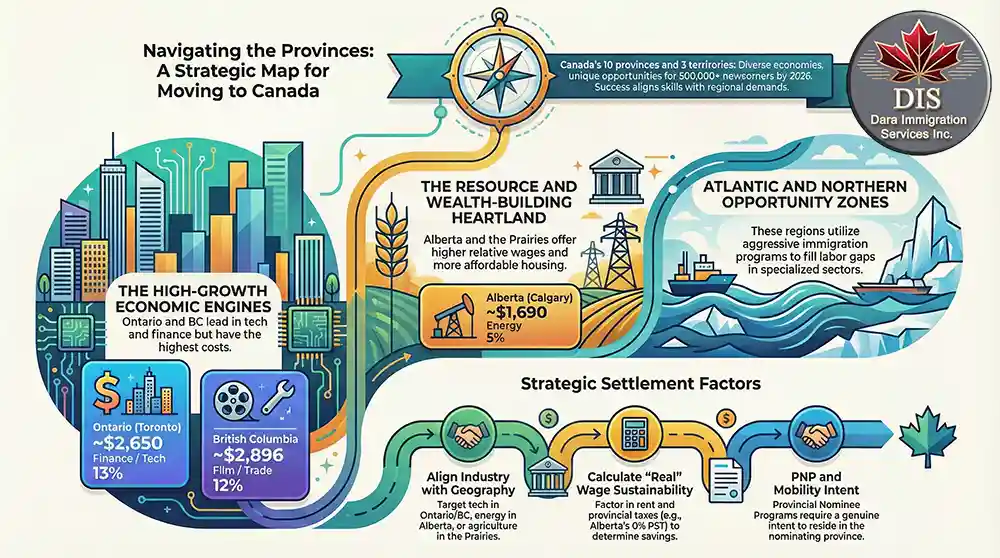
For the 500,000+ newcomers arriving in 2026, the biggest mistake is treating Canada as one monolith. A strategy that works in Ontario (high-tech, high cost) will fail in New Brunswick (resource-based, affordable). Your choice of province determines your cost of living, your salary, and most importantly, your eligibility for Permanent Residence.
At Dara Immigration Services, we believe that success starts with geography. This guide is your strategic map to the Provinces of Canada, helping you align your settlement goals with the right region.
Provinces of Canada : Economic & Lifestyle Profile
Canada is divided into five main geographic regions. While the federal government manages criminal law and citizenship, the Provinces of Canada hold power over the things that affect your daily life: health, education, and civil rights.
For immigrants, the most critical distinction is the Provincial Nominee Program (PNP). Provinces of Canada have an agreements with the federal government to nominate immigrants who meet their specific economic needs. This means a software engineer might be “in demand” in one province but not another.
Quick Facts : Provinces of Canada at a Glance
- Number of Jurisdictions: 10 Provinces, 3 Territories.
- Most Populous: Ontario (Approx. 16 Million).
- Highest Wages: Alberta and Northwest Territories.
- Most Affordable: Newfoundland and Labrador / Saskatchewan.
- Best Climate: British Columbia (Coastal).
- Official Languages: English (9 provinces), French (Quebec), Bilingual (New Brunswick).
The Regional Breakdown
To choose where to live, you must look at Canada by region. Different Provinces of Canada offer different opportunities for immigrants.
Central Canada (Ontario & Quebec)
The economic and political heart of the country, home to over 60% of the population.
Ontario
- Economy: The financial and industrial engine. Hub for finance (Toronto), tech (Waterloo), and manufacturing.
- Lifestyle: Fast-paced and multicultural. Toronto is one of the most diverse cities on earth.
- Cost of Living: High. Toronto rents average $2,650.
- Best For: Corporate professionals, finance experts, and tech workers.
Quebec
- Economy: A leader in aerospace, AI, and hydroelectricity.
- Lifestyle: Distinctly European. French is the language of work and life.
- Cost of Living: Moderate. Subsidized childcare ($9/day) makes it family-friendly.
- Best For: Francophones and families seeking affordable urban living.
Western Canada (British Columbia)
The gateway to the Pacific, defined by mountains, ocean, and mild weather.
British Columbia
- Economy: Trade, Film/TV, Green Tech, and Real Estate.
- Lifestyle: Outdoorsy and health-conscious. Residents prioritize work-life balance.
- Cost of Living: Very High. Vancouver rents average $2,896, the highest in Canada.
- Best For: Tech professionals and those who prioritize climate over savings.
The Prairies (Alberta, Saskatchewan, Manitoba)
The resource heartland, offering the highest average incomes relative to housing costs.
Alberta
- Economy: Energy (Oil & Gas), Agriculture, and a growing Tech sector.
- Lifestyle: Entrepreneurial and independent. No Provincial Sales Tax (PST).
- Cost of Living: Moderate. High wages combined with affordable housing (Calgary rent ~$1,690).
- Best For: Engineers, tradespeople, and young families building wealth.
Saskatchewan & Manitoba
- Economy: The world’s breadbasket (Agriculture) and mining (Potash/Uranium).
- Lifestyle: Community-focused and quiet. Winters are harsh, but communities are tight-knit.
- Cost of Living: Low. You can buy a detached home for under $350,000.
- Best For: Immigrants seeking a faster path to PR via aggressive PNPs.
Atlantic Canada (NB, NS, PEI, NL)
The historic east coast, currently experiencing a population boom due to the Atlantic Immigration Program (AIP).
Nova Scotia
- Economy: Defense (Shipbuilding), Ocean Tech, and Seafood.
- Lifestyle: Coastal and relaxed. Halifax is a booming “Zoom Town.”
- Best For: Remote workers and those seeking an ocean lifestyle.
New Brunswick
- Economy: Logistics, Forestry, and Cybersecurity.
- Lifestyle: Bilingual and traffic-free.
- Best For: Bilingual (English/French) candidates and families.
Prince Edward Island
- Economy: Tourism, Bioscience, and Agriculture.
- Lifestyle: Small-town intimacy. Safe and slow-paced.
- Best For: Entrepreneurs and those seeking safety.
Newfoundland and Labrador
- Economy: Offshore Oil, Mining, and Ocean Tech.
- Lifestyle: Rugged and friendly. Unique island culture.
- Best For: Engineers and those seeking the lowest housing costs in Canada.
The North (Yukon, NWT, Nunavut)
The vast, remote wilderness offering high wages and adventure.
- Economy: Mining and Government.
- Lifestyle: Isolated but adventurous. The Midnight Sun and Northern Lights are daily realities.
- Cost of Living: High due to shipping costs, but offset by the “Northern Residents Deduction” tax break.
- Best For: Adventurers and those chasing high salaries.
Provinces of Canada Comparison Table (2026)
Use this table to quickly compare the realities of major Canadian regions.
| Province / Region | Avg Rent (1-Bdrm) | Top Industry | Sales Tax (Total) | Climate (Jan) |
| Ontario | ~$2,650 (Toronto) | Finance / Tech | 13% | -5°C |
| British Columbia | ~$2,896 (Vancouver) | Film / Trade | 12% | +5°C |
| Quebec | ~$1,700 (Montreal) | Aerospace / AI | ~15% | -10°C |
| Alberta | ~$1,690 (Calgary) | Energy | 5% (No PST) | -12°C |
| Nova Scotia | ~$1,700 (Halifax) | Defense | 15% | -5°C |
| Manitoba | ~$1,450 (Winnipeg) | Manufacturing | 12% | -20°C |
“How-To” Guide: Choosing Your Province
Selecting one of the Provinces of Canada is a strategic process. Follow these steps.
Step 1: Analyze Your Industry
Different provinces of Canada have different labor shortages.
- Tech/Finance: Target Ontario or British Columbia.
- Oil/Gas/Engineering: Target Alberta or Newfoundland.
- Agriculture: Target Saskatchewan or Manitoba.
Step 2: Calculate Your “Real” Wage
A $100,000 salary goes much further in Edmonton than in Toronto.
- Use a “Cost of Living Calculator” to deduct rent and taxes from your offer. Alberta often wins this calculation due to 0% PST and lower rent.
Step 3: Check PNP Eligibility
If you do not have enough points for federal Express Entry, look for a province that wants you.
- Example: Nova Scotia often recruits nurses directly; Saskatchewan recruits truck drivers.
Mobility Rights vs. PNP Intent
Immigrants often ask: “Can I move to another province after I get PR?”
The Legal Reality
- Charter Rights: Section 6 of the Canadian Charter of Rights and Freedoms guarantees the right to live and work in any province.
- The Catch: If you obtained PR through a Provincial Nominee Program (PNP), you signed a declaration of “intent to reside.” If you move immediately after landing, you could be accused of misrepresentation, which can lead to the revocation of your status.
- The Strategy: Settle in the province that nominated you. Make a genuine effort to live and work there before considering a move.
Frequently Asked Questions (FAQ)
- Which province is the easiest to immigrate to?
There is no single “easiest” province, but Saskatchewan and Manitoba generally have lower CRS score requirements and broader occupation lists for their PNPs compared to Ontario or BC.
- Can I live in one province and work in another?
Yes, but it complicates your taxes and healthcare. You are a resident of the province where you have your primary home. For example, many people live in Gatineau (Quebec) but work in Ottawa (Ontario).
- Which province has the lowest taxes?
Alberta. It is the only province with no Provincial Sales Tax (PST) and has relatively low income tax rates. Nunavut also has no territorial sales tax, but the cost of goods is higher.
- Is healthcare the same in every province?
No. While all provinces of Canada cover “medically necessary” services (doctors/hospitals), they differ on what else they cover. For example, pharmacare (drug coverage) and waiting periods for new immigrants vary by province.
- What is the difference between a Province and a Territory?
Provinces of Canada derive their power from the Constitution. Territories derive their power from the Federal government. Practically, territories have smaller populations and receive more federal funding to support remote living.
Professional Immigration Assistance
Choosing the right province is the foundation of your Canadian journey. A mistake here can cost you thousands of dollars in living expenses or, worse, a rejected permanent residence application due to ineligibility for a specific PNP.
At Dara Immigration Services, we analyze your profile against the regulations of all 10 provinces to find your perfect match.
Disclaimer: This article provides general information regarding the provinces of Canada. It does not constitute legal or financial advice.
Download:
Download the bulletin of Provinces of Canada as a PDF.
Download “Provinces-of-Canada-Bulletin-2026-2027.pdf” Provinces-of-Canada-Bulletin-2026-2027.pdf – Downloaded 1545 times – 1.74 MB