Business in Canada
Business in Canada Overview 2026-2027
To do Business in Canada is to operate in one of the world’s most stable and connected economies. For the thousands of entrepreneurs and investors looking to enter the North American market in 2026, Canada offers a unique value proposition: access to 1.5 billion consumers through free trade agreements, a highly educated workforce, and a corporate tax advantage over the United States.

However, the Canadian market is not a monolith. It is a federation of diverse regional economies, each with its own regulations, tax structures, and industry strengths. Navigating the difference between federal incorporation and provincial registration is the first test of your business acumen.
At Dara Immigration Services, we help international entrepreneurs turn business plans into Canadian reality. This guide is your blueprint to doing Business in Canada successfully, ensuring your venture is built on a solid legal and economic foundation.
The Canadian Business Ecosystem
Canada consistently ranks as one of the best countries in the world for doing business. The system is built on English Common Law (except in Quebec), providing a predictable legal framework for contracts and intellectual property.
For foreign investors, the key advantage is the General Corporate Income Tax Rate, which, after federal abatements and provincial adjustments, is significantly lower than many G7 competitors. Additionally, Canada’s Start-Up Visa Program and various Provincial Nominee Entrepreneur streams actively encourage immigrant ownership.
Quick Facts: Business in Canada at a Glance
- GDP: Approx. $2.3 Trillion CAD (2026 Estimate).
- Currency: Canadian Dollar (CAD).
- Corporate Tax: 15% (Federal Net, General) + Provincial Rate (Varies).
- Key Advantage: Duty-free access to the USA and Mexico (CUSMA).
- Workforce: Highly educated; >60% of adults have post-secondary education.
- Time Zones: 6 distinct time zones (Pacific to Newfoundland).
Economic Hubs & Business Opportunities
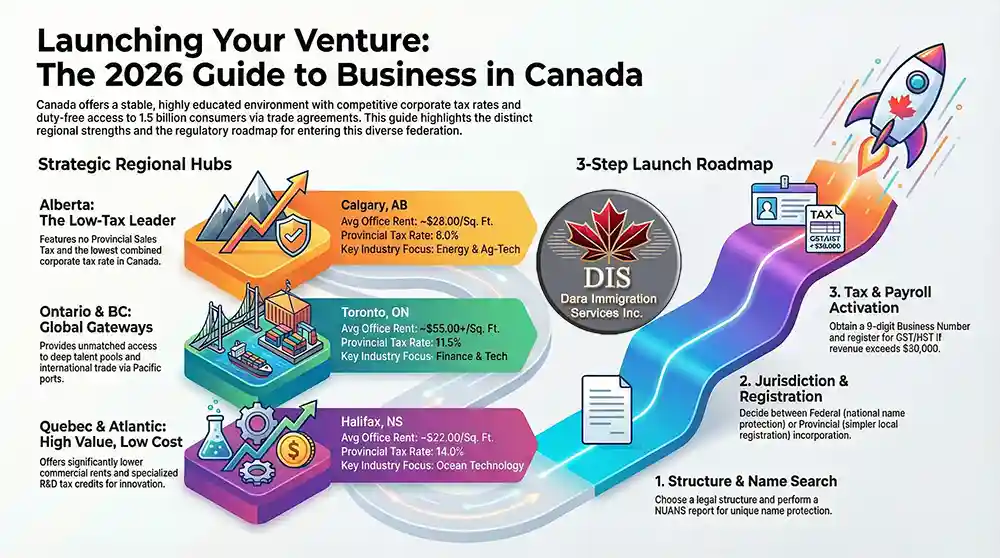
To succeed in Business in Canada, you must target the region that aligns with your industry vertical. Canada is a collection of distinct regional economies.
Ontario (Toronto & Waterloo)
The financial and industrial heart of the country, hosting the headquarters of Canada’s “Big Five” banks.
Economy & Labour Market
- Key Industries: Financial Services, Technology (“Silicon Valley North” in Waterloo), and Advanced Manufacturing.
- Business Climate: Highly competitive. Toronto offers access to the deepest talent pool and venture capital but comes with the highest commercial rents in the country.
- Cost of Doing Business: High. Commercial real estate is premium-priced, but access to the US border and global markets is unmatched.
British Columbia (Vancouver)
The gateway to the Pacific, focusing on trade with Asia, green technology, and digital media.
Economy & Labour Market
- Key Industries: Clean Tech, Film & Television Production, and International Trade/Logistics.
- Business Climate: Innovation-driven. Vancouver is a global hub for environmental sustainability startups. However, the high cost of living impacts wage expectations for employees.
- Cost of Doing Business: Very High. Industrial land is scarce, and office rents rival downtown Toronto.
Quebec (Montreal)
A global leader in high-tech research, offering a European-style business culture with North American efficiency.
Economy & Labour Market
- Key Industries: Artificial Intelligence (AI), Aerospace (Bombardier/Airbus), and Life Sciences.
- Business Climate: Unique. You must operate in French to serve the local market (Bill 96 compliance). The province offers generous R&D tax credits to attract foreign tech companies.
- Cost of Doing Business: Moderate. Montreal offers some of the lowest commercial rents and electricity rates in North America.
Alberta (Calgary)
The energy capital, rapidly diversifying into agriculture technology and logistics.
Economy & Labour Market
- Key Industries: Energy (Oil & Gas), Ag-Tech, and Transportation.
- Business Climate: Entrepreneurial and low-tax. Alberta has no Provincial Sales Tax (PST) and boasts the lowest combined corporate tax rate in Canada, making it highly attractive for headquarters.
- Cost of Doing Business: Low. High vacancy rates in downtown Calgary have created a “tenant’s market” for office space.
Atlantic Canada (Halifax)
The emerging “Ocean Tech” supercluster, offering low operating costs and strong government incentives.
Economy & Labour Market
- Key Industries: Ocean Technology, Shipbuilding, and Food Processing.
- Business Climate: Collaborative. The region is actively recruiting businesses through the Atlantic Immigration Program, making it easier to hire and retain foreign talent.
- Cost of Doing Business: Very Low. Wages and operational costs are significantly lower than the national average.
Business in Canada Costs
Use this table to compare the operational reality of major Canadian business hubs.
| City / Region | Avg Class A Office Rent (Per Sq. Ft.) | Corporate Tax (Provincial General) | Key Industry | Notes |
| Toronto, ON | ~$55.00+ | 11.5% | Finance / Tech | Talent Hub |
| Vancouver, BC | ~$52.00 | 12.0% | Green Tech | Pacific Gateway |
| Montreal, QC | ~$35.00 | 11.5% | AI / Aerospace | Low OpEx |
| Calgary, AB | ~$28.00 | 8.0% | Energy / Ag | Lowest Taxes |
| Halifax, NS | ~$22.00 | 14.0% | Ocean Tech | Growth Market |
Note: Rents are 2026 estimates. Tax rates are for general corporations; small business rates are significantly lower (often 0-2% provincial).
“How-To” Guide: Starting a Business in Canada
Launching a business requires navigating federal and provincial jurisdictions.
Step 1: Planning & Structure
- Choose Your Structure: Decide between a Sole Proprietorship (simplest, unlimited liability), Partnership, or Corporation (separate legal entity, tax advantages).
- Name Search: Perform a NUANS report to ensure your business name is unique and does not infringe on existing trademarks.
Step 2: Registration & Incorporation
- Federal vs. Provincial: You can incorporate Federally (allows you to use your name across Canada) or Provincially (cheaper, but name protection is local).
- Get a Business Number (BN): Once registered, the Canada Revenue Agency (CRA) will assign you a 9-digit Business Number. This is your tax ID.
Step 3: Tax Accounts & Permits
- GST/HST Registration: If your revenue exceeds $30,000 in a single quarter, you must register to collect and remit Goods and Services Tax (GST) or Harmonized Sales Tax (HST).
- Payroll Accounts: If you plan to hire employees, you must register a payroll program account with the CRA to make deductions (CPP, EI, Tax).
Challenges of Starting a Business in Canada
Doing Business in Canada offers stability, but it is not without hurdles.
Challenge #1: Access to Capital
- The Reality: Canadian banks are historically risk-averse compared to US banks. Securing a small business loan without significant collateral or credit history in Canada is difficult.
- The Strategy: Leverage government grants (like SR&ED for research) and business development banks (BDC) that specialize in supporting entrepreneurs.
Challenge #2: Inter-Provincial Barriers
- The Reality: Surprisingly, it is sometimes easier to trade with the US than with another Canadian province due to differing regulations and certifications.
- The Strategy: Focus on your local or international market first. Do not assume a product approved in Ontario is automatically compliant in Quebec.
Frequently Asked Questions (FAQ)
- Can a non-resident own a business in Canada?
Yes. You do not need to be a citizen or Permanent Resident to own a Canadian corporation. However, federal corporations require 25% of directors to be resident Canadians (some provinces like BC and Ontario have waived this residency requirement).
- What is the corporate tax rate?
The net federal tax rate is 15% for general corporations. Provincial rates are added on top, ranging from 8% (Alberta) to 16% (PEI). Small businesses (CCPCs) pay a much lower rate, often totaling around 9-12% combined.
- Do I need a visa to start a business?
Owning a business does not grant you the right to work in Canada. If you want to actively manage your business inside Canada, you need a Work Permit (e.g., Intra-Company Transfer, C11 Entrepreneur Stream, or Start-Up Visa).
- What is the “Start-Up Visa” Program?
It is a federal immigration pathway for entrepreneurs with innovative business ideas. You must secure support from a designated Venture Capital fund, Angel Investor group, or Business Incubator to qualify.
- Is it better to incorporate Federally or Provincially?
If you plan to operate internationally or across multiple provinces, Federal incorporation provides better name protection. If you will operate only locally (e.g., a restaurant), Provincial incorporation is simpler and requires less paperwork.
Professional Business Immigration Assistance
Doing Business in Canada is a high-reward venture, but the intersection of corporate law and immigration rules is complex. A mistake in your corporate structure can disqualify you from immigration pathways like the Owner-Operator policies or Intra-Company Transfers.
Ensure your business is built for both profit and permanent residence. Contact Dara Immigration Services today for a strategic business consultation.
Disclaimer: This article provides general information regarding business and immigration in Canada. It does not constitute legal or financial advice.
Download:
Download the bulletin of Business in Canada as a PDF.
Download “Business-in-Canada-Bulletin-2026-2027.pdf” Business-in-Canada-Bulletin-2026-2027.pdf – Downloaded 1501 times – 1.59 MB