Refugees in Canada
Refugees in Canada Overview 2026-2027
Refugees in Canada are individuals who have been forced to flee their home countries due to a well-founded fear of persecution, war, or violence. For the thousands seeking safety in 2026, Canada remains a global beacon of human rights, offering not just temporary shelter but a clear pathway to permanent residence and citizenship.

However, the journey is fraught with legal complexity and financial struggle. The difference between entering as a “Government-Assisted Refugee” and arriving as an “Asylum Claimant” at the border determines your immediate rights, your income support, and your settlement experience. With housing costs at record highs, surviving on the Resettlement Assistance Program (RAP) rates requires exceptional budgeting and community support.
At Dara Immigration Services, we fight for the vulnerable. This guide is your blueprint to understanding the system for Refugees in Canada, ensuring you navigate the legal hearings and settlement challenges with dignity and success.
Strategic Overview: The Refugee System in Canada
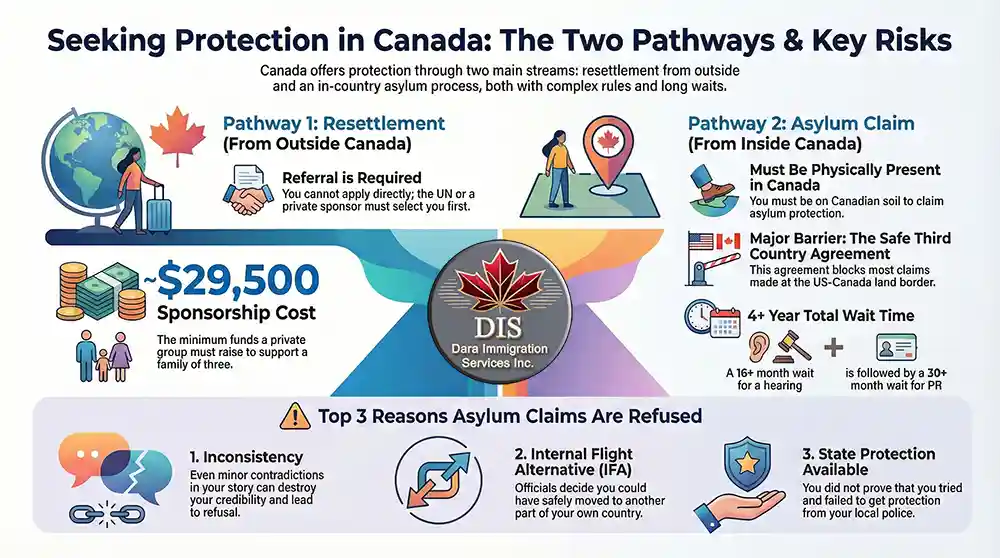
The system for Refugee in Canada operates on two distinct tracks. It is critical not to confuse them.
- Resettlement Program: You are selected outside Canada (usually by the UNHCR) and arrive as a Permanent Resident. You receive immediate government support.
- In-Canada Asylum Program: You arrive in Canada (at a border or airport) and claim refugee status. You must prove your claim to the Immigration and Refugee Board (IRB). You are a “claimant” until the board accepts you.
Quick Facts: Refugees in Canada at a Glance
- Primary Decision Maker: Immigration and Refugee Board (IRB).
- Work Rights: Open Work Permit available for claimants (after medical exam).
- Healthcare: Interim Federal Health Program (IFHP) covers basic needs.
- Settlement Support: RAP (Income support) for up to 1 year.
- Key Document: Refugee Protection Claimant Document (RPCD).
- Safe Third Country Agreement: Limits claims at the US-Canada land border.
Regional Breakdown: Where Refugees in Canada Settle
While you may arrive in a major city, the best opportunities for Refugees in Canada are often found in mid-sized communities with lower housing costs.
Toronto & Southern Ontario
The primary destination for claimants due to the presence of legal aid and community centers.
Economy & Labour Market
- Key Industries: Construction, Food Services, and Logistics.
- Employment Outlook: High demand for general labour. Many Refugees in Canada find their first jobs in the gig economy or manufacturing sectors in the GTA.
- Lifestyle & Culture: Highly multicultural. You will likely find a community that speaks your language.
- Cost of Living: Critical Challenge. Shelter allowances provided by the government cover less than 50% of the average rent. Shared housing is mandatory.
Montreal (Quebec)
A historic sanctuary city, Montreal processes a high volume of French-speaking claims.
Economy & Labour Market
- Key Industries: Manufacturing, Healthcare Support, and Textiles.
- Employment Outlook: Strong demand, but you must learn French. The government offers paid “Francisation” courses.
- Lifestyle: Vibrant and European. The support network for Refugees in Canada is robust here (e.g., PRAIDA).
- Cost of Living: Rising but moderate. Rents are lower than Toronto, but winter heating costs must be factored in.
Calgary & Edmonton (Alberta)
Increasingly popular for Refugee in Canada who prioritize financial independence.
Economy & Labour Market
- Key Industries: Agriculture, Meat Processing, and Warehousing.
- Employment Outlook: Excellent. Employers often actively recruit refugees for stable, well-paying industrial jobs.
- Lifestyle: Family-oriented. Communities are spread out, so access to a car is important eventually.
- Cost of Living: Manageable. Higher RAP rates relative to rent costs allow families to stabilize faster than in Vancouver or Toronto.
Atlantic Canada (Halifax & Moncton)
Small communities with big hearts. Private sponsorship groups are very active here.
Economy & Labour Market
- Key Industries: Fisheries, Customer Service, and Hospitality.
- Employment Outlook: Seasonal work is common.
- Lifestyle: Quiet and safe. Refugees in Canada settling here report high levels of social inclusion but limited public transit.
- Cost of Living: Affordable. It is possible for a family to rent a whole apartment, which is rare in larger cities.
Financial Reality for Refugees in Canada (2026)
Use this table to understand the gap between government support (RAP) and real costs.
| City | Monthly RAP Allowance (Single) | Avg Rent (Room) | Gap | Notes |
| Toronto | ~$1,100 | ~$1,200 | -$100 | Must use food bank / share room |
| Vancouver | ~$1,150 | ~$1,300 | -$150 | Highest cost of living |
| Calgary | ~$1,000 | ~$900 | +$100 | Best financial balance |
| Montreal | ~$950 | ~$850 | +$100 | French required for work |
| Halifax | ~$900 | ~$950 | -$50 | Strong community support |
Note: RAP rates are estimates based on social assistance rates in each province. Most Refugees in Canada supplement this with part-time work immediately.
“How-To” Guide: Steps to Become Refugees in Canada
The path depends on how you enter. This guide focuses on the In-Canada Asylum Process.
Phase 1: The Claim (Port of Entry or Inland)
- Declare Intent: Tell the CBSA officer you fear persecution. They will interview you and confiscate your passport.
- Eligibility Interview: If eligible, you receive a “Refugee Protection Claimant Document” (RPCD). This is your ID.
- BOC Form: You must submit your “Basis of Claim” form within 15 days (Inland) or provide it at the border. This is the most important document in your life.
Phase 2: The Waiting Period
- Medical Exam: Complete your IME within 30 days to trigger your health coverage (IFHP).
- Work Permit: Apply for an Open Work Permit. In 2026, processing usually takes 1-2 months.
- Legal Aid: Secure a lawyer immediately. Refugees in Canada with legal counsel have significantly higher acceptance rates.
Phase 3: The Hearing
- IRB Hearing: You will appear before a member of the Refugee Protection Division. You must testify about your fear.
- Decision: If accepted (“Protected Person”), you can apply for Permanent Residence. If rejected, you may appeal to the RAD or face deportation.
Challenges for Refugees in Canada
To be one of the Refugees in Canada is to be safe, but it is not easy.
Challenge #1: The “RAP Gap”
- The Reality: The monthly money provided by the government (Resettlement Assistance Program) is based on social welfare rates, not the market cost of living. It is rarely enough to cover rent and food.
- The Strategy: Use food banks aggressively. Share housing with other families. Focus on getting the Work Permit to transition to employment income ASAP.
Challenge #2: The Hearing Backlog
- The Reality: You may wait 12 to 24 months for your hearing. Living in “limbo” causes high stress.
- The Strategy: Do not pause your life. Work, learn English/French, and build community ties. Evidence of “establishment” helps if you later apply for H&C grounds.
Frequently Asked Questions (FAQs)
- Can Refugees in Canada work legally?
Yes. As an asylum claimant, you can apply for an Open Work Permit once your claim is found eligible and you have completed your medical exam. Government-Assisted Refugees (GARs) are Permanent Residents and can work immediately.
- Is healthcare free for Refugees in Canada?
Yes. The Interim Federal Health Program (IFHP) covers basic medical services, emergency dental, and vision care until you qualify for provincial health coverage.
- What is the “Safe Third Country Agreement”?
This agreement means you cannot claim asylum at the Canada-US land border if you are arriving from the USA (unless you meet an exception, like having family in Canada). You must make your claim at an airport or regular port of entry.
- How long does it take to become a PR?
If you are a resettled refugee, you are a PR upon arrival. If you are an asylum claimant, you apply for PR after the IRB accepts your claim. This PR processing can take another 20+ months.
- Can I visit my home country?
No. If you return to the country you claimed to fear, Canada may revoke your refugee status (Cessation). You should not travel there until you are a Canadian citizen.
Professional Immigration Assistance
A refugee claim is a life-or-death legal proceeding. A mistake in your Basis of Claim (BOC) form—such as a contradiction in dates or a poorly explained narrative—can destroy your credibility and lead to deportation.
Ensure your story is heard clearly and correctly. Contact Dara Immigration Services today for a confidential consultation on asylum protection.
Disclaimer: This article provides general information regarding refugee protection in Canada. It does not constitute legal advice.
Download:
Download the bulletin of Refugees in Canada as a PDF.
Download “Refugees-in-Canada-Bulletin-2026-2027.pdf” Refugees-in-Canada-Bulletin-2026-2027.pdf – Downloaded 1330 times – 1.85 MB