Canadian Study Permit Refusal
Canadian Study Permit Refusal Overview 2026-2027
Receiving a Canadian Study Permit Refusal can feel like a door slamming shut on your future. For many, it is the heartbreaking pause of a “Canadian Dream” defined by world-class education and career growth.
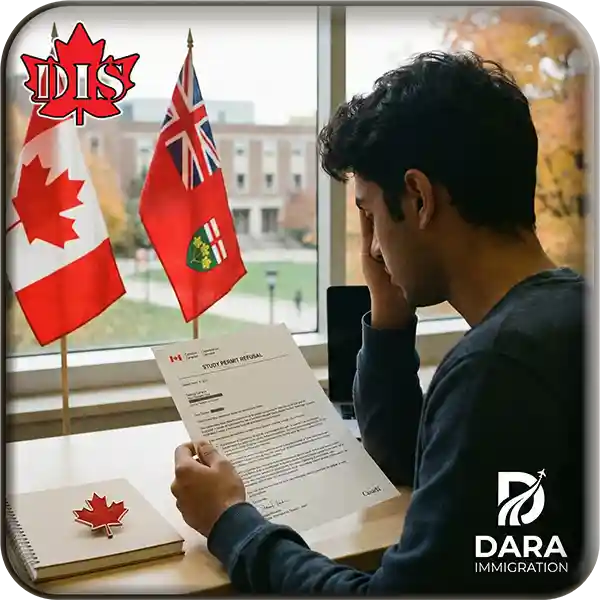
But a Canadian Study Permit refusal is not a permanent ban. It is often just a request for better evidence. In 2025, refusal rates have risen significantly, with automated AI tools processing initial applications. This means even genuine students get rejected for vague reasons.
At Dara Immigration Services, we specialize in turning a Canadian Study Permit Refusal into an approval. We dig deep into the officer’s internal notes to uncover the real reason you were denied and build a strategy to get your application back on track.
Key Takeaways (Quick Summary):
- Don’t Panic: A refusal is not a rejection of you, but of your application. It can often be fixed.
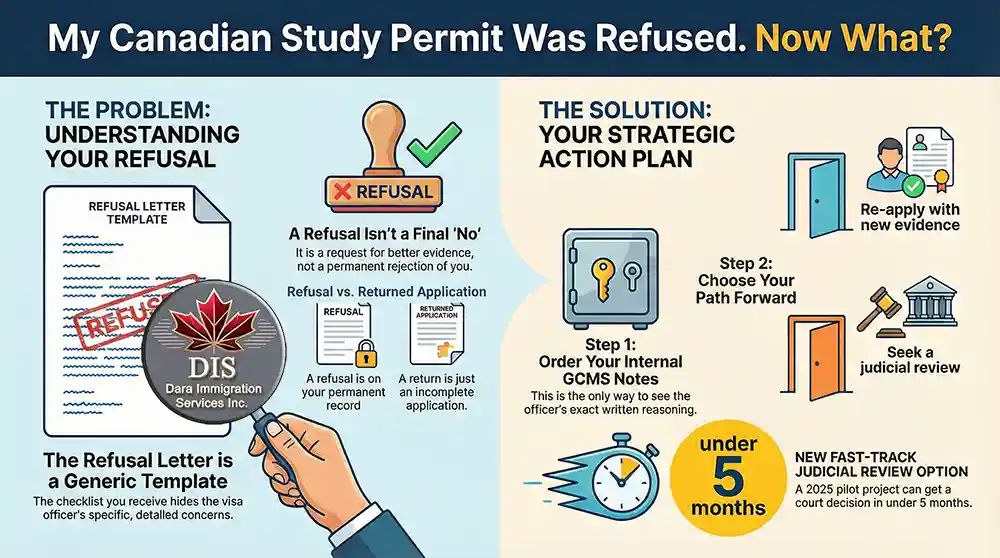
- The “Template” Letter: The letter you received is generic. The real reasons are hidden in the officer’s internal notes (GCMS).
- Judicial Review (New Pilot): A new 2025 Federal Court pilot can fast-track legal reviews in under 5 months.
- Re-applying vs. Review: Never re-apply with the exact same documents. You must address the specific concerns.
Understanding a Canadian Study Permit Refusal
A Study Permit Refusal means the visa officer was not satisfied that you met the requirements of the Immigration and Refugee Protection Act (IRPA). However, not all negative outcomes are the same.
Refusal vs. Return
It is crucial to distinguish between a formal refusal and a returned application.
The Refusal
- Definition: The officer processed your file, reviewed your documents, and decided “No.”
- Outcome: You receive a formal refusal letter, and the decision is recorded in your permanent immigration history.
The Return
- Definition: Your application was incomplete (e.g., missing a Provincial Attestation Letter, incorrect fee, or blank forms).
- Outcome: IRCC sends the entire package back without processing it.
- Impact: This does not count as a refusal on your record. You can simply fix the error and submit again.
The “Generic” Refusal Letter
Most applicants receive a standard template letter with a checklist of reasons (e.g., “I am not satisfied you will leave Canada…”).
Why the Letter is Vague
IRCC uses an Excel-based tool called Chinook to process applications efficiently. Officers select reasons from a drop-down menu, which generates the generic letter. This letter rarely explains the specific concern (e.g., “Your study plan does not match your previous job history”).
Steps to Take After a Canadian Study Permit Refusal
Do not simply “guess” and apply again. Follow this forensic approach to fix the problem.
Step 1: Analyze the Decision
Read the refusal letter to see which broad categories were checked. Common reasons include “Purpose of Visit,” “Personal Assets,” or “Family Ties.”
Step 2: Request Global Case Management System (GCMS) Notes
You cannot fix what you cannot see. The most critical step is to order your GCMS Notes through an Access to Information and Privacy (ATIP) request.
What are GCMS Notes?
These are the detailed internal records of your file. They contain the officer’s actual written reasoning.
- Example: Instead of “Financial Insufficiency,” the notes might say: “Large deposit of $30,000 appeared in account one week before application. Source of funds unclear.”
Step 3: Determine Your Legal Strategy
Once we have the notes, we choose the correct path forward.
Option A: Re-Application
This is the most common route. We submit a brand new application that:
- Includes a new, detailed Letter of Explanation.
- Provides new evidence to specifically address the officer’s notes.
- Clarifies any confusion from the first application.
Option B: Judicial Review (Federal Court)
If the officer’s decision was unreasonable, unfair, or ignored evidence you provided, we may advise suing IRCC at the Federal Court.
The New Study Permit Pilot Project (2025)
- What is it? A streamlined process for eligible study permit refusals.
- Timeline: Reviews are often completed in under 5 months (compared to the traditional 14-18 months).
- Outcome: If successful, the Court orders a different officer to re-open and re-assess your application.
Common Reasons for a Canadian Study Permit Refusal
IRCC officers review applications quickly. If your story isn’t clear immediately, they refuse it.
1. Purpose of Visit (Bonafides)
The officer must believe you are a “bona fide” student who genuinely intends to study.
The “Career Progression” Disconnect
Refusals often happen when the study plan doesn’t make logical sense.
- Example: A 35-year-old with a Master’s degree applying for a general 2-year college diploma.
- Officer’s View: This looks like a downgrade in education solely to gain entry to the labor market, not for genuine study.
2. Financial Insufficiency
You must prove you can support yourself without working.
The “Sudden Funding” Problem
- Reason: You showed the minimum required amount (e.g., $22,895 CAD), but the money appeared in your account recently (“lump sum”).
- Fix: You must show the history of funds or a clear gift deed to prove the money is yours and not borrowed just for the application.
3. Family Ties and Dual Intent
- Reason: The officer believes your ties to Canada (e.g., family here) are stronger than your ties to your home country.
- Dual Intent: You are allowed to intend to become a Permanent Resident later, but you must prove you will leave if your permit expires and PR is not granted.
Timelines and Costs (2026 Estimates)
Note: Timelines for legal reviews have improved significantly with the new Pilot Project.
| Category | Time / Cost | Notes |
| ATIP (GCMS Notes) Request | 30 – 60 Days | The critical first step. Cost is $5.00 CAD. |
| Judicial Review (Pilot Project) | Under 5 Months | New streamlined process for eligible refusals. |
| Re-Application Fee | $150 CAD | You must pay the government fee again. |
| Biometrics | Valid for 10 Years | You usually do not need to pay again. |
Frequently Asked Questions (FAQ)
- Is there a “cooling off” period before I can re-apply?
No. You can re-apply immediately. However, submitting the exact same application will result in another refusal. You must provide new evidence or a better explanation to change the outcome.
- Does a Canadian Study Permit Refusal ban me from Canada?
Generally, no. A refusal is just a denial of that specific application. However, if you are refused for Misrepresentation (lying or submitting fake documents), you face a 5-year ban from entering Canada.
- Will a refusal affect my future applications?
Yes, it is permanently on your record. In all future applications (even for a tourist visa), you must declare that you have been refused. Failing to declare it is considered misrepresentation.
- Can I appeal the decision?
You cannot “appeal” to the visa office (there is no formal appeal process for temporary residence). However, you can apply for Judicial Review at the Federal Court if the decision was legally unreasonable.
- How long do GCMS notes take?
The legal requirement is 30 days, but in 2025/2026, we frequently see delays of 45–60 days. Despite the wait, they are essential for a successful re-application strategy.
Professional Immigration Assistance
A Canadian Study Permit refusal is not the end of the road, but it is a warning sign. You cannot afford to make the same mistake twice. The second refusal is much harder to overturn than the first.
Don’t navigate the complex IRCC maze alone. Contact Dara Immigration Services today. We will review your Canadian Study Permit Refusal, order your notes, and build the strategy to pave your path to Canada.
Disclaimer: This article provides general information regarding Study Permit Refusals and does not constitute legal advice. Immigration policies change frequently.
Download:
Download the bulletin of Canadian Study Permit Refusal as a PDF.
Download “Canadian-Study-Permit-Refusal-Bulletin-2026-2027.pdf” Canadian-Study-Permit-Refusal-Bulletin-2026-2027.pdf – Downloaded 1275 times – 1.39 MB