Bring Your Family to Canada
Bring Your Family to Canada Overview 2026-2027
The ability to bring your family to Canada allows you to build a life defined by togetherness and shared opportunity, rather than separation. For many international students and skilled workers, the journey is not complete without their loved ones.
However, recent 2025 policy changes have significantly altered the eligibility rules for spouses that makes it harder for you to bring your family to Canada. What was once a straightforward process is now a complex landscape of program-specific restrictions and higher financial thresholds.
At Dara Immigration Services, we specialize in keeping families together. Whether you need to secure a work permit for your spouse or a study permit for your child, this guide is your roadmap to navigating Canadian immigration laws successfully.
Key Takeaways (Quick Summary):
- Spousal Work Permits: Eligibility is now largely restricted to spouses of students in Master’s, Doctoral, or Professional Degree programs.
- Minor Children: Can accompany you and attend public school (often for free) without a separate study permit, though obtaining one is recommended.
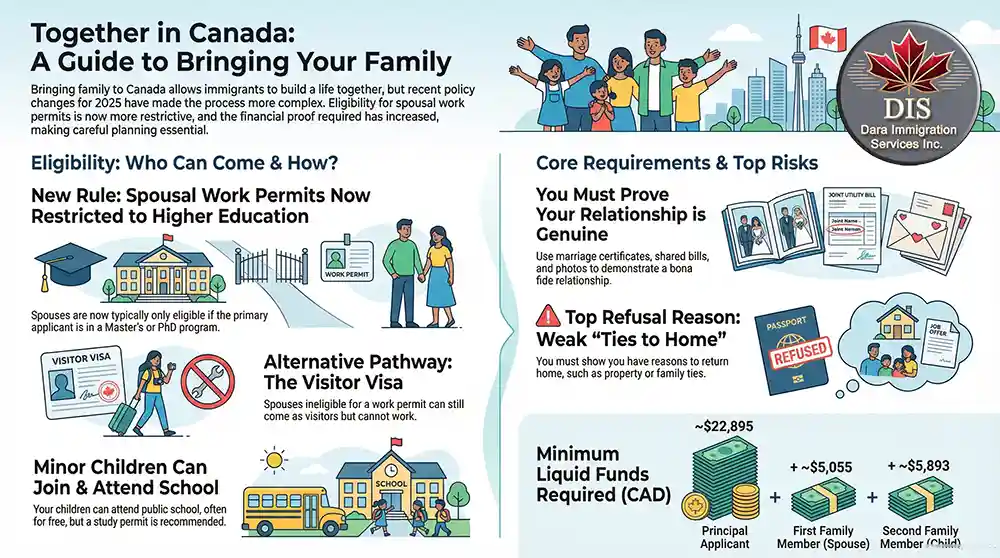
- Financial Proof: You must show increased funds: $22,895 (Principal) + $5,055 (Spouse) + $5,893 (Child).
- Application Strategy: Applying together (concurrent processing) vs. applying separately has different risks and benefits.
Pathways to Bring Your Family to Canada
There are three primary legal statuses your family members can hold while accompanying you in Canada. Choosing the right one depends on your own status (student vs. worker) and your level of study.
1. The Spousal Open Work Permit (SOWP)
This is the most desirable pathway to bring your family to Canada, as it allows your spouse or common-law partner to work for almost any employer in Canada.
The “Master’s Degree” Restriction (New Rule)
Recent updates have tightened eligibility. Generally, your spouse is only eligible for an SOWP if you (the principal applicant) are studying in:
- A Master’s degree (at least 16 months).
- A Doctoral degree (PhD).
- A specific Professional Degree program (e.g., Medicine, Law, Dentistry, Engineering) at a university.
Note: Spouses of students in college diploma or general undergraduate programs are typically no longer eligible for an Open Work Permit, unless the principal applicant holds a specific high-skilled work permit (e.g., CUAET, PGWP in certain tiers).
2. The Visitor Visa (TRV)
If your spouse is not eligible for a work permit, they can still accompany you as a Visitor.
- Limitation: They cannot work in Canada.
- Duration: They are usually granted entry for the duration of your study or work permit.
3. Study Permits for Minor Children
Your dependent children (under age 22) can accompany you.
- Schooling: Children usually have the right to attend preschool, primary, or secondary school (K-12).
- Permit vs. Visitor Record: While minors don’t strictly need a study permit to attend school, applying for one is highly recommended to ensure they have legal status as they age.
Eligibility Requirements to Bring Your Family to Canada
To successfully bring your family to Canada, you must prove both your relationship and your financial stability.
1. Proof of Relationship
You must provide official documentation to prove the legitimacy of your family unit.
- Spouse: Marriage Certificate.
- Common-Law Partner: Statutory Declaration of Common-Law Union (IMM 5409) plus proof of 12 months of cohabitation (leases, shared bills).
- Children: Birth Certificates listing both parents’ names.
2. Admissibility
All family members must be admissible to Canada.
- Medical: Must pass an Immigration Medical Exam (IME).
- Criminal: Must provide Police Clearance Certificates (if over 18).
3. Sufficient Financial Support (2026 Standards)
You must demonstrate liquid funds to support your entire family unit when you bring your family to Canada, as you will likely be the primary income earner initially.
The “LICO” Calculation
You need to show the base amount for yourself plus specific add-ons for each family member.
- Principal Applicant: ~$22,895 CAD.
- First Family Member (Spouse): + ~$5,055 CAD.
- Second Family Member (Child): + ~$5,893 CAD.
Unsure if you qualify? [Link to: Book a Consultation] for a full eligibility assessment.
Costs, Fees, and Timelines
Note: Fees are estimates and subject to change by IRCC.
| Category | Government Fee (CAD) | Processing Time | Notes |
| Spousal Open Work Permit | $255 CAD | 3 – 5 Months | Includes Work Permit fee ($155) + Open Permit holder fee ($100). |
| Visitor Visa (per person) | $100 CAD | Varies by Country | Required for spouses ineligible for work permits. |
| Study Permit (Child) | $150 CAD | 8 – 14 Weeks | Recommended for all minor children. |
| Biometrics (Family) | $170 CAD | Once every 10 years | Maximum fee for a family of 2 or more applying together. |
| Minimum Funds Required | See “LICO” above | N/A | Must be liquid funds (bank statements). |
Application Process: Step-by-Step
You can apply to bring your family to Canada concurrently (at the same time as your own application) or subsequently (after you are approved/in Canada).
Step 1: Determine Eligibility Strategy
Check if your program of study qualifies your spouse for a Work Permit. If not, decide if a Visitor Visa is the better strategic option to ensure they can at least enter Canada.
Step 2: Gather “Bona Fide” Relationship Proofs
IRCC scrutinizes relationships to ensure they are genuine.
- Tip: For newer marriages, include a “Love Story” Letter of Explanation with photos of the wedding, outings, and communications.
Step 3: Secure Comprehensive Financials
Collect 4 months of bank statements showing the total amount required for the whole family.
- Warning: Do not just show the minimum. Having a buffer increases your chances of approval.
Step 4: Submit the Application
- Concurrent: Upload all family members’ forms under your primary GCKey profile.
- Subsequent: Your family member creates their own profile and links it to your status documents (e.g., your Study Permit copy).
Step 5: Biometrics and Medicals
Once submitted, the family member will receive instructions to visit a Visa Application Centre (VAC) for fingerprints and photos.
Risks and Common Refusals
Applications to bring your family to Canada are scrutinized heavily for “intent to return.”
1. The “Ties to Home” Paradox
If your whole family comes to Canada, the officer may argue you have no “ties” (reasons to return) to your home country.
- The Fix: You must show remaining assets (property, investments) or strong extended family ties back home to prove you will leave if your status expires.
2. Insufficient Financials
Officers often refuse families because they believe the principal applicant cannot support everyone on a student budget.
- The Fix: Show clear, liquid funds. Avoid using “future income” (like part-time work) as proof.
3. Non-Genuine Relationship
If documentation is weak (e.g., no photos, vague timelines), the officer may suspect a “marriage of convenience.”
Frequently Asked Questions (FAQ)
- Can my spouse work if I am studying in a college diploma program?
Under the new 2025/2026 rules, generally no. Unless you are in a specialized professional degree program (e.g., Law, Nursing degrees), spouses of college students are usually only eligible for a Visitor Visa, not an Open Work Permit.
- Can my children attend school for free?
Yes. In most provinces, minor children of parents with valid study or work permits can attend public elementary and secondary schools without paying international tuition fees.
- Should I apply to bring my family to Canada now or later?
It depends on the strength of your application. Applying together ensures you arrive together, but it increases the financial requirement. Applying later (after you are established) can sometimes be safer if funds are tight.
- What happens if my child turns 18/19 while in Canada?
They are no longer considered a “minor” (age varies by province). They must apply for their own Study Permit as an adult international student to continue studying.
- Can my spouse study while on a Work Permit?
Generally, yes, but only for short-term courses (under 6 months). If they want to pursue a full degree (over 6 months), they must apply for their own separate Study Permit.
Professional Immigration Assistance
Navigating the rules to bring your family to Canada is emotional and legally complex. A rejection doesn’t just mean a delay; it means continued separation from your loved ones.
Don’t take risks with your family’s future. Contact Dara Immigration Services today for a strategy session to maximize your chances of approval.
Disclaimer: This article provides general information regarding family accompaniment and does not constitute legal advice. Policies change frequently.
Download:
Download the bulletin of Bring Your Family to Canada as a PDF.
Download “Bring-Your-Family-to-Canada-Bulletin-2026-2027.pdf” Bring-Your-Family-to-Canada-Bulletin-2026-2027.pdf – Downloaded 2118 times – 1.42 MB