Canadian LMIA Based Work Permit
Canadian LMIA Based Work Permit Overview 2026-2027
For many foreign professionals, a Canadian LMIA Based Work Permit is the “Golden Ticket” to working in Canada. Unlike open work permits, this pathway is tied to a specific employer who has proven to the Canadian government that no local worker is available to do the job.

However, the Labour Market Impact Assessment (LMIA) process is arguably the most scrutinized program in Canadian immigration. With the government re-introducing strict processing caps in 2026 for low-wage positions in major cities, a single error in a job advertisement can lead to an instant rejection.
At Dara Immigration Services, we bridge the gap between employers and global talent. Whether you are a business owner struggling to find staff or a worker with a job offer, this guide is your roadmap to navigating the complex Labour Market Impact Assessment process and apply for your Canadian LMIA Based Work Permit.
Key Takeaways (Quick Summary):
- Employer-Driven: An LMIA is an application submitted by the employer, not the worker.
- The “Median Wage” Rule: Your stream (High-Wage vs. Low-Wage) determines your processing speed and requirements.
- Prohibited Fees: It is illegal for an employer to ask a worker to pay the $1,000 LMIA government fee.
- PR Benefits: While direct “Job Offer” points were removed in 2025, an LMIA job allows you to gain Canadian Work Experience points or qualify for a PNP Nomination (+600 points).
What is an LMIA?
A Labour Market Impact Assessment (LMIA) is a document issued by Employment and Social Development Canada (ESDC). It gives an employer permission to hire a temporary foreign worker. Using the positive or neutral LMIA the foreign worker can then apply for their Canadian LMIA Based Work Permit.
The “Positive/Neutral” Decision
- Positive LMIA: Confirms that there is a genuine labour shortage and hiring a foreign worker will not negatively impact the Canadian labour market.
- Negative LMIA: Means the officer believes a Canadian could have filled the role, or the job offer is not genuine.
The Two-Step Process
It is critical to understand that the “LMIA” and the “Work Permit” are two separate applications:
- Step 1 (The Employer): Applies to ESDC for the LMIA.
- Step 2 (The Worker): Once the LMIA is approved, applies to IRCC for the Closed Work Permit.
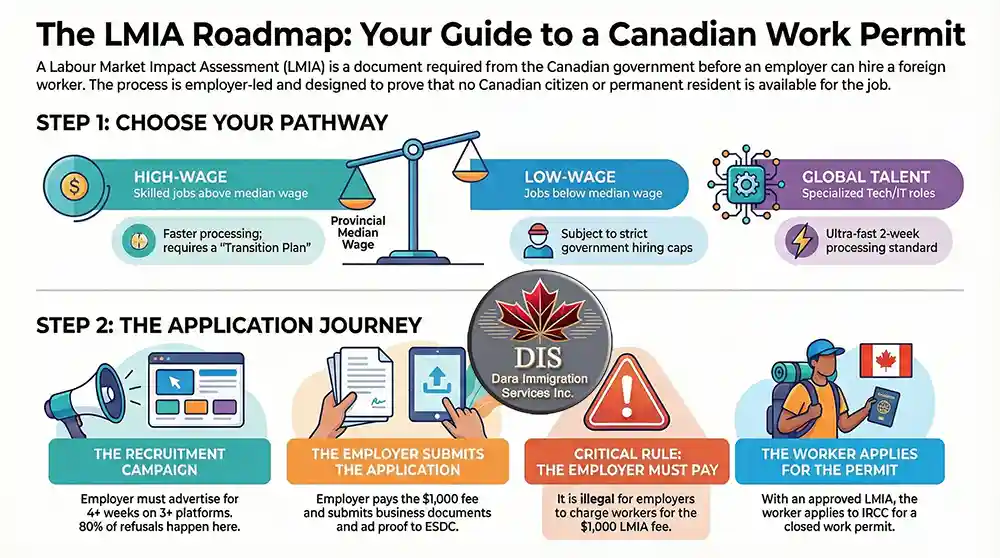
The Four Main Canadian LMIA Based Work Permit Streams
Your Canadian LMIA Based Work Permit application path depends entirely on the wage being offered compared to the Provincial Median Wage (e.g., approx. $36.60/hr in BC or $36.00/hour in Alberta for 2026).
1. High-Wage Stream
- Wage: At or above the provincial median.
- Requirement: Employer must submit a Transition Plan showing how they will eventually hire a Canadian (e.g., training programs).
- Processing: Generally faster; 10-day expedited processing available for top 10% wage earners.
2. Low-Wage Stream
- Wage: Below the provincial median.
- Requirement: Strict caps apply (employers can generally only hire 10-20% of their workforce through this stream).
- 2026 Update: Processing has resumed in some cities (e.g., Vancouver, Halifax) where unemployment has dropped below 6%, but remains paused in high-unemployment regions.
3. Global Talent Stream (GTS)
- Target: Specialized IT/Tech roles or unique talent.
- Benefit: 2-week processing standard.
- Requirement: Employer must commit to a “Labour Market Benefits Plan” (e.g., creating jobs for Canadians).
4. Dual Intent (PR Support)
- Goal: To support the worker’s Permanent Residence application (Express Entry).
- Benefit: The LMIA is fee-exempt ($0) if the worker is only using it for points and not a work permit. If used for both, the fee applies.
Costs, Fees & Timelines (2026 Estimates)
Note: Employers must pay all recruitment and government fees. Passing these costs to the worker is illegal. The foreign worker is only responsible for their Canadian LMIA Based Work Permit fees.
| Category | Fee / Metric | Notes |
| LMIA Government Fee | $1,000 CAD | Per position. Paid by Employer. |
| Advertising Costs | $300 – $800+ | Job Bank is free; secondary platforms vary. |
| Work Permit Fee | $155 CAD | Paid by the Worker (after LMIA approval). |
| Processing Time (High Wage) | 30 – 50 Days | Varies by volume. |
| Processing Time (Low Wage) | 40 – 70 Days | Slower due to higher scrutiny. |
| Global Talent Stream | ~14 Days | The fastest option for tech roles. |
Canadian LMIA Based Work Permit Eligibility Requirements
To get a positive LMIA, the employer must prove they tried—and failed—to hire a Canadian. Without this step, the work cannot apply for their Canadian LMIA based Work Permit.
1. The Recruitment Campaign (The “Ad”)
This is where 80% of refusals happen.
- Duration: Ads must run for at least 4 consecutive weeks before applying and remain live until a decision is issued.
- Platforms: Must use the Government Job Bank plus two additional methods (e.g., Indeed, LinkedIn, or specialized industry sites).
- Content: Must include salary, business address, and specific duties matching the NOC (National Occupational Classification) code.
2. Business Legitimacy
The company must be an active, operating business in Canada.
- Proof: T2 tax returns, payroll records (PD7A), lease agreements, and business licenses.
- Red Flag: Shell companies or businesses operating out of a residential house without permits will be refused.
3. Financial Ability
The employer must prove they can afford to pay the foreign worker the promised wage.
- Note: For “Owner/Operator” scenarios (where the worker owns the company), the rules have become extremely strict to prevent buying status.
Canadian LMIA Based Work Permit Step-by-Step Application Process
Step 1: Confirm the Wage and Stream
Check the current 2026 Median Wage for your province. This dictates whether you apply for High-Wage or Low-Wage.
Step 2: Launch Advertising
Post the job on the Job Bank and two other sources.
- Critical: Keep screenshots of the ads on Day 1, Day 14, and Day 28. ESDC will ask for proof.
Step 3: Interview Candidates
If any Canadians apply, the employer must interview them. You must have a valid, non-discriminatory reason for rejecting them (e.g., “Lack of required 5 years’ experience”). Keep detailed interview notes.
Step 4: Submit to ESDC (LMIA Online Portal)
Upload the business documents, proof of ads, and the transition plan. Pay the $1,000 fee.
Step 5: The Employer Interview
An ESDC officer will often call the employer to confirm details.
- Question: “Why couldn’t the Canadian applicant do this job?” The employer must be ready to answer confidently.
Step 6: Worker Applies for Permit
Once the “Positive Decision Letter” is received, the worker uses it to apply for their work permit via the IRCC portal.
Risks and Refusals of a Canadian LMIA Based Work Permit
LMIA applications are audited heavily. Here are the most common pitfalls in 2026.
1. “Fake” Advertising
If the ads look generic or were clearly posted just to satisfy the rule (not to find a real worker), ESDC will refuse for “Recruitment not genuine.”
2. The “Cap” Rejection
For Low-Wage positions: If the employer already has a high number of temporary foreign workers, they may hit the 10% or 20% cap and be ineligible to hire more.
3. Inconsistent Wage
If the ad listed a range of “$25–$35” but the job offer is for “$25,” ESDC may reject it for misleading Canadian applicants who might have applied for the higher rate.
Frequently Asked Questions (FAQ)
- Can the worker pay the $1,000 LMIA fee?
Absolutely not. It is a violation of the Immigration and Refugee Protection Act for an employer to recover the LMIA fee from the worker. If caught, the LMIA will be revoked and the employer fined.
- How long is a positive LMIA valid for?
Once issued, the LMIA is typically valid for 6 to 18 months (updated 2025/2026). The worker must apply for their work permit before this expiry date.
- Does an LMIA guarantee a work permit?
No. IRCC can still refuse the work permit if the worker is not qualified for the job (e.g., lacks the education listed in the LMIA) or is inadmissible to Canada (criminal/medical).
- Can I change employers on an LMIA work permit?
No. An LMIA work permit is “Closed” or employer-specific. To change jobs, your new employer must get a new LMIA, and you must apply for a new work permit.
- What is the difference between LMIA and PNP?
An LMIA is a federal labour market test. A PNP (Provincial Nominee Program) is a provincial nomination. Both can lead to work permits and PR, but PNP is often better for those who want to settle permanently in a specific province.
Professional Immigration Assistance
Applying for a Canadian LMIA Based Work Permit is a complex process. The LMIA process is a minefield of compliance rules. A single missed day of advertising or a wrong NOC code can waste months of time and thousands of dollars.
Don’t risk your business’s hiring ability. Contact Dara Immigration Services today. We handle the recruitment compliance, the application, and the final work permit to get your team working sooner.
Disclaimer: This article provides general information regarding the Canadian LMIA process and does not constitute legal advice. Policies change frequently.
Download:
Download the bulletin of Canadian LMIA Based Work Permit as a PDF.
Download “Canadian-LMIA-Based-Work-Permit-Bulletin-2026-2027.pdf” Canadian-LMIA-Based-Work-Permit-Bulletin-2026-2027.pdf – Downloaded 2096 times – 1.82 MB