Canadian Work Permit Refusal
Canadian Work Permit Refusal Overview 2026-2027
Receiving a Canadian Work Permit Refusal can feel like a sudden, crushing halt to your career aspirations and your future life in Canada. Whether you are an IT professional waiting for a Global Talent Stream visa or a tradesperson with a hard-won LMIA, a rejection letter is confusing, stressful, and often vaguely worded.

But a refusal is not necessarily the final verdict. In 2026, with IRCC utilizing automated systems like “Chinook” to process applications in record time, valid candidates are frequently rejected due to minor oversights or generic templated reasons.
At Dara Immigration Services, we specialize in refusal management. We do not guess why you were rejected; we use legal tools to uncover the officer’s internal notes and build a forensic strategy to overturn the Canadian Work Permit Refusal and get you to work.
Key Takeaways (Quick Summary):
- It’s Not Personal: Most refusals are generated via “bulk processing” tools. The letter is a template; the real reason is in the internal notes.
- The “Chinook” Effect: Speed often leads to errors. Officers may overlook key documents in complex applications.
- Judicial Review Pilot: A new Federal Court process can now fast-track eligible refusal reviews in under 5 months.
- Don’t Rush: Re-applying with the exact same documents will lead to a second (and faster) refusal.
What Does a Canadian Work Permit Refusal Mean?
A Canadian Work Permit Refusal means that an immigration officer was not satisfied that your application met the requirements of the Immigration and Refugee Protection Act (IRPA) or Regulations (IRPR).
Refusal vs. Return
It is critical to distinguish between the two:
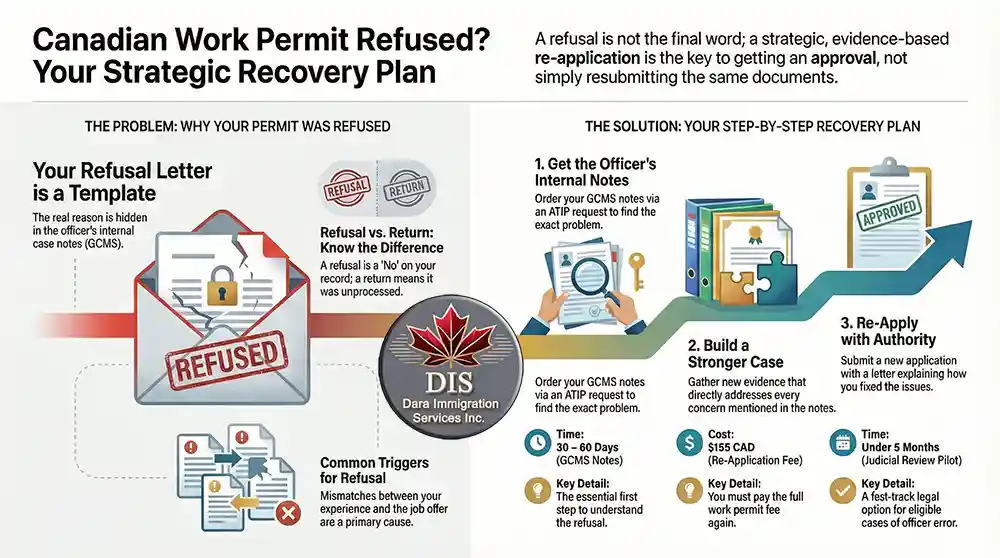
- Refusal: The officer reviewed your file and decided “No.” This is a permanent record in your immigration history (GCMS).
- Return: Your application was incomplete (e.g., missing a signature, wrong fee, or missing LMIA number). IRCC sends it back unprocessed. This does not count as a refusal.
Your Three Options After a Refusal
- Re-Application: Submitting a new, stronger application with fresh evidence (the most common route).
- Reconsideration Request: Asking the program manager to fix a clear factual error (rarely successful).
- Judicial Review (Federal Court): Suing IRCC if the decision was legally unreasonable or procedurally unfair.
Requirements for a Successful Re-Application
To overturn a Canadian Work Permit Refusal, you cannot simply “try again.” You must meet a higher standard of proof than the first time.
The “Forensic” Checklist
- GCMS Notes: You must obtain the Global Case Management System notes to see the officer’s specific comments (e.g., “Applicant lacks 2 years of experience required by LMIA”).
- Addressed Concerns: Every concern raised in the notes must be explicitly answered with new evidence.
- Consistency: Your new application must not contradict the old one (unless correcting a mistake with a clear explanation).
- Valid Job Offer: Ensure the LMIA or Employer Portal Offer (A-number) is still valid and has not expired during the delay.
Costs & Timelines (2026 Estimates)
Note: Timelines for ATIPs and Court reviews are estimates based on 2025/2026 trends.
| Category | Time / Cost | Notes |
| ATIP (GCMS Notes) Request | 30 – 60 Days | Gov Fee: $5.00. Essential first step. |
| Re-Application Fee | $155 CAD | You must pay the full work permit fee again. |
| Biometrics | Valid for 10 Years | Usually, you do not need to pay/give again. |
| Judicial Review (Pilot) | Under 5 Months | Fast-track legal review for eligible cases. |
| Standard Processing | Varies | Re-applications enter the standard queue. |
Step-by-Step: Managing a Canadian Work Permit Refusal
Do not panic and re-submit immediately. Follow this structured process to maximize your chances of success.
Step 1: Analyze the Refusal Letter
Read the generic letter. It will check boxes like “Purpose of Visit,” “Qualifications,” or “Genuineness of Offer.”
- Reality: These are broad categories. They do not tell you the specific problem.
Step 2: Order GCMS Notes (ATIP)
We submit an Access to Information request to get the officer’s internal case notes.
- The “Aha” Moment: The notes might reveal, “The job requires English CLB 7, but applicant only provided CLB 5.” Now we know exactly what to fix.
Step 3: Conduct a Gap Analysis
Compare the officer’s notes against your original submission.
- Did the officer miss a document you uploaded? (Possible Judicial Review).
- Did you fail to upload proof of employment? (Re-Application).
Step 4: Develop the Strategy
- For Weak Evidence: We draft a robust Letter of Explanation and attach the missing proofs (e.g., pay stubs, tax records, updated reference letters).
- For Officer Error: We prepare a legal submission highlighting the oversight.
Step 5: Re-Submit with Authority
Submit the new application. The first page of your submission letter should clearly state: “This is a re-application following a refusal. We have addressed the Officer’s concerns as follows…”
Common Reasons for a Canadian Work Permit Refusal
In 2026, Canadian Work Permit Refusals often stem from inconsistencies between the job offer and the applicant’s history.
1. The “NOC” Mismatch
- The Issue: The LMIA is for a Software Engineer (TEER 1), but your reference letters describe duties of a Technical Support Agent (TEER 2/3).
- The Refusal: “I am not satisfied the applicant is able to perform the work sought.”
2. Genuineness of the Job Offer
- The Issue: The business is new, or the salary is below market rate, or the employer has no digital footprint.
- The Refusal: “I am not satisfied the offer of employment is genuine.”
3. Purpose of Visit (Dual Intent)
- The Issue: You have a PR application in process, or your temporary ties to your home country (assets, family) are weak.
- The Refusal: “I am not satisfied you will leave Canada at the end of your authorized stay.”
Frequently Asked Questions (FAQ)
- Can I apply for a work permit at the border (Flagpoling) after a refusal?
Technically yes, if you are visa-exempt or from the US. However, it is highly risky. Border officers can see the previous refusal and will scrutinize you heavily. If you fail again at the border, you could face an exclusion order.
- Does a refusal affect my future Permanent Residence application?
A refusal itself does not block PR. However, if the refusal was due to Misrepresentation (fake documents), you face a 5-year ban from applying for any status, including PR.
- How long do I have to wait to re-apply?
There is no waiting period. You can re-apply the same day. However, without addressing the reasons for the Canadian Work Permit Refusal, the result will be the same. Wait for your GCMS notes.
- Can I appeal the decision?
There is no formal administrative appeal for temporary work permits. Your legal remedy is Judicial Review at the Federal Court, which reviews if the decision was lawful, not if you are “worthy.”
- Will I get a refund of my fees?
No. The $155 work permit processing fee covers the cost of the officer reviewing your file. IRCC does not refund fees for refused applications.
Professional Immigration Assistance
A Canadian Work Permit Refusal is a permanent mark on your immigration file. Navigating the recovery process requires more than just filling out forms; it requires a legal strategy to prove your competence and intent.
Don’t let a generic rejection letter end your career plans. Contact Dara Immigration Services today. We will dig into the notes, find the error, and fight to get your permit approved.
Disclaimer: This article provides general information regarding Canadian Work Permit Refusals and does not constitute legal advice. Policies change frequently.
Download:
Download the bulletin of Canadian Work Permit Refusal as a PDF.
Download “Canadian-Work-Permit-Refusal-Bulletin-2026-2027.pdf” Canadian-Work-Permit-Refusal-Bulletin-2026-2027.pdf – Downloaded 2697 times – 1.56 MB