About Canada
About Canada Overview 2026-2027
Let’s Learn about Canada, a diverse nation, celebrated for its breathtaking landscapes, exceptional quality of life, and warm, welcoming environment. From the bustling urban centers of Toronto and Vancouver to the serene beauty of the Canadian Rockies and the remote tranquility of the Northern territories, Canada presents an extraordinary mix of modern city living and pristine natural surroundings.

For the millions of people eyeing a move in 2026, Canada represents a stable democracy, a robust G7 economy, and a society built on the foundation of immigration. However, the Canada of 2026 is different from the Canada of a decade ago.
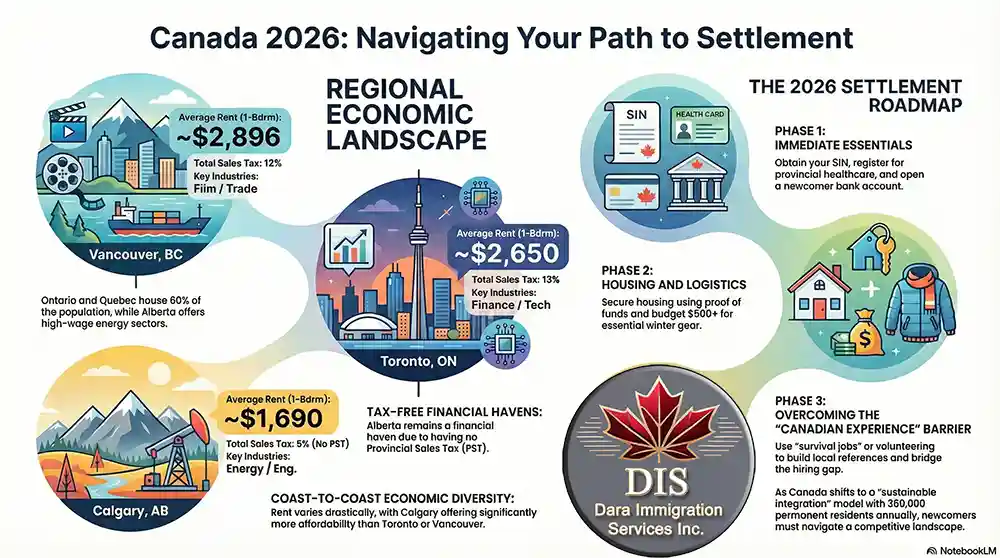
With a stabilized immigration target of 380,000 permanent residents this year, the federal government has shifted from “rapid growth” to “sustainable integration.” This means the competition for entry is fiercer, and the economic landscape—defined by higher costs of living and housing shortages—requires a strategic approach to settlement.
At Dara Immigration Services, we believe that an informed immigrant is a successful immigrant. This guide provides the unvarnished truth About Canada, helping you navigate the opportunities and challenges of starting a new life in the Great White North.
Discover Canada
Live in Canada
Education in Canada
Jobs in Canada
Healthcare in Canada
Visa of Canada
About Canada’s Systems
In order to learn About Canada, you must know that Canada is a federal parliamentary democracy and a constitutional monarchy. Practically, this means we have a Prime Minister who leads the federal government and Premiers who lead the provinces. This distinction is critical for immigrants because provinces control key services like healthcare, education, and many immigration nominations (PNPs).
Economically, Canada is a resource-rich nation (oil, timber, minerals) transitioning into a knowledge economy (AI, tech, finance). While the banking system is widely regarded as one of the safest in the world, the taxation system is progressive—meaning higher earners pay a significant percentage to fund social services like universal healthcare.
Quick Facts: About Canada at a Glance
- Capital City: Ottawa, Ontario.
- Population: Approx. 42 Million (2026 Estimate).
- Official Languages: English and French.
- Currency: Canadian Dollar (CAD).
- Political Structure: 10 Provinces, 3 Territories.
- Key Advantage: Universal Healthcare (for PRs and Citizens).
Regional Breakdown
When learning About Canada, you must realize that life in Toronto bears little resemblance to life in rural Saskatchewan.
Central Canada (Ontario & Quebec)
The industrial and political heartland, home to over 60% of the population.
Ontario
- Economy: A diverse powerhouse led by finance (Toronto), tech (Waterloo), and manufacturing.
- Lifestyle: Fast-paced and multicultural. Toronto is often called the “most diverse city on the planet.”
- Climate: Hot, humid summers (+30°C) and cold, snowy winters (-10°C to -20°C).
- Cost of Living: High. Toronto is the most expensive city for rent and auto insurance.
Quebec
- Economy: A leader in aerospace, hydroelectricity, and artificial intelligence.
- Lifestyle: Distinctly European. French is the language of work and life.
- Climate: Severe winters with heavy snowfall; beautiful, festive summers.
- Cost of Living: Moderate. Subsidized childcare ($9/day) and lower rents make it family-friendly, though income taxes are higher.
Western Canada (British Columbia & Alberta)
The frontier of mountains, ocean, and energy.
British Columbia
- Economy: Real estate, technology, and international trade (Gateway to Asia).
- Lifestyle: Active and health-conscious. Residents prioritize the outdoors.
- Climate: The mildest in Canada. Vancouver rarely sees snow, but experiences heavy rain in winter.
- Cost of Living: Very High. Vancouver housing costs are a major barrier to entry.
Alberta
- Economy: Energy (Oil & Gas), Agriculture, and a booming tech sector in Calgary.
- Lifestyle: Young and entrepreneurial. It has the youngest median age in Canada.
- Climate: Dry and sunny, but bitterly cold in winter (-30°C is common).
- Cost of Living: Affordable. No Provincial Sales Tax (PST) and high wages make it a financial haven.
The Prairies & Atlantic Canada
Regions offering community, space, and a slower pace of life.
- The Prairies (SK/MB): The agricultural breadbasket. Life here is affordable and community-focused, though the winters are harsh.
- Atlantic Canada (NS/NB/PEI/NL): Known for maritime hospitality. The economy is growing due to the Atlantic Immigration Program, making it a top choice for families seeking safety and lower housing costs.
About Canada: Costs and Climate (2026)
Learn more about Canada by using this table to set realistic expectations for your first year.
| Region | Avg Rent (1-Bdrm) | Sales Tax (Total) | Climate (Jan Avg) | Key Industry |
| Toronto, ON | ~$2,650 | 13% | -5°C | Finance / Tech |
| Vancouver, BC | ~$2,896 | 12% | +5°C | Film / Trade |
| Calgary, AB | ~$1,690 | 5% | -12°C | Energy / Eng |
| Montreal, QC | ~$1,700 | ~15% | -10°C | AI / Aerospace |
| Halifax, NS | ~$1,700 | 15% | -5°C | Ocean Tech |
Note: Food prices in 2026 are projected to rise 4-6%, meaning a family of four will spend ~$17,500/year on groceries.
Comprehensive “How-To” Guide: Settling in Canada
Moving is more than just a flight. Here is the settlement roadmap.
Phase 1: Immediate Essentials
- Social Insurance Number (SIN): You cannot work legally without this. Apply at Service Canada immediately upon landing.
- Healthcare Registration: Apply for your provincial health card. Note that provinces like BC and Ontario may have waiting periods; buy private insurance for the first 90 days.
- Bank Account: Open a “Newcomer” bank account. Canada’s “Big Five” banks (RBC, TD, Scotiabank, BMO, CIBC) all offer fee-free packages for new immigrants.
Phase 2: Housing & Logistics
- Credit History: You have none. Landlords will ask for proof of funds or a co-signer. Be prepared to pay the first and last month’s rent upfront.
- Winter Prep: If arriving after October, budget $500+ per person for a proper winter coat and waterproof boots. This is a safety necessity, not a luxury.
Challenges About Canada
We believe in honesty. Here are the hurdles you will face in 2026.
Challenge #1: The “Canadian Experience” Barrier
- The Reality: Highly qualified professionals often struggle to find their first job because employers prefer candidates with local work history.
- The Strategy: Do not wait for the perfect role. Take a “survival job” or volunteer to get Canadian references on your resume.
Challenge #2: The Housing Crisis
- The Reality: Canada has a shortage of rental units. In major cities, vacancy rates are below 1.5%, leading to “bidding wars” for apartments.
- The Strategy: Consider mid-sized cities (e.g., London, Winnipeg, Moncton) where your income-to-rent ratio will be significantly healthier.
Challenge #3: Credential Recognition
- The Reality: Regulated professions (Engineering, Nursing, Law) require re-licensing, which can take years.
- The Strategy: Start your credential assessment (WES/ICAS) before you leave your home country. Research “bridging programs” at local colleges.
Frequently Asked Questions About Canada
- Is healthcare completely free?
It is “free at the point of use” for doctor visits and hospital stays. However, it generally does not cover prescription drugs, dental care, or vision care for adults. Most employers provide private insurance to cover these gaps.
- Can I live in Canada without speaking English or French?
It is extremely difficult. While you can survive in specific ethnic enclaves, you will struggle to access government services, find employment, or integrate. Language fluency is the #1 predictor of economic success.
- Is Canada safe?
Yes. Canada consistently ranks as one of the safest countries in the world. Gun violence is rare compared to the US, and political stability is high.
- How do taxes work?
You file taxes annually. Income tax is deducted automatically from your paycheck. You also pay sales tax (GST/HST/PST) on most goods and services at the register. The posted price on a shelf is rarely the final price.
- What is the “poverty line” in Canada?
In 2026, the Market Basket Measure (MBM) for a family of four in a major city is approx. $55,000 – $60,000. You should aim for a household income above this to live comfortably.
Professional Immigration Assistance
Learning About Canada is the first step; getting here is the second. Whether you are a skilled worker targeting a specific province or a student looking for a safe future, the paperwork must be flawless.
Start your journey on the right foot. Contact Dara Immigration Services today for a consultation.
Disclaimer: This article provides general information about life and settlement in Canada. It does not constitute legal or financial advice.
Download:
Download the bulletin of About Canada as a PDF.
Download “About-Canada-Bulletin-2026-2027.pdf” About-Canada-Bulletin-2026-2027.pdf – Downloaded 31 times – 1.47 MB