Jobs in Canada
Jobs in Canada Overview 2026-2027
To secure jobs in Canada is to gain access to one of the world’s most stable economies, where high wages, worker protections, and work-life balance are the standard. For the thousands of skilled workers arriving under the 2026 Immigration Levels Plan, the goal is not just employment—it is a pathway to permanent residence and financial security.

However, the Canadian job market is highly regional and credential-focused. A strategy that lands a tech job in Toronto may fail for an engineer in Calgary. From understanding the Labour Market Impact Assessment (LMIA) process to navigating “Canadian Experience” barriers, success requires a targeted approach.
At Dara Immigration Services, we connect your skills with the right legal pathway. This guide is your blueprint to navigating Jobs in Canada successfully, ensuring your career move aligns with your immigration goals.
The Canadian Labour Market
Canada’s economy is a mix of natural resources, advanced manufacturing, and a booming service sector. Unlike many countries where jobs are centralized in one capital, opportunities in Canada are spread across diverse provincial economies.
To work here, most foreign nationals need a Work Permit (either Open or Employer-Specific), unless they are already Permanent Residents. Understanding the difference between a “job offer” and a “valid job offer for immigration” is the first step.
Quick Facts: Jobs in Canada at a Glance
- Unemployment Rate: Approx. 5.8% (National Avg, 2026 Est).
- Minimum Wage: Varies by province ($15.00 – $19.00+ per hour).
- Top Sectors: Healthcare, Technology, Construction, Natural Resources.
- Standard Work Week: 40 Hours (Overtime pay required thereafter).
- Key Requirement: Social Insurance Number (SIN).
Regional Breakdown: Labour Markets by Province
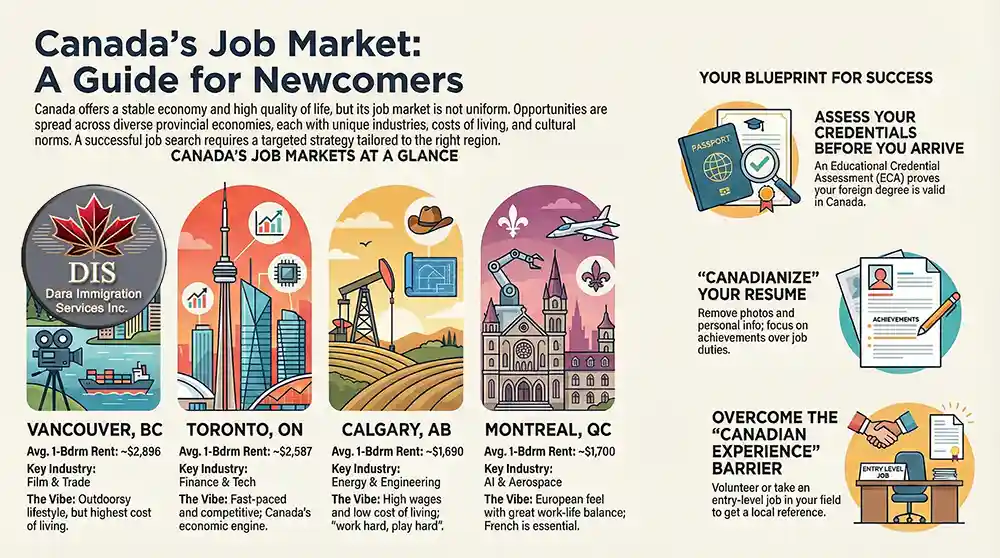
To find the best Jobs in Canada, you must target the region that needs your specific skills.
Ontario & Central Canada
Ontario is the economic engine of Canada, home to the largest number of multinational corporations and the financial district.
Ontario
- Economy & Labour Market: Diverse and robust. Key sectors include Finance (Toronto), Tech (Waterloo/Ottawa), and Automotive Manufacturing (Windsor).
- Lifestyle & Culture: Fast-paced and competitive. Professionals in Toronto work hard but enjoy a vibrant, multicultural city life.
- Climate Profile: Hot, humid summers (30°C) and cold, snowy winters (-10°C).
- Cost of Living: High. One-bedroom rents in Toronto average $2,587, meaning high salaries are necessary to maintain a comfortable lifestyle.
Quebec
- Economy & Labour Market: A powerhouse in Aerospace, Artificial Intelligence (AI), and Hydroelectricity.
- Lifestyle & Culture: Distinctly European with a strong focus on work-life balance.
- Language Requirement: French is the legal language of work. You generally need intermediate to fluent French to secure employment outside of Montreal’s tech bubbles.
- Cost of Living: Moderate. Montreal rents average $1,700, offering a significant cost advantage over Ontario.
British Columbia & The West
BC is the gateway to the Pacific, with an economy heavily tied to trade, film, and green technology.
British Columbia
- Economy & Labour Market: Dominated by the Port of Vancouver (Logistics), Film & TV (“Hollywood North”), and a growing Tech sector.
- Lifestyle & Culture: Health-conscious and outdoorsy. Professionals often value flexibility to enjoy the mountains and ocean.
- Climate Profile: The mildest in Canada. Rain is frequent, but snow in Vancouver is rare.
- Cost of Living: Very High. Vancouver rents average $2,896+, often requiring dual incomes for families to settle comfortably.
The Prairies (Alberta, Saskatchewan, Manitoba)
These provinces are the resource heartland, offering the highest average wages relative to the cost of living.
Alberta
- Economy & Labour Market: Anchored by Energy (Oil & Gas), but rapidly diversifying into Tech and Agriculture.
- Lifestyle & Culture: Entrepreneurial and independent. The “work hard, play hard” mentality is common here.
- Climate Profile: Sunny but very cold winters (-30°C is common).
- Cost of Living: Low. With no provincial sales tax and high wages, disposable income is often higher here than anywhere else.
Atlantic Canada
The four Atlantic provinces are actively recruiting skilled workers to combat an aging population.
The Maritimes (NS, NB, PEI)
- Economy & Labour Market: Historically fisheries, now pivoting to Ocean Tech, Shipbuilding, and Healthcare.
- Lifestyle & Culture: Community-focused and slower-paced. Employers value long-term retention over “hustle culture.”
- Cost of Living: Rising but attainable. Halifax rents are approx. $2,064, but home ownership remains more accessible than in big cities.
Job Market Comparison (2026)
Use this table to compare where your skills will go furthest.
| Region / City | Avg Rent (1-Bdrm) | Key Industry | Climate (Jan) | Notes |
| Toronto, ON | ~$2,587 | Finance / Tech | -5°C | Most jobs, highest competition. |
| Vancouver, BC | ~$2,896 | Film / Trade | +5°C | High “Sunshine Tax” on wages. |
| Montreal, QC | ~$1,700 | AI / Aerospace | -10°C | French required for most jobs. |
| Calgary, AB | ~$1,690 | Energy / Eng. | -12°C | Highest avg weekly earnings. |
| Halifax, NS | ~$2,064 | Ocean Tech | -4°C | High demand for healthcare. |
| Winnipeg, MB | ~$1,450 | Manufacturing | -18°C | Friendly PNP immigration paths. |
Comprehensive “How-To” Guide: Landing a Job
Finding work requires a strategic approach tailored to Canadian standards.
Pre-Arrival Preparation
- Canadianize Your Resume: Convert your CV to a Canadian-style resume. Remove photos, age, and marital status. Focus on “achievements” rather than just duties.
- Get Your Credentials Assessed: An Educational Credential Assessment (ECA) is vital to prove your foreign degree is equivalent to a Canadian one.
Your First Week
- Get Your SIN: You cannot legally work without a Social Insurance Number from Service Canada.
- Network Locally: 80% of jobs are in the “hidden job market.” Join local industry groups or attend networking mixers immediately.
Long-Term Career Growth
- Upskill: Canadian employers value continuous learning. Take short certificates or workshops to stay competitive.
- Volunteer: If you lack “Canadian Experience,” volunteering is a recognized and respected way to build local references.
Challenges Finding Jobs in Canada
Securing jobs in Canada is competitive, and newcomers face specific hurdles.
Challenge #1: The “Canadian Experience” Barrier
- The Reality: Employers often hesitate to hire workers without local history, fearing a lack of “soft skills” or cultural fit.
- The Strategy: Accept a “survival job” or a lower-level position in your field to get your foot in the door. Once you have one local reference, the barrier disappears.
Challenge #2: Credential Recognition
- The Reality: Regulated professions (Doctors, Engineers, Nurses, Electricians) require provincial licensing. You cannot just arrive and practice.
- The Strategy: Research the regulatory body for your profession before you fly. Start the licensing process from your home country if possible.
Frequently Asked Questions (FAQ)
- Do I need a job offer to immigrate?
No, not for all programs. Express Entry (Federal Skilled Worker) allows you to immigrate based on your skills (age, education, language) without a specific job offer, though having one adds points.
- What is an LMIA?
A Labour Market Impact Assessment (LMIA) is a document an employer must get to hire a foreign worker. It proves there is no Canadian worker available to do the job.
- Can I work in Canada on a Visitor Visa?
No. You are strictly prohibited from working on a visitor visa. You must apply for and receive a valid Work Permit before starting any employment.
- What are the highest paying jobs in Canada?
Specialized medical specialists, senior software architects, engineering managers, and mining executives consistently rank as the highest-paid roles.
- Is it easy to find jobs in Canada?
It depends on your sector. High-demand fields like Healthcare, Construction, and Tech have shortages. However, general administrative or entry-level roles are highly competitive.
Professional Immigration Assistance
Your career is your most valuable asset. Don’t let a rejected work permit application or a misunderstanding of labour laws derail your future. The rules for Jobs in Canada—especially regarding LMIAs and work permits—are complex and strictly enforced.
Ensure your path to employment is secure. Contact Dara Immigration Services today for a professional assessment.
Disclaimer: This article provides general information regarding employment and work permits in Canada. It does not constitute legal or career advice.
Download:
Download the bulletin of Jobs in Canada as a PDF.
Download “Jobs-in-Canada-Bulletin-2026-2027.pdf” Jobs-in-Canada-Bulletin-2026-2027.pdf – Downloaded 29 times – 1.60 MB