Immigrate to Canada
Immigrate to Canada Overview 2026-2027
To Immigrate to Canada is to make one of the most significant investment decisions of your life. It is not merely a change of address; it is a transition into a society that values multiculturalism, safety, and economic stability. For the 500,000 permanent residents arriving in 2026, Canada offers a pathway to citizenship that is faster and more transparent than almost any other G7 nation.

However, the journey is complex. The era of “first-come, first-served” is over. Today, successful candidates must navigate a highly competitive, data-driven system that prioritizes specific skills—like healthcare, trades, and French proficiency. Furthermore, the reality of the high cost of living means that financial preparation is just as important as your visa application.
At Dara Immigration Services, we look beyond the paperwork. This guide is your blueprint to Immigrate to Canada successfully, ensuring you understand not just how to get here, but how to thrive once you arrive.
Strategic Overview: How to Immigrate to Canada
The Canadian immigration system is designed to select candidates who can contribute to the economy immediately. It operates primarily on a “points system” (Express Entry) and a “nomination system” (Provincial Nominee Programs).
When you plan to Immigrate to Canada, you must understand that the federal government sets the targets (approx. 500,000 per year), but the provinces increasingly decide who gets selected based on local labour shortages.
Quick Facts: Immigrate to Canada at a Glance
- Annual Target: Approx. 500,000 New Permanent Residents (2026).
- Primary System: Express Entry (Federal) & PNPs (Provincial).
- Processing Time: 6 to 12+ Months (varies by stream).
- Cost of Living: High in urban centres; Moderate in rural areas.
- Citizenship Pathway: Eligible after living in Canada for 3 out of 5 years.
- Key Requirement: Language Test (IELTS/CELPIP/TEF) & Educational Credential Assessment (ECA).
Regional Opportunities When You Immigrate to Canada
Canada is a massive country with five distinct economic regions. Your experience when you Immigrate to Canada will depend entirely on where you land.
Central Canada (Ontario & Quebec)
The majority of newcomers choose this region for its robust job market and established cultural communities.
Ontario
- Economy: The financial and tech capital. Home to 50% of new immigrants.
- Lifestyle: Fast-paced and urban. Toronto is a global city with unmatched diversity.
- Cost of Living: Very High. Expect to pay $2,650+ for a one-bedroom apartment in Toronto.
- Why Immigrate Here: Maximum career growth in Finance, IT, and Engineering.
Quebec
- Economy: Aerospace, AI, and Hydroelectricity.
- Lifestyle: Distinctly Francophone. A European work-life balance with affordable childcare ($9/day).
- Cost of Living: Moderate. Rents are significantly lower than Toronto.
- Why Immigrate Here: If you speak French, this is the easiest pathway to PR.
Western Canada (British Columbia & Alberta)
A region defined by natural resources and stunning landscapes.
British Columbia
- Economy: Green Tech, Film, and Trade with Asia.
- Lifestyle: Health-conscious and outdoorsy. Winters are mild (rainy), not snowy.
- Cost of Living: Extreme. Vancouver has the highest housing costs in Canada.
- Why Immigrate Here: For the lifestyle and the tech sector.
Alberta
- Economy: Energy (Oil & Gas), Agriculture, and Tech.
- Lifestyle: Entrepreneurial and young.
- Cost of Living: Affordable. No Provincial Sales Tax and high wages make it a financial haven.
- Why Immigrate Here: To build wealth quickly.
The Prairies & Atlantic Canada
These regions are actively recruiting immigrants to solve demographic challenges.
Saskatchewan & Manitoba
- Economy: Agriculture and Mining.
- Lifestyle: Community-focused. Winters are harsh (-30°C), but neighbors help each other.
- Why Immigrate Here: Easier PNP pathways for those with lower CRS scores.
Atlantic Canada (NS, NB, PEI, NL)
- Economy: Ocean Tech, Shipbuilding, and Fisheries.
- Lifestyle: Slower pace, friendly, and traffic-free.
- Why Immigrate Here: The Atlantic Immigration Program (AIP) offers a streamlined path for those with job offers.
Costs of Immigrating to Canada (2026)
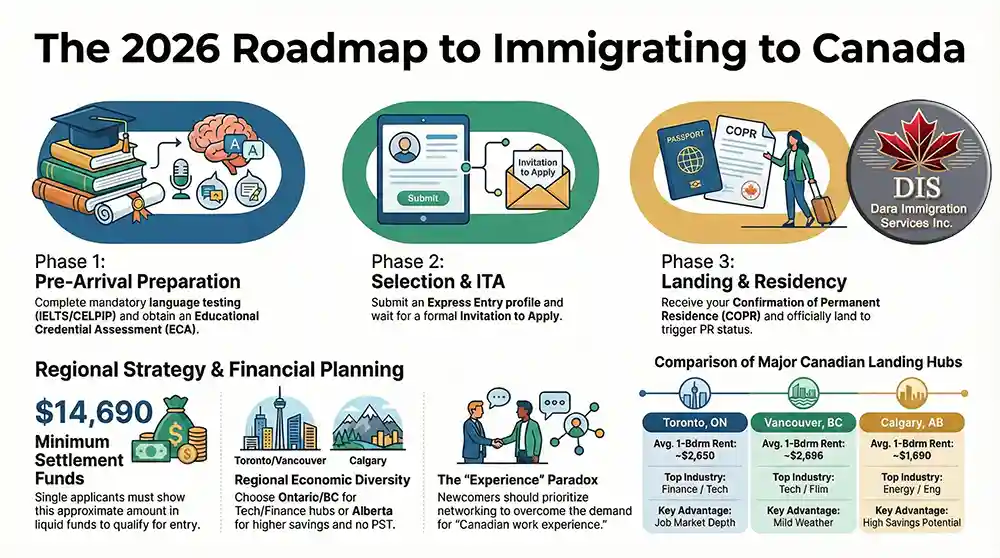
Financial planning is critical. Use this table to estimate your first year.
| Region | Avg Rent (1-Bdrm) | Top Industry | Climate (Jan) | Key Advantage |
| Toronto, ON | ~$2,650 | Finance / Tech | -5°C | Job Market Depth |
| Vancouver, BC | ~$2,896 | Tech / Film | +5°C | Mild Weather |
| Calgary, AB | ~$1,690 | Energy / Eng | -12°C | High Savings Potential |
| Montreal, QC | ~$1,700 | AI / Aero | -10°C | Cultural Richness |
| Halifax, NS | ~$1,700 | Ocean Tech | -5°C | AIP Stream |
Note: You must also show Proof of Funds (Settlement Funds) to the government, approx. $14,690 for a single applicant (2026 estimate).
“How-To” Guide: Necessary Steps to Immigrate to Canada
The process is methodical. Here is the roadmap to Immigrate to Canada successfully.
Phase 1: Preparation (Pre-Arrival)
- Language Testing: Take your IELTS (General) or CELPIP immediately. You cannot create a profile without these scores.
- Credential Assessment (ECA): Send your foreign degree to WES or ICAS to prove it is equivalent to a Canadian degree.
- Check Eligibility: Determine if you fit into Express Entry (Federal) or need a Provincial nomination (PNP).
Phase 2: The Application
- Create Profile: Submit your Expression of Interest (EOI) to the pool.
- Wait for ITA: If your score is high enough, you will receive an Invitation to Apply (ITA).
- Submit Documents: You have 60 days to upload police certificates, medical exams, and proof of work experience.
Phase 3: Arrival (Landing)
- COPR: Receive your Confirmation of Permanent Residence.
- Port of Entry: Land in Canada. The officer will sign your COPR, making you a permanent resident officially.
- PR Card: Your physical card will be mailed to your Canadian address within months.
Challenges of Immigrating to Canada
To Immigrate to Canada is a privilege, but it comes with real-world hurdles.
Challenge #1: The “Canadian Experience” Paradox
- The Reality: Highly skilled immigrants often struggle to find their first job because employers ask for “Canadian experience.”
- The Strategy: Accept a “survival job” or a lower-level position initially to get your foot in the door. Network aggressively on LinkedIn.
Challenge #2: The Housing Crisis
- The Reality: Vacancy rates in major cities are under 1.5%. Finding a rental can take weeks and may require paying months of rent upfront.
- The Strategy: Consider “secondary cities” (like London, ON or Kelowna, BC) where housing competition is slightly lower.
Challenge #3: Credential Recognition
- The Reality: Doctors, nurses, and engineers cannot practice immediately. You must undergo a lengthy re-licensing process.
- The Strategy: Research the licensing body for your profession before you leave your home country. Start the paperwork early.
Frequently Asked Questions (FAQs)
- What is the age limit to Immigrate to Canada?
There is no strict age limit. However, the Express Entry system strips you of age points after 30, reaching zero points by age 45. Older applicants often need a job offer or business visa to succeed.
- Can I Immigrate to Canada without a job offer?
Yes. The Express Entry system (Federal Skilled Worker) does not require a job offer if your CRS score is high enough based on age, education, and language skills.
- How much money do I need to Immigrate to Canada?
For a single applicant under Express Entry, you need to show approx. $14,690 CAD in liquid funds. For a family of four, it is approx. $27,297 CAD. This does not apply if you are working in Canada or have a valid job offer.
- How long does it take to get PR?
Through Express Entry, processing takes about 6 months after you submit your full application. PNPs can take longer (12-18 months) due to the two-step provincial/federal process.
- Is healthcare free for immigrants?
Yes, for Permanent Residents. However, most provinces have a waiting period (up to 3 months) after you arrive before coverage begins. You should buy private insurance for this gap.
Professional Immigration Assistance
The decision to Immigrate to Canada is complex because the rules change frequently. A slight error in your National Occupational Classification (NOC) code or a miscalculation of your points can result in a refusal and a ban for misrepresentation.
Ensure your future is secure. Contact Dara Immigration Services today for a comprehensive strategy session.
Disclaimer: This article provides general information regarding immigration to Canada. It does not constitute legal advice.
Download:
Download the bulletin of Immigrate to Canada as a PDF.
Download “Immigrate-to-Canada-Bulletin-2026-2027.pdf” Immigrate-to-Canada-Bulletin-2026-2027.pdf – Downloaded 97 times – 1.44 MB