Canadian Experience Class
Canadian Experience Class Overview 2026-2027
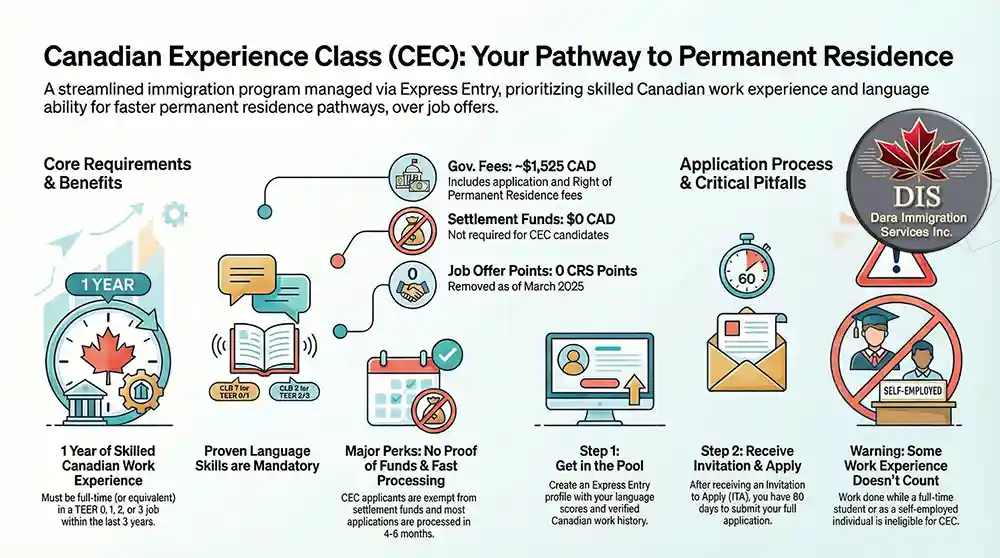
The Canadian Experience Class (CEC) is the preferred immigration pathway for temporary foreign workers and international graduates who have already put down roots in Canada. If you are currently working here or have recently done so, you have a significant advantage: you have already proven your value to the Canadian economy.

However, the 2026 landscape has shifted. With the removal of CRS points for job offers (March 2025), simply “having a job” is no longer a guarantee of invitation. Today, the CEC is a highly competitive stream where your English/French skills and skilled work history are the primary drivers of your success.
At Dara Immigration Services, we specialize in converting your hard-earned Canadian work history into Permanent Residence. Whether you are on a PGWP or a closed work permit, this guide is your roadmap to maximizing your profile for the next draw.
Key Takeaways (Quick Summary):
- No “Proof of Funds”: Unlike FSW, CEC candidates do not need to show settlement savings to apply.
- Job Offer Points Removed: As of 2025, holding a valid job offer adds 0 CRS points directly (though it may qualify you for a PNP).
- Student Work Excluded: Work done while you were a full-time student (co-op or off-campus) does not count toward the 1-year requirement.
- The “3-Year” Window: Your skilled work experience must have been obtained within the 3 years prior to applying.
What is the Canadian Experience Class?
The Canadian Experience Class (CEC) is a federal immigration program managed under the Express Entry system. It is designed specifically for workers who have already adapted to Canadian life.
Why is CEC the “Gold Standard” for PR?
- High Approval Rate: Because candidates have Canadian history, refusal rates are generally lower than FSW.
- Fast Processing: Most complete CEC applications are processed in 5 to 6 months.
- Location Flexibility: You can apply from inside Canada (while working) or outside Canada (if you returned home recently), provided your experience is from the last 3 years.
Canadian Experience Class Eligibility Requirements
To enter the Express Entry pool under the Canadian Experience Class, you must meet strict “pass/fail” criteria.
1. Canadian Skilled Work Experience
You must have at least 1 year of full-time work experience (or the equivalent in part-time) in Canada.
- Timeline: Must be within the last 3 years.
- Status: You must have had valid temporary resident status (e.g., a work permit) during this time. Work done without authorization (or while on a study permit) does not count.
- Job Level: Must be in TEER 0, 1, 2, or 3 of the National Occupational Classification (NOC).
- TEER 0: Management.
- TEER 1: Professionals (Degree required).
- TEER 2/3: Technical jobs and skilled trades.
2. Language Proficiency (CLB)
You must take an approved language test (CELPIP, IELTS General, PTE Core, or TEF/TCF).
- For TEER 0 or 1 jobs: Minimum CLB 7 in all four abilities.
- For TEER 2 or 3 jobs: Minimum CLB 5 in all four abilities.
3. Education (Optional but Recommended)
There is no minimum education requirement for CEC eligibility.
- Strategy Note: To have a competitive CRS score, you almost certainly need to provide an ECA Report for foreign degrees or proof of your Canadian education.
Costs, CRS Scores & Timelines (2026 Estimates)
Note: The CRS cut-off for CEC-specific draws is often lower than “All-Program” draws.
| Category | Fee / Metric | Notes |
| Processing Fee | $950 CAD | Payable after receiving an ITA. |
| Right of Permanent Residence Fee | $575 CAD | Payable before approval. Total: ~$1,525. |
| Biometrics Fee | $85 CAD | Required once every 10 years. |
| Settlement Funds | $0 CAD | Exempt for CEC candidates. |
| Arranged Employment Points | 0 Points | Job offers no longer grant 50/200 points (since March 2025). |
| Processing Time | 4 – 6 Months | One of the fastest PR pathways. |
Canadian Experience Class Step-by-Step Application Process
Securing PR through the Canadian Experience Class involves entering a pool of candidates and waiting for an invitation.
Step 1: Validate Your NOC/TEER Code
Confirm your Canadian job falls under TEER 0, 1, 2, or 3.
- Warning: If your reference letter duties match a TEER 4 or 5 job (e.g., server, cleaner), you are ineligible for CEC.
Step 2: Ace the Language Test
Book your test. Even if you are fluent, prepare for the format. A higher score equals a higher CRS ranking.
Step 3: Create Your Express Entry Profile
Log in to your GCKey account. Enter your work history, education, and language results.
- Result: You are given a CRS score and placed in the pool.
Step 4: Wait for the ITA (Invitation to Apply)
IRCC conducts draws roughly every two weeks.
- General Draws: High score required.
- Category-Based Selection: Targeted draws for French speakers, Healthcare, STEM, Trades, Transport, and Agriculture.
Step 5: Submit the eAPR (Electronic Application)
Once invited, you have 60 days to upload your medicals, police certificates, and employment letters proving your Canadian Experience Class eligibility.
Canadian Experience Class Risks and Refusals
The most common reasons for Canadian Experience Class refusals stem from misunderstanding what counts as “valid” experience.
1. The “Student Work” Exclusion
Rule: Work experience gained while you were a full-time student does not count for CEC.
- Scenario: You worked 40 hours/week during a summer break while at university.
- Result: This cannot be used for the 1-year requirement. Only work done after graduation (and after applying for a PGWP) counts.
2. Self-Employment is Ineligible
Rule: Self-employment inside Canada generally does not count for CEC.
- Scenario: You are a graphic designer on a PGWP, but you freelance for multiple clients and invoice them directly without T4 slips.
- Result: This experience is usually rejected. You must be an “employee” with a standard employer-employee relationship.
3. “Implied” Status Gaps
If you worked while on “Maintained Status” (waiting for a permit extension), that work does count. However, if your status expired and you worked without authorization, that period cannot be counted.
Frequently Asked Questions (FAQ)
- Does my LMIA job offer give me CRS points?
No. As of 2025, valid job offers (LMIA or Exempt) award 0 CRS points. However, holding such a job is still valuable as it helps you qualify for the program and may make you eligible for a Provincial Nominee Program (PNP), which awards +600 points.
- Can I combine multiple jobs to meet the 1-year requirement?
Yes. You can work two part-time jobs simultaneously (e.g., 15 hours + 15 hours = 30 hours/week) or work different jobs back-to-back. The key is reaching 1,560 hours of total skilled work within 52 weeks.
- Does refugee claimant work experience count?
No. Experience gained while waiting for a refugee decision is not considered “temporary resident status” for the Canadian Experience Class. You must hold a valid work permit (e.g., PGWP, LMIA).
- Can I move to another province after applying?
Yes, you have mobility rights under the Charter. However, you cannot intend to live in Quebec, as Quebec has its own immigration system (PEQ).
- What if I lose my job after receiving an ITA?
Since CEC is based on past experience, losing your current job usually does not affect your eligibility, provided you already attained the 1-year minimum.
Professional Immigration Assistance
The Canadian Experience Class looks simple on paper, but the removal of job offer points means every other part of your profile must be perfect.
Don’t let 11 months and 3 weeks of work count as a full year in your mind, only to be rejected by IRCC. Contact Dara Immigration Services today. We calculate your hours, verify your TEER, and optimize your profile for the next draw.
Disclaimer: This article provides general information regarding the Canadian Experience Class and does not constitute legal advice. Policies change frequently.
Download:
Download the bulletin of Canadian Experience Class as a PDF.
Download “Canadian-Experience-Class-Bulletin-2026-2027.pdf” Canadian-Experience-Class-Bulletin-2026-2027.pdf – Downloaded 40 times – 1.61 MB