Canadian Federal Skilled Trades Program
Canadian Federal Skilled Trades Program Overview 2026-2027
For skilled tradespeople globally, the Canadian Federal Skilled Trades Program (FSTP) is the most direct pathway to building a permanent life in Canada. With the country facing a historic shortage of electricians, plumbers, welders, and constructors, the government has rolled out the red carpet for hands-on talent.
However, qualifying is not as simple as knowing your trade. In 2026, the challenge isn’t just proving your skills; it’s navigating the specific certification requirements of Canadian provinces. Without a provincial Certificate of Qualification or a valid LMIA job offer, your application will stall before it even begins.
At Dara Immigration Services, we specialize in helping tradespeople cross the border. Whether you are a pipefitter in the UK or a chef in India, this guide is your roadmap to leveraging the Canadian Federal Skilled Trades Program to secure Permanent Residence.
Key Takeaways (Quick Summary):
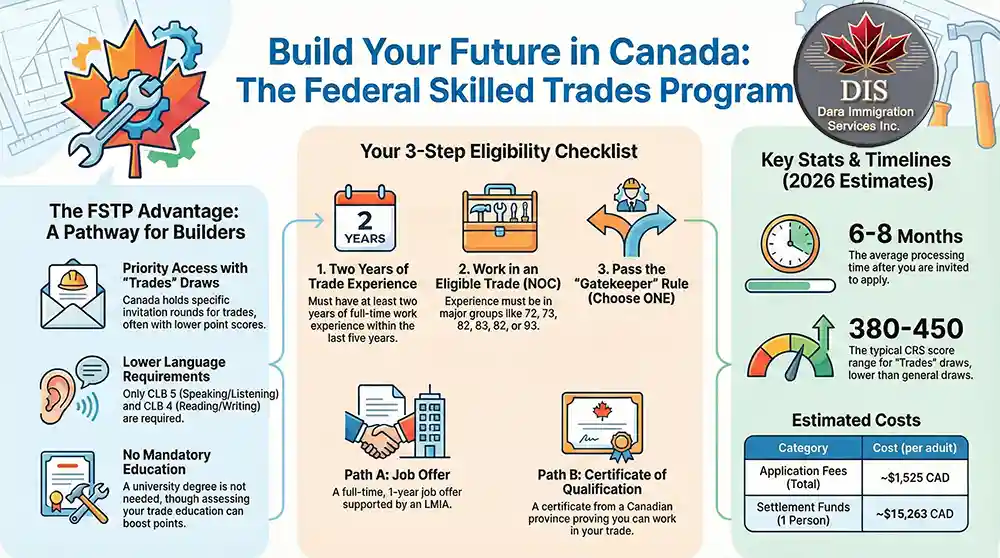
- Category-Based Priority: IRCC now holds specific “Trades” draws with lower score requirements than general draws.
- Lower Language Bar: Unlike other programs, FSTP requires only CLB 5 (Speaking/Listening) and CLB 4 (Reading/Writing).
- The “Gatekeeper” Rule: You must have either a valid 1-year job offer (LMIA) OR a Canadian provincial Certificate of Qualification to apply.
- No Education Requirement: While not mandatory, having your foreign trade school assessed (ECA) is highly recommended to boost your ranking.
What is the Canadian Federal Skilled Trades Program?
The Canadian Federal Skilled Trades Program is one of the three economic immigration programs managed by Express Entry. It is exclusively designed for individuals qualified in a skilled trade who want to become Permanent Residents.
Why Canadian Federal Skilled Trades Program (FSTP) is Unique
Most immigration programs favor university degrees and office jobs. The Canadian Federal Skilled Trades Program values technical skill.
- The Advantage: Because tradespeople often have lower language scores or no university degree, this program lowers the entry barriers to ensure Canada gets the builders and makers it needs.
- The “Trades” Draw: Under the Category-Based Selection system, IRCC specifically invites candidates with experience in groups like Construction, Transport, and Agriculture, often bypassing higher-scoring “general” candidates.
Canadian Federal Skilled Trades Program Eligibility Requirements
To qualify, you must meet specific “Pass/Fail” criteria.
1. Eligible Trade Categories (NOC)
Your work experience must fall under specific Major Groups of the National Occupational Classification (NOC):
- Major Group 72: Technical trades and transportation officers (e.g., Electricians, Plumbers).
- Major Group 73: General trades (e.g., Carpenters, Roofers).
- Major Group 82: Supervisors in natural resources/agriculture.
- Major Group 83: Occupations in natural resources (e.g., Mining).
- Major Group 92: Processing/manufacturing supervisors.
- Major Group 93: Central control and process operators (e.g., Cooks, Butchers, Bakers).
2. Work Experience
You must have at least 2 years of full-time work experience (or the equivalent in part-time) in your skilled trade.
- Timeline: Must be within the 5 years before you apply.
- Compliance: You must show you performed the essential duties described in the NOC.
3. The “Gatekeeper” (Job or Certificate)
This is the hardest part. You must have ONE of the following:
- A Valid Job Offer: A continuous, paid, full-time employment offer (for at least 1 year) from up to two Canadian employers, supported by an LMIA.
- OR
- A Certificate of Qualification: A certificate issued by a Canadian provincial body (e.g., Skilled Trades Ontario, Red Seal) proving you are qualified to work in that trade in Canada.
4. Language Proficiency
- Speaking & Listening: Minimum CLB 5.
- Reading & Writing: Minimum CLB 4.
Costs, Funds & Timelines (2026 Estimates)
Note: While job offers do not give CRS points directly (as of 2025), they are often essential for FSTP eligibility.
| Category | Fee / Metric | Notes |
| Processing Fee | $950 CAD | Per adult. Paid post-ITA. |
| Right of Permanent Residence | $575 CAD | Per adult. Total ~$1,525. |
| Biometrics Fee | $85 CAD | Required once every 10 years. |
| Processing Time | 6 – 8 Months | Standard Express Entry timeline. |
| Settlement Funds (1 Person) | ~$15,263 CAD | Exempt if you have a valid work permit/job offer. |
| Typical CRS Score (Trades) | 380 – 450 | Significantly lower than “General” draws. |
Canadian Federal Skilled Trades Program Step-by-Step Application Process
Applying for the Canadian Federal Skilled Trades Program requires a strategic approach to certification.
Step 1: Determine Your Path (Offer vs. Certificate)
Most overseas applicants do not have a job offer. Therefore, your first step is usually contacting the Provincial Apprenticeship Body (e.g., in Alberta or Ontario) to challenge the trade exam and get your Certificate of Qualification.
Step 2: Take the Language Test
Book your CELPIP-General or IELTS-General. Aim higher than CLB 5 if possible to boost your CRS score.
Step 3: Create Express Entry Profile
Submit your profile under the Canadian Federal Skilled Trades Program.
- Strategy: Even though education is not required, we strongly advise getting an ECA Report for any diploma you have. Without it, your CRS score may be too low even for a Trades draw.
Step 4: Wait for a Category-Based Draw
IRCC holds specific draws for “Trade Occupations.” Watch for your NOC code to be listed.
Step 5: Submit Your Application (eAPR)
Once invited (ITA), you have 60 days to upload your proofs.
- Crucial: If claiming a Certificate of Qualification, you must upload the actual certificate issued by the province, not just a trade school diploma.
Canadian Federal Skilled Trades Program Risks and Refusals
Canadian Federal Skilled Trades Program applications are scrutinized for safety and certification compliance.
1. The “Red Seal” Confusion
- The Issue: Applicants assume their foreign trade license is enough.
- The Reality: It is not. Canada is strict about regulated trades (e.g., Electrician). You generally cannot practice—or qualify for FSTP via the certificate route—without being assessed by a Canadian province.
2. Job Duties Mismatch
- The Issue: Your job title is “Construction Manager” (TEER 0), but FSTP is for “Constructors/Carpenters” (TEER 2/3).
- The Reality: Management roles generally fall under Federal Skilled Worker, not Trades. Ensure your NOC matches a hands-on trade.
3. Proof of Funds
- The Issue: Relying on a job offer that isn’t LMIA-supported to waive the funds requirement.
- The Reality: Only a valid LMIA-supported offer (or specific exempt offers) allows you to bypass showing settlement funds.
Frequently Asked Questions (FAQ)
- Do I need a Red Seal to apply?
Not necessarily, but it helps. You need a Certificate of Qualification from a province. The Red Seal is a national endorsement that sits on top of the provincial certificate, allowing you to work anywhere in Canada.
- Can I apply for FSTP without a job offer?
Yes, IF you have a provincial Certificate of Qualification. If you have neither a job offer nor a Canadian certificate, you are not eligible for the Canadian Federal Skilled Trades Program.
- Does my experience need to be continuous?
No. Unlike the Federal Skilled Worker Program, the Canadian Federal Skilled Trades Program allows your 2 years of experience to be cumulative (e.g., two separate 1-year contracts) within the last 5 years.
- Is there an education requirement?
No. However, in the Express Entry pool, you get 0 points for education if you don’t provide an ECA. We highly recommend assessing your trade certificate to improve your ranking.
- Can I live in Quebec?
No. The FSTP is for residents intending to live outside Quebec. Quebec selects its own tradespeople through the Quebec Regular Skilled Worker Program (QSWP).
Professional Immigration Assistance
The Canadian Federal Skilled Trades Program is a powerful tool, but it requires navigating the complex web of provincial trade regulations before you even enter the Express Entry pool.
Don’t let a missing certificate keep you off the job site. Contact Dara Immigration Services today. We help you navigate the provincial certification process and build a profile that gets you invited.
Disclaimer: This article provides general information regarding the FSTP and does not constitute legal advice. Policies change frequently.
Download:
Download this bulletin of Canadian Federal Skilled Trades Program as a PDF.
Download “Federal-Skilled-Trades-Program-Bulletin-2026-2027.pdf” Federal-Skilled-Trades-Program-Bulletin-2026-2027.pdf – Downloaded 216 times – 2.22 MB