Canadian Rural Community Immigration Pilot
Canadian Rural Community Immigration Pilot Overview 2026-2027
For many, the “Canadian Dream” isn’t found in the skyscrapers of Toronto or Vancouver, but in the welcoming, tight-knit communities that form the heart of this country. The Canadian Rural Community Immigration Pilot (RCIP) is the federal government’s answer to this aspiration, offering a streamlined pathway to Permanent Residence for skilled workers willing to settle in specific rural regions.
Unlike the fierce competition of Express Entry, this pilot is community-driven. If a participating town like Moose Jaw, Saskatchewan, or Sudbury, Ontario, wants you, they can recommend you for Permanent Residence directly to the federal government.
At Dara Immigration Services, we specialize in connecting your skills with the communities that need them most. We navigate the dual-layer application process—securing the Community Recommendation first, then the federal visa—to ensure your move to rural Canada is smooth and successful.
Key Takeaways (Quick Summary):
- Successor to RNIP: The Canadian Rural Community Immigration Pilot replaces the old “Rural and Northern Immigration Pilot” (closed in 2024) and is now a permanent fixture.
- Community Specific: You cannot just “apply to the pilot.” You must apply to a specific participating community.
- Job Offer Mandatory: You must have a genuine job offer from a local employer within the community boundaries.
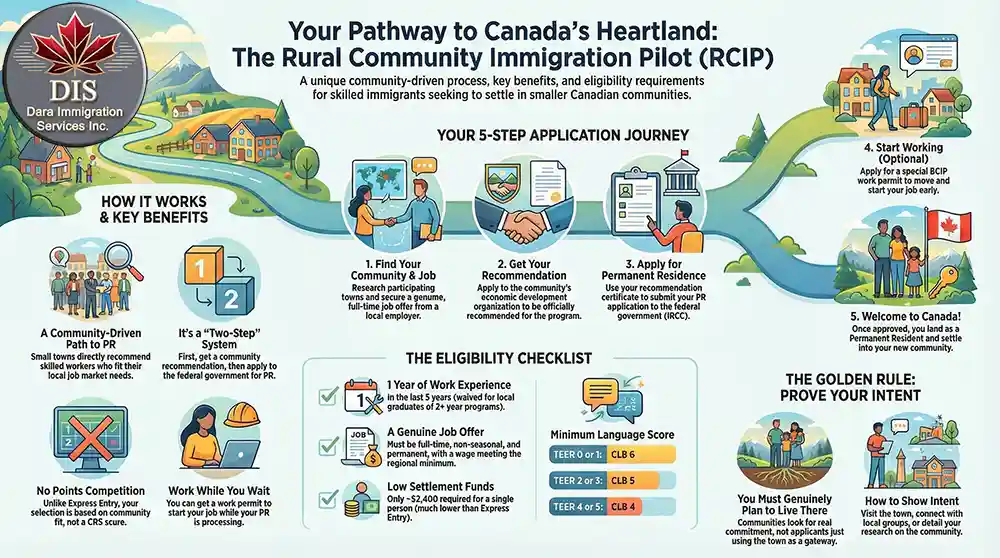
- Intention to Reside: You must prove you genuinely intend to live in that specific town, not just use it as a backdoor to a big city.
What is the Canadian Rural Community Immigration Pilot?
The Canadian Rural Community Immigration Pilot is an economic immigration program designed to spread the benefits of immigration to smaller communities. It empowers participating towns to “vouch” for candidates who fit their local labour market needs.
How It Works (The “Two-Step” System)
- Community Level: You find a job in a participating community (e.g., Vernon, BC) and apply for a “Community Recommendation.”
- Federal Level: Once recommended, you apply to IRCC for Permanent Residence. Because the community has already vetted you, IRCC processing is generally faster than standard paper-based streams.
Why Choose the Canadian Rural Community Immigration Pilot?
- Lower CRS Pressure: There is no point competition against thousands of others. If the community selects you, you are in.
- Work Permit Bridge: You can often get a 1-year work permit to start working while your PR application processes.
- Family Friendly: These communities offer affordable housing and a lower cost of living compared to major urban centers.
Canadian Rural Community Immigration Pilot Eligibility Requirements
To qualify, you must meet both the federal eligibility standards AND the specific criteria of the community you are applying to.
1. Work Experience
You need 1 year of continuous work experience (1,560 hours) in the last 3 years.
- Flexibility: The experience does not need to be in the same occupation as your job offer, but it must be at a similar TEER level.
- International Student Exemption: If you graduated from a public post-secondary institution in the community (2+ year program) and lived there during your studies, you are exempt from the work experience requirement.
2. The Job Offer
The offer must be from an employer located within the community boundaries.
- Terms: Full-time, non-seasonal, and permanent (indeterminate).
- Wage: Must meet the Job Bank minimum for that occupation in that region.
3. Education
- Minimum: A Canadian High School Diploma (or foreign equivalent with an ECA).
- Note: Some communities may require higher education for specific roles.
4. Language Proficiency
The requirement depends on the TEER level of the job offer:
- TEER 0 or 1: CLB 6.
- TEER 2 or 3: CLB 5.
- TEER 4 or 5: CLB 4.
5. Settlement Funds
You must prove you have enough money to support yourself and your family, unless you are already working legally in Canada.
- Amount: Approx. $2,400 for a single person (significantly lower than Express Entry).
Participating Communities & Costs (2026)
Note: Each community manages its own “intake periods” and may charge a small processing fee for the recommendation.
Participating Communities (Selected List)
- British Columbia: Vernon, West Kootenay (Trail, Castlegar, Rossland), North Okanagan-Shuswap.
- Alberta: Claresholm.
- Saskatchewan: Moose Jaw.
- Manitoba: Brandon, Altona/Rhineland, Steinbach.
- Ontario: North Bay, Sudbury, Timmins, Sault Ste. Marie, Thunder Bay.
Fees & Timelines
| Category | Fee / Metric | Notes |
| Federal PR Fee | $950 CAD | Paid to IRCC. |
| Community Fee | $0 – $500 | Varies by town (some are free). |
| RPRF (Landing Fee) | $575 CAD | Paid to IRCC. |
| Processing Time | 12 – 16 Months | Federal stage. |
| Recommendation Time | 1 – 3 Months | Community stage (varies by local committee). |
Canadian Rural Community Immigration Pilot Step-by-Step Application Process
Securing PR through the Canadian Rural Community Immigration Pilot is a localized process.
Step 1: Choose Your Community
Do not apply blindly. Research the 15+ participating communities. Which one fits your lifestyle? Where is your occupation in demand?
Step 2: Secure a Job Offer
This is the hardest part. You must apply to employers in that specific town.
- Tip: Look for the community’s official Canadian Rural Community Immigration Pilot portal (e.g., “North Bay RNIP/RCIP Job Board”). Employers listed there are already vetted.
Step 3: Apply for Recommendation
Submit your application to the Community Economic Development Organization. They assess your “intent to reside” and labour market fit.
- Result: You receive a Recommendation Certificate.
Step 4: Submit Federal PR Application
Use the recommendation to apply for Permanent Residence through the IRCC portal.
Step 5: Apply for Work Permit (Optional)
While waiting for PR, you can apply for an RCIP-specific work permit (LMIA-exempt) to move to the community and start working immediately.
Canadian Rural Community Immigration Pilot Risks and Refusals
The pilot is community-focused, and “intent” is the primary filter.
1. “Parachute” Applicants
- The Issue: Applying to Moose Jaw while living in Toronto, with no visit history or connection.
- The Refusal: The community committee will likely reject you for lacking a genuine “Intent to Reside.” You must show you want to live there (e.g., previous visits, family ties, detailed knowledge of the town).
2. Job Offer Mismatch
- The Issue: The employer offers a wage below the regional median, or the business has no history of hiring.
- The Reality: Communities vet employers strictly to prevent fraud. If the employer isn’t compliant, your recommendation is denied.
3. Leaving the Community Early
- The Risk: If you get PR and move away immediately, IRCC can investigate you for misrepresentation regarding your initial intent.
Frequently Asked Questions (FAQ)
- Can I apply to multiple communities?
Technically yes, but it is not recommended. It signals that you are desperate for any visa, rather than committed to a specific community. Committees prioritize candidates who show exclusive interest in their town.
- Is this different from the Atlantic Immigration Program?
Yes. The AIP is for the four Atlantic provinces. The Canadian Rural Community Immigration Pilot covers specific rural towns in Ontario, Western Canada, and the Territories. The processes are similar (employer-driven), but the locations differ.
- Do I need an LMIA for Canadian Rural Community Immigration Pilot?
No. The job offer for Canadian Rural Community Immigration Pilot is LMIA-exempt. This makes you much more attractive to local employers who want to avoid the $1,000 LMIA fee and advertising requirements.
- Can I buy a house to prove intent?
It helps, but it is not required (and often risky before PR). Better proof of intent includes visiting the town, connecting with local settlement groups, or enrolling children in local schools.
- What happens if I lose my job after getting the recommendation?
If you haven’t applied for PR yet, you lose the recommendation. If you have already applied for PR, you must inform IRCC. Depending on the timing, you may need to find a new eligible job in the same community to keep your application alive.
Professional Immigration Assistance
The Canadian Rural Community Immigration Pilot is one of the most “human” immigration programs—success depends on convincing a local committee that you are a good neighbor, not just a skilled worker.
Don’t treat this like a generic application. Contact Dara Immigration Services today. We help you build a “Community Fit” strategy that proves your commitment to rural life.
Disclaimer: This article provides general information regarding the Canadian Rural Community Immigration Pilot and does not constitute legal advice. Policies change frequently.
Download:
Download the bulletin of Canadian Rural Community Immigration Pilot as a PDF.
Download “Rural-Community-Immigration-Pilot-Bulletin-2026-2027.pdf” Rural-Community-Immigration-Pilot-Bulletin-2026-2027.pdf – Downloaded 211 times – 1.61 MB