Family Sponsorship
Family Sponsorship in Canada Overview 2026-2027
The “Canadian Dream” is incomplete without the people you love. For many Permanent Residents and Citizens, the ultimate goal isn’t just a better job or a safe home—it’s bringing their spouse, children, or parents to join them. Family Sponsorship in Canada is the federal pathway designed to make this reunion possible.
However, the stakes are incredibly high. A refused sponsorship application isn’t just a paperwork error; it can mean years of separation or a ban for “Marriage Fraud.” In 2026, with the Parents and Grandparents Program (PGP) intake strictly limited, navigating the correct stream is more critical than ever.
At Dara Immigration Services, we treat family reunification with the urgency it deserves. We help you navigate the complex proofs of relationship and financial undertakings to ensure your family lands in Canada—for good.
Key Takeaways (Quick Summary):
- No Income Requirement (Spousal): You generally do not need to meet a minimum income to sponsor a spouse or child (unless they have their own children).
- The “Undertaking”: You are legally signing a contract to support your family member for 3 to 20 years, even if you divorce or separate.
- PGP Status (2026): The Parents and Grandparents Program remains closed to new applicants. The Super Visa is the primary alternative.
- Open Work Permit: Spouses applying from inside Canada can usually get an Open Work Permit while waiting for the decision.
Who Can You Sponsor?
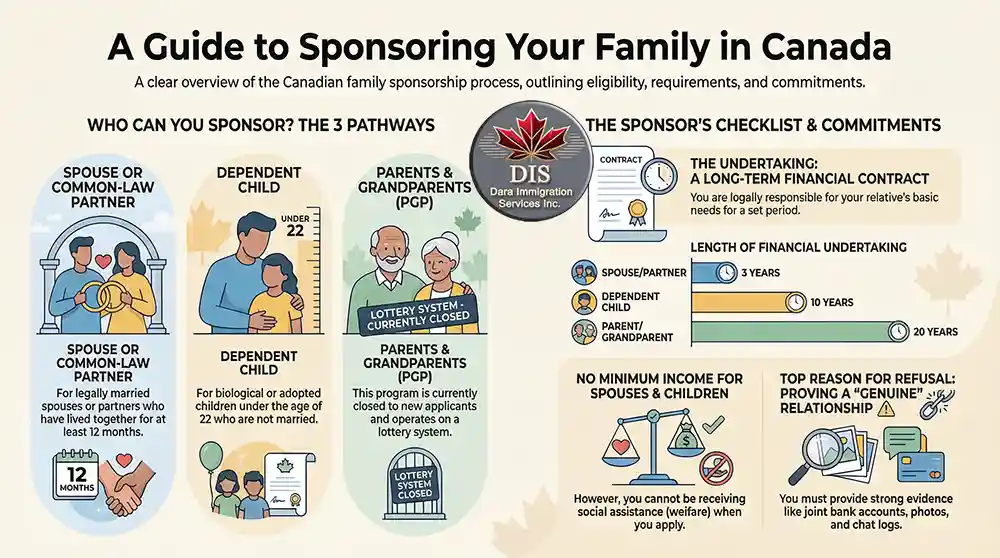
Canada’s family class is divided into three distinct categories, each with its own rules and processing times.
1. Spousal & Common-Law Sponsorship
- Who: Your legally married spouse, common-law partner (lived together for 12 months), or conjugal partner.
- Benefit: High priority processing (target of 12 months).
2. Dependent Child Sponsorship
- Who: Your biological or adopted children under the age of 22 who are not married.
- Benefit: Bypasses many financial hurdles; priority processing.
3. Parents and Grandparents (PGP)
- Who: Your parents or grandparents by blood or adoption.
- Status: currently operates on a Lottery System. New intakes are rare and highly competitive. Most families must use the Super Visa instead.
Family Sponsorship in Canada Eligibility Requirements
Family Sponsorship has very specific requiremtns for the Sponsor and the Principal Applicant. To become a sponsor, you must meet the “Sponsor” criteria, and your relative must meet the “Principal Applicant” criteria.
1. The Sponsor (You)
- Age: Must be at least 18 years old.
- Status: Must be a Canadian Citizen or Permanent Resident living in Canada.
- Exception: Citizens living abroad can sponsor a spouse if they prove they will return to Canada once the PR is approved. PRs must be in Canada to sponsor.
- Financial Health: You cannot be on social assistance (welfare) for any reason other than a disability. You cannot be in undischarged bankruptcy.
- Clean Record: You cannot have been convicted of a violent crime or sexual offense against a relative.
2. The Relationship (The “Genuineness” Test)
This is the #1 cause of refusal. You must prove the relationship is real, not just for immigration.
- Spouses: Photos of wedding, chat logs, joint bank accounts, lease agreements, insurance policies.
- Common-Law: Proof of 12 months of continuous cohabitation (hydro bills, joint lease, driver’s licenses with same address).
3. The Undertaking (Legal Contract)
You must sign an agreement to repay the government if your sponsored relative claims social assistance.
- Spouse: 3 Years.
- Child: 10 Years (or until age 25).
- Parents: 20 Years.
Costs, Fees & Timelines (2026 Estimates)
Note: The Parents & Grandparents Program (PGP) is currently closed to new applicants. Fees below reflect the standard streams.
| Category | Government Fee (CAD) | Processing Time | Notes |
| Spousal Sponsorship | $1,205 | 10 – 14 Months | Includes Sponsor ($85), Applicant ($545), and PR Fee ($575). |
| Dependent Child | $175 | 8 – 12 Months | Per child. No PR fee required for children. |
| Biometrics Fee | $85 | N/A | Max $170 for families applying together. |
| PGP (Parents) | $1,205 | 20 – 24 Months | Intake Closed. Only processing 2020 pool. |
| Minimum Income | $0 | N/A | Exempt for Spousal/Child streams. |
Family Sponsorship in Canada Step-by-Step Application Process
Securing PR through Family Sponsorship in Canada is a paper-heavy process that is now submitted digitally.
Step 1: Determine Eligibility
Are you married, or just “dating”? You must be legally married or have lived together for 1 year (Common-Law). Boyfriends/girlfriends do not qualify.
Step 2: Gather “Proof of Relationship”
This is the most time-consuming step. Gather:
- 20 photos of your life together.
- Joint utility bills or lease.
- Letters of support from friends/family.
- Chat logs showing communication over time.
Step 3: Complete the Forms (IMM 1344 & IMM 5532)
- IMM 1344: The Sponsorship Agreement.
- IMM 5532: The Relationship Questionnaire. Be honest. If there are gaps in your history or language barriers, explain them here.
Step 4: Submit Online (PR Portal)
Create an account on the Permanent Residence Portal. Upload your digital documents and pay the $1,205 fee online.
Step 5: Track and Wait
- AOR: You will receive an “Acknowledgement of Receipt” in 2-4 months.
- Biometrics/Medical: IRCC will request these midway through processing.
- COPR: Once approved, your spouse receives the “Confirmation of Permanent Residence.”
Family Sponsorship in Canada Risks and Refusals
IRCC officers are trained to spot “Marriages of Convenience” in Family Sponsorship applications.
1. The “Red Flags”
Officers look for:
- Large age gaps (e.g., 20+ years).
- Incompatibility (e.g., no common language).
- Quick marriage (e.g., married 2 weeks after meeting online).
- The Fix: If you have red flags, you must provide extra evidence (e.g., extensive chat history, explanation letters).
2. Undeclared Family Members
- The Rule: You must declare ALL children, even if they are not coming to Canada.
- The Consequence: If you fail to declare a child now, you will be banned from ever sponsoring them in the future (Regulation 117(9)(d)).
3. Financial Inadmissibility
Even though there is no “income” requirement for spouses, you will be refused if you are currently receiving social assistance (welfare). You must get off assistance before applying.
Frequently Asked Questions (FAQ)
- Can I sponsor my girlfriend/boyfriend?
No. Canada does not have a “fiancé” visa. You must be legally married or have lived together continuously for 12 months (Common-Law) to qualify.
- Can my spouse work while waiting?
Yes, IF you apply under the “Spouse or Common-Law Partner in Canada Class” (Inland) and they have valid temporary status. Once you receive the AOR, they can apply for an Open Work Permit.
- Is there an income requirement for spousal sponsorship?
Generally, no. You do not need to meet the LICO (Low Income Cut-Off) unless you are sponsoring a spouse who has a dependent child, and that child also has a child.
- Can I sponsor my parents in 2026?
Likely no. The PGP works on a lottery system and has not accepted new interest forms recently (only drawing from the 2020 pool). We recommend the Super Visa instead.
- What happens if we divorce?
If you divorce after your spouse becomes a PR, they keep their status. However, the 3-year undertaking remains active. If they go on welfare during those 3 years, the government will demand you repay that money.
Professional Immigration Assistance
Family Sponsorship in Canada is about more than just filling out forms; it is about telling the story of your relationship convincingly. A single missing date or a misunderstood question on the IMM 5532 can lead to a refusal and a heartbreaking separation.
Don’t risk your family’s future. Contact Dara Immigration Services today. We audit your relationship evidence and manage the entire sponsorship process to bring your loved ones home.
Disclaimer: This article provides general information regarding Family Sponsorship in Canada and does not constitute legal advice. Policies change frequently.