Manitoba
Manitoba Overview 2026-2027
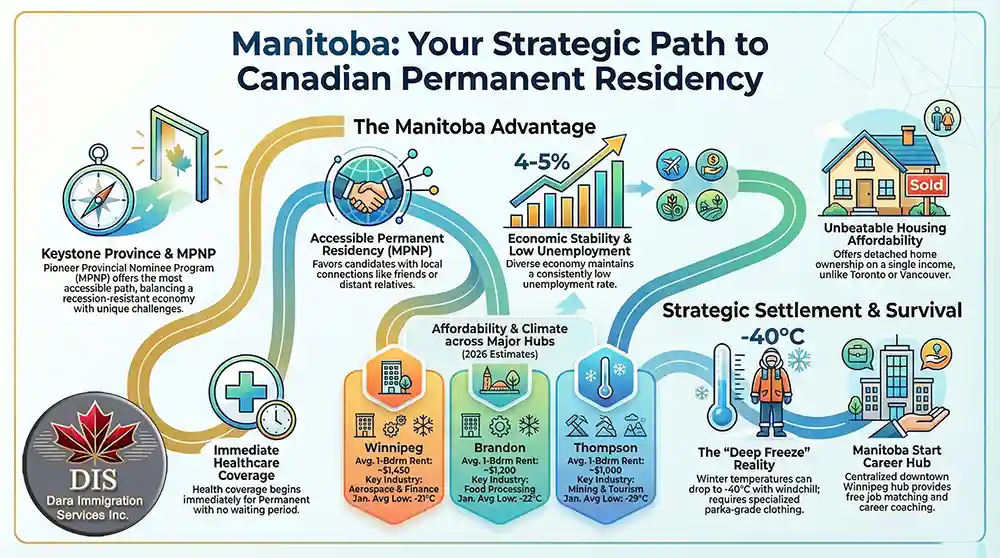
To choose Manitoba is to choose stability, community, and arguably the most affordable path to homeownership in Canada today. Located at the longitudinal center of the country, Manitoba is often called the “Keystone Province”—the bridge between the industrial East and the resource-rich West.
For the thousands of immigrants arriving in 2026, Manitoba offers a unique value proposition. While Toronto and Vancouver struggle with housing crises, Manitoba remains a place where a middle-class income still buys a detached home with a backyard. Its economy is incredibly diverse, avoiding the “boom and bust” cycles of its oil-rich neighbors. Instead, it relies on a steady mix of advanced manufacturing, aerospace, financial services, and a massive agribusiness sector.
However, moving here requires a specific mindset. The winters are legendary for their severity, and the immigration system is distinct. The Manitoba Provincial Nominee Program (MPNP) was the first of its kind in Canada and remains the gold standard. It heavily favors candidates with a “connection to Manitoba”—whether that is a friend, a distant relative, or previous work experience in the province.
At Dara Immigration Services, we help you leverage the MPNP to its full potential. This guide is your blueprint to settling in Manitoba successfully, ensuring your move is strategic, safe, and financially rewarding.
Manitoba Overview: Economy & Lifestyle
Manitoba’s economy is one of the most diversified in Canada. It is the aerospace capital of Western Canada and a global hub for bus manufacturing (New Flyer). Because it does not rely on a single commodity like oil, the labour market is remarkably stable. In 2026, the province is actively recruiting skilled tradespeople, transport drivers, and healthcare workers to replace an aging workforce.
For immigrants, the Manitoba Provincial Nominee Program (MPNP) is the primary vehicle for entry. Unlike other provinces that prioritize high CRS scores above all else, Manitoba prioritizes adaptability. The province wants to know: “Will you stay?” This is why having a “Manitoba Supporter”—a friend or relative who has lived in the province for at least one year—can add 200 points to your Expression of Interest (EOI), effectively guaranteeing an invitation to apply.
Quick Facts: Manitoba at a Glance
- Capital City: Winnipeg.
- Population: Approx. 1.5 Million (2026 Estimate).
- Taxation: 5% Federal GST + 7% Provincial RST (Retail Sales Tax).
- Key Immigration Stream: MPNP (Skilled Worker in Manitoba & Overseas).
- Minimum Wage: Approx. $15.80+ per hour (Indexed).
- Unemployment Rate: Consistently low (4-5%).
Cities & Economic Zones
To succeed in Manitoba, you must understand its geography. The province is dominated by its capital, which houses over 60% of the population, but the “rural” cities offer some of the most aggressive immigration pathways and tight-knit communities in the country.
Winnipeg
Winnipeg is a cultural and economic powerhouse disguised as a small town. It is a city of distinct neighborhoods, from the historic Exchange District to the rapidly expanding suburbs of Bridgwater.
Economy & Labour Market
- Key Industries: Aerospace (Boeing Canada, StandardAero), Advanced Manufacturing (New Flyer), Insurance (Canada Life, IG Wealth Management), and Agribusiness (Richardson International).
- Employment Outlook: Steady and reliable. As a logistics hub for North America (CentrePort Canada), jobs in transport, rail, and supply chain management are abundant. The tech sector is also growing, particularly in digital agriculture and financial technology.
- Lifestyle & Culture: A city of festivals. Winters are celebrated with the “Festival du Voyageur” (Western Canada’s largest winter festival), while summers feature “Folklorama,” the world’s largest and longest-running multicultural festival. The city is also home to the NHL’s Winnipeg Jets and the Canadian Museum for Human Rights.
- Cost of Living: Very Low compared to other major capitals. One-bedroom rents average $1,450 (2026 est), and a starter home can still be purchased for under $350,000. This affordability allows newcomers to save aggressively.
Brandon
The “Wheat City” is the second-largest urban center, located two hours west of Winnipeg. It is a critical hub for the agricultural sector and serves a trading population of over 180,000 people.
Economy & Labour Market
- Key Industries: Food Processing (Maple Leaf Foods), Agriculture, Chemicals, and Education (Assiniboine Community College).
- Employment Outlook: High demand for industrial butchers, truck drivers, agricultural technicians, and nurses. The Maple Leaf pork processing plant is a major employer of new immigrants.
- Lifestyle & Culture: Quiet, safe, and family-oriented. Commutes are non-existent (10 minutes max across town). It offers all the amenities of a city but the pace of a rural community.
- Cost of Living: Extremely Affordable. Rents are typically 15-20% lower than in Winnipeg, and property taxes are reasonable.
Rural Powerhouses (Steinbach, Winkler, Morden)
Do not overlook these communities. Steinbach and the Winkler/Morden corridor are manufacturing giants and are among the fastest-growing cities in Canada due to high immigration rates.
Economy & Lifestyle
- Steinbach: Known as the “Automobile City,” it has a strong Mennonite heritage and a booming economy based on window manufacturing and agriculture.
- Winkler/Morden: Famous for the “Morden Community Driven Immigration Initiative,” these twin cities are industrial hubs (Triple E RVs). They actively recruit workers who fit their specific labour needs.
- Immigration Advantage: These towns have robust support networks for newcomers. Integration is faster here because the community needs you.
- Climate Profile: Similar to Winnipeg—hot summers and very cold winters.
Northern Manitoba (Thompson & Churchill)
The rugged north is a land of lakes, forests, and bedrock.
Economy & Lifestyle
- Key Industries: Mining (Nickel in Thompson), Hydroelectricity, and Tourism (Polar Bears/Beluga Whales in Churchill).
- Lifestyle: Remote and resilient. Living here requires a love for the outdoors (fishing, snowmobiling) and an ability to handle isolation.
- Opportunity: Wages in the north are often higher to attract workers (the “Northern Allowance”).
Cost of Living & Climate (2026)
Use this table to see just how far your dollar goes in Manitoba compared to other provinces.
| City / Region | Avg Rent (1-Bdrm) | Key Industry | Avg Winter Low (Jan) | Notes |
| Winnipeg | ~$1,450 | Aerospace / Finance | -21°C | Capital City Hub |
| Brandon | ~$1,200 | Food Processing | -22°C | “Wheat City” |
| Steinbach | ~$1,150 | Agriculture | -20°C | High Immigrant Pop. |
| Thompson | ~$1,000 | Mining | -29°C | Northern Hub |
| Winkler | ~$1,100 | Manufacturing | -20°C | Industrial Jobs |
Note: Winter temperatures listed are averages, but windchill can drop effectively to -40°C. At these temperatures, exposed skin can freeze in under 10 minutes.
“How-To” Guide: Settling in Manitoba
Your transition to Manitoba is supported by some of the best settlement services in Canada.
Pre-Arrival: The MPNP Connection Strategy
- Secure a Supporter: If applying from overseas, having a “Manitoba Supporter” is your golden ticket. This must be a friend or relative who is a PR/Citizen and has lived in the province for 1 year. Reconnect with old university friends or distant cousins—they can add massive points to your application.
- Winter Gear Budget: Do not underestimate this. Allocate $500 – $800 per person for “parka-grade” winter clothing (rated for -30°C or lower) before your first winter. Fashion coats from Europe or Asia will not suffice.
Your First Week: Essential Setup
- Apply for Manitoba Health: Good news—coverage begins immediately for Permanent Residents and eligible work permit holders (valid for 12+ months). Visit a Manitoba Health office with your passport and visa to get your card.
- Get a Peggo Card: If in Winnipeg, buy a reloadable “Peggo” card for the transit system. Public transit is the most economical way to navigate the city initially.
- Visit “Manitoba Start”: This centralized hub in downtown Winnipeg is unique to the province. It provides free career coaching, resume rewriting, and job matching for all new immigrants. Register here within your first 3 days.
Long-Term: Integration
- Buy a Home: With the savings from low rent, aim to enter the housing market within 2-3 years. Pre-approval amounts in Manitoba go much further than in Ontario.
- Embrace “Cabin Culture”: In summer, Manitobans head to the lakes. Visit Grand Beach (one of Canada’s best beaches) or the Whiteshell to understand why residents tolerate the winter.
Challenges for Newcomers in Manitoba
To succeed in this province, you must be prepared for the climate and specific social challenges.
Challenge #1: The Deep Freeze (Winter Reality)
- The Reality: Manitoba winters are long, harsh, and sunny. Temperatures of -30°C are standard in January. Cars need “block heaters” (a cord you plug into an electrical outlet to keep the engine warm). Without this, your car will not start.
- The Strategy: Embrace “indoor culture.” Winnipeg has an extensive indoor skywalk system connecting downtown buildings. Dress in layers: thermal base layer, fleece mid-layer, and windproof outer shell. View winter as a season for festivals and skating, not hibernation.
Challenge #2: Crime Rates
- The Reality: Statistically, Winnipeg has a higher crime severity index than the national average, particularly regarding property crime and inner-city issues.
- The Strategy: Research neighborhoods carefully. Crime is often localized. Areas like Bridgwater, Sage Creek, Linden Woods, and Tuxedo are very safe and popular with newcomer families. Downtown areas require more vigilance, especially at night.
Challenge #3: The “Mosquito” Season
- The Reality: In summer, the flat, wet geography makes Manitoba a breeding ground for mosquitoes. It is often jokingly referred to as the “Provincial Bird.”
- The Strategy: Buy quality repellent and ensure your home has good window screens. The city conducts fogging programs to control the population, but it is a fact of prairie life.
Frequently Asked Questions (FAQ)
- Is healthcare free in Manitoba?
Yes. Manitoba Health covers medically necessary services for Permanent Residents and work permit holders (valid for at least 12 months). Coverage typically begins on the date of arrival, with no waiting period.
- What is the “Manitoba Supporter” requirement?
For the MPNP Skilled Worker Overseas stream, having a friend or relative who is a Permanent Resident or Citizen living in this province can guarantee your eligibility. They must have lived in the province for at least one year and be willing to endorse your plan.
- How cold does it really get?
Very cold. In January and February, temperatures often drop to -30°C, and with windchill, it can feel like -40°C or colder. Schools rarely close for cold, so you must be prepared with proper insulated clothing.
- Is it easy to find a job in Winnipeg?
Yes. Winnipeg has a diverse economy with chronic labour shortages in manufacturing, healthcare, and transport. The unemployment rate is consistently lower than the national average.
- What is the “Retail Sales Tax” (RST)?
Unlike Alberta (0%) or Ontario (HST), Manitoba charges a 7% provincial sales tax on most goods, plus the 5% federal GST. This means you pay 12% tax on most purchases at the register.
Professional Immigration Assistance
Manitoba offers the most straightforward path to PR for those who can prove a connection to the province. However, the MPNP points grid is strict, and a mistake in demonstrating your “Settlement Plan” can lead to immediate rejection.
Don’t risk your future on a paperwork error. Contact Dara Immigration Services today to optimize your MPNP application.
Disclaimer: This article provides general information regarding settlement and immigration in Manitoba. It does not constitute legal advice.
Download:
Download this bulletin of Manitoba as a PDF.
Download “Manitoba-Bulletin-2026-2027.pdf” Manitoba-Bulletin-2026-2027.pdf – Downloaded 35 times – 1.40 MB