Canadian Refugee Programs
Canadian Refugee Programs Overview 2026-2027
Recognized globally for their commitment to humanitarian aid, Canadian refugee programs offer life-saving pathways for displaced individuals through a unique combination of government resettlement and private sponsorship. Canada’s reputation as a global sanctuary is well-earned, but the path to safety is far more restricted than the headlines suggest. For those fleeing persecution, the “Canadian Dream” is not just about a better life—it is about life itself.
However, in 2026, the doors are narrower. With the expansion of the Safe Third Country Agreement (STCA) closing the border to most irregular crossers and strict new caps on private sponsorship, a mistake in your initial claim can lead to immediate deportation.
At Dara Immigration Services, we handle the highest-stakes cases in immigration law. Whether you are a Private Sponsor Group in Toronto or an asylum seeker facing a Refugee Board hearing, we provide the legal shield you need to navigate Canadian Refugee Programs.
Key Takeaways (Quick Summary):
- Two Distinct Paths: You are either Resettled (brought to Canada by the government/sponsors) or an Asylum Seeker (you arrive in Canada and ask for protection).
- New 2026 Reality: A special initiative is underway to transition 115,000 Protected Persons already in Canada to Permanent Residence, prioritizing them over new arrivals.
- The STCA Barrier: You cannot claim asylum at the US-Canada land border unless you meet a specific exception (e.g., family member in Canada).
- Processing Time: Refugee hearings now take 16+ months, followed by a 30-month wait for PR processing.
What are the Canadian Refugee Programs?
Refugee status is not a “choice”—it is a legal recognition that you cannot return home. Canada Refugee Programs divide into two streams.
1. Refugee and Humanitarian Resettlement Program (Outside Canada)
You cannot apply directly to Canada for this. You must be referred by the UNHCR or a designated private sponsor.
- Government-Assisted Refugees (GAR): Selected by the UN. Canada supports you for 1 year.
- Private Sponsorship of Refugees (PSR): Groups of 5 Canadians or Community Organizations pay to support you for 1 year. Status: Highly competitive with limited quota spots.
- Human Rights Defenders Stream: A niche stream for up to 250 journalists/activists per year (Referral only).
2. In-Canada Asylum Program (Inside Canada)
For people who are physically present in Canada or at a Port of Entry.
- The Test: You must prove a “well-founded fear of persecution” based on race, religion, nationality, political opinion, or social group (e.g., LGBTQ+).
- The Risk: If refused, you face a removal order. You cannot simply “try again.”
Canadian Refugee Programs Eligibility Requirements
Canadian Refugee Programs have specific requirements. To claim protection from inside Canada, you must pass a strict eligibility interview.
1. Physical Presence
You must be on Canadian soil. You cannot claim asylum at a Canadian embassy abroad.
2. The “Convention Refugee” Definition
You must demonstrate you are personally at risk.
- NOT Eligible: Fleeing general poverty, seeking better jobs, or fleeing natural disasters (unless specific discrimination exists).
3. Safe Third Country Agreement (STCA)
If you arrive from the USA (land border, train, or airports), you are ineligible to claim asylum unless:
- You have a family member in Canada (parent, spouse, sibling, aunt/uncle, etc.).
- You are an unaccompanied minor.
- You hold a valid Canadian visa (visitor, student).
- You face the death penalty in your country.
4. No “Exclusion” Factors
You are ineligible if:
- You have been recognized as a refugee in another country (e.g., France, USA).
- You have serious criminal convictions or human rights violations.
- You have a previous refused claim in Canada.
Costs, Funds & Timelines (2026 Estimates)
Note: Canadian Refugee Programs are often free. There is no government fee to claim asylum, but the costs of sponsorship or PR processing are significant.
| Category | Fee / Metric | Notes |
| Asylum Claim Fee | $0 CAD | Free to apply for protection. |
| Work Permit (Claimant) | $0 CAD | Free for eligible claimants. |
| Private Sponsorship Cost | ~$29,500 CAD | Minimum funds a “Group of 5” must raise for a family of 3. |
| PR Processing Fee | $575 CAD | Paid after your claim is accepted (Protected Person). |
| IRB Hearing Wait | 16 – 24 Months | Time until your refugee hearing. |
| PR Processing Time | 30 – 45 Months | Wait time for PR after a positive hearing. |
Canadian Refugee Programs Step-by-Step Application Process
The application process for Canadian Refugee Programs are complex. This is a legal battle, not a simple application.
Step 1: Port of Entry vs. Inland Claim
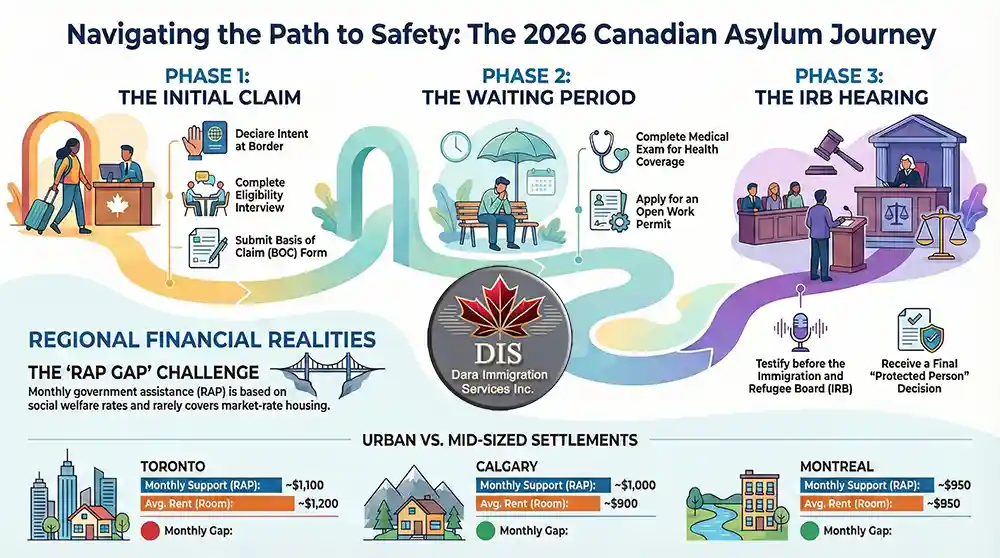
- Port of Entry: You declare asylum to the CBSA officer upon arrival (airport/border). You must complete your Basis of Claim (BOC) form within 15 days.
- Inland: You apply online via the IRCC Portal. You must upload your BOC with the application.
Step 2: The “Brown Paper” (Refugee Protection Claimant Document)
If eligible, you receive this document. It proves your status and gives you access to the Interim Federal Health Program (IFHP).
Step 3: Apply for a Work Permit
You do not need to wait for your hearing. You can apply for an Open Work Permit immediately after your claim is referred to the Refugee Board.
Step 4: The Refugee Hearing (IRB)
The most critical day. You testify before a Board Member.
- Evidence: You must present police reports, medical records, and witness statements proving your risk.
- Warning: Inconsistencies between your oral testimony and your written BOC form are the #1 reason for failure.
Step 5: Decision
- Positive: You become a “Protected Person” and can apply for Permanent Residence.
- Negative: You receive a conditional Departure Order. You may appeal to the Refugee Appeal Division (RAD) or Federal Court.
Common Reasons for Refusal in Canadian Refugee Programs
Refugee claims are scrutinized for “Credibility” above all else.
1. Inconsistency (The “Story” Trap)
- The Issue: Your BOC form says you were attacked in June, but at the hearing, you say July.
- The Refusal: The Board Member will rule you are not credible and reject your entire claim, even if the danger is real. Precision is mandatory.
2. Internal Flight Alternative (IFA)
- The Issue: You fled cartel violence in Mexico City.
- The Refusal: The Board may argue you could have safely moved to Merida or Monterrey instead of Canada. If you could be safe anywhere in your home country, Canada will not protect you.
3. State Protection
- The Issue: You were threatened but never went to the police.
- The Refusal: You must prove you tried to get state protection (police) and they failed or refused to help. If you didn’t try, your claim fails.
Frequently Asked Questions (FAQ)
- Can I work while waiting for my hearing?
Yes. Once your claim is found eligible and referred to the IRB, you can apply for a Refugee Claimant Open Work Permit. This allows you to work for any employer to support yourself during the 16+ month wait.
- What if I entered Canada irregularly (e.g., Roxham Road)?
Since March 2023, the STCA applies to the entire land border. If you cross irregularly and are caught within 14 days, you will be sent back to the USA unless you qualify for an exception (e.g., family in Canada).
- Does Canada accept climate refugees?
No. “Climate change” is not currently a ground for refugee protection under the Geneva Convention. You must fear persecution based on race, religion, nationality, membership in a social group, or political opinion.
- How much does it cost to sponsor a refugee family?
For a “Group of Five” to sponsor a family of 4, you must raise approximately $30,000 – $35,000 CAD and hold it in a trust account to support them for their first year.
- Can I visit my home country after becoming a refugee?
No. If you return to the country you fled (even for a short visit), Canada can revoke your refugee status and Permanent Residence. It is called “Re-availment”—it proves you no longer fear persecution.
Professional Immigration Assistance
A refugee claim is a life-or-death legal proceeding. A poorly drafted Basis of Claim form or a misunderstood question at the border can result in deportation to the danger you fled.
Do not face the Refugee Board alone. Contact Dara Immigration Services today. We prepare your evidence, coach you for your hearing, and fight for your right to safety in Canada.
Disclaimer: This article provides general information regarding Canadian Refugee Programs and does not constitute legal advice. Policies change frequently.
Download:
Download the bulletin of Canadian Refugee Programs as a PDF.
Download “Canadian-Refugee-Programs-Bulletin-2026-2027.pdf” Canadian-Refugee-Programs-Bulletin-2026-2027.pdf – Downloaded 229 times – 1.53 MB