Refugee Claim Refusal in Canada
Refugee Claim Refusal in Canada Overview 2026-2027
Receiving a Refugee Claim Refusal in Canada is a devastating moment that triggers a countdown on your stay in the country. When the Refugee Protection Division (RPD) rejects your case, your “Conditional Removal Order” becomes active, and the threat of deportation becomes real.

However, a “No” from the RPD is not necessarily the final word. In 2026, the Canadian legal system provides robust appeal mechanisms, but they operate on extremely tight timelines. If you miss a deadline by even 24 hours, you may lose your right to appeal forever.
At Dara Immigration Services, we specialize in crisis management for refused claimants. We rapidly assess the reasons for your refugee claim refusal and determine if you are eligible to appeal to the Refugee Appeal Division (RAD) or if other humanitarian pathways can save your status.
Key Takeaways (Quick Summary):
- The 15-Day Rule: You have strictly 15 days from receiving your refusal decision to file a Notice of Appeal to the RAD.
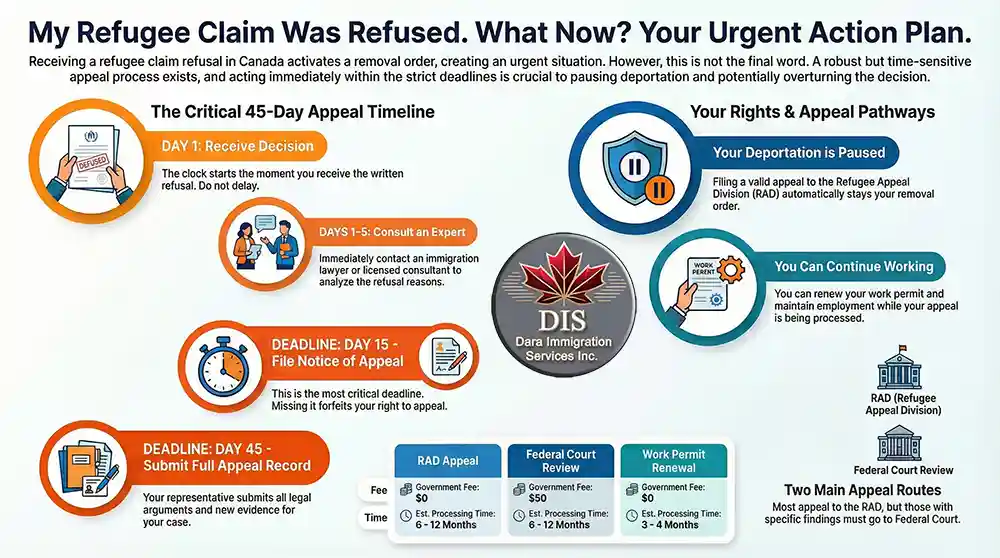
- Removal is Paused: If you file a valid appeal to the RAD, your deportation is stayed (paused) until a decision is made.
- Work Permit Validity: In most cases, you can renew your claimant work permit and keep working while your appeal is in process.
- Not Everyone Can Appeal: Some claimants (e.g., STCA exceptions, “No Credible Basis” findings) are barred from the RAD and must go to Federal Court.
Options After a Refugee Claim Refusal in Canada
When you face a Refugee Claim Refusal in Canada, your path forward depends on why you were refused and which rules apply to your specific case.
1. Appeal to the Refugee Appeal Division (RAD)
This is the most common route. The RAD is a higher tribunal that reviews the RPD’s decision.
- What they do: They check if the RPD officer made errors in law or fact.
- The Power: They can overturn the refusal and grant you refugee status, or send the case back for a new hearing.
- Who represents you: An RCIC (with specific licensing) or an Immigration Lawyer.
2. Judicial Review (Federal Court)
If you are barred from the RAD, your only option is the Federal Court.
- What they do: A judge reviews if the process was fair. They do not re-assess the evidence, only the process.
- Representation: You generally require a lawyer for this level of court.
3. Pre-Removal Risk Assessment (PRRA)
If you have exhausted all appeals and are facing removal, you may be offered a PRRA to check if new risks have arisen in your home country since your original hearing.
Appealing a Refugee Claim Refusal in Canada
Before filing an appeal, we must verify you are eligible to access the RAD for Refugee Claim Refusal in Canada.
Eligible for RAD Appeal (Most Claimants)
- You appeared for your hearing (you did not abandon the claim).
- The RPD decision did not state “No Credible Basis” or “Manifestly Unfounded.”
- You did not arrive via the STCA (Safe Third Country Agreement) exception pathway (exceptions apply).
Ineligible for RAD (Must go to Federal Court)
- Designated Irregular Arrival: You arrived as part of a group designated by the Minister.
- STCA Exception: You entered from the USA under an exception (e.g., family member).
- Withdrawn/Abandoned: You withdrew your previous claim.
- Credibility Finding: The RPD explicitly stated there was “No Credible Basis” for your claim.
Costs, Fees & Timelines (2026 Estimates)
Note: Legal fees for appeals are higher than initial claims due to the complexity and tight deadlines.
| Category | Government Fee (CAD) | Processing Time | Notes |
| RAD Appeal | $0 CAD | 6 – 12 Months | No gov fee, but Service Fees apply. |
| Federal Court (JR) | $50 CAD | 6 – 12 Months | Requires a Lawyer. |
| H&C Application | $575 CAD | 24+ Months | Humanitarian & Compassionate grounds. |
| Restoration of Status | $229 CAD | Variable | If you lost status during the process. |
| Work Permit Renewal | $0 CAD | 3 – 4 Months | Free for active refugee appellants. |
If you receive a Refugee Claim Refusal in Canada, do not panic—act.
Step 1: Read the “Notice of Decision” Immediately
The clock starts the day you receive the written reasons. Do not ignore the letter.
Step 2: Consult Counsel (Day 1–5)
Contact Dara Immigration or a lawyer immediately. We need time to review the RPD’s reasons (the “reasons for decision”) to see if they made a mistake.
Step 3: File “Notice of Appeal” (Day 15 Deadline)
We must submit three copies of the Notice of Appeal to the RAD registry.
- Crucial: If you miss this Day 15 deadline, your removal order becomes enforceable.
Step 4: Perfect the Appeal (Day 45 Deadline)
We have 30 days after filing the Notice to submit the Appellant’s Record. This includes:
- Legal arguments explaining the RPD’s errors.
- Any new evidence (strictly limited to evidence that was not reasonably available during the first hearing).
Step 5: Decision
- Accepted: You are granted Protected Person status.
- Rejected: You may seek “Leave for Judicial Review” at the Federal Court (Lawyer required).
Common Reasons For a Refugee Claim Refusal in Canada
Understanding the why is essential for a successful appeal.
1. Internal Flight Alternative (IFA)
- The Reason: The officer believed that even if you are in danger in your city, you could move to another city in your country (e.g., moving from Bogota to Cartagena) and be safe.
- The Challenge: On appeal, we must prove it is unreasonable or unsafe for you to move there.
2. Credibility Issues
- The Reason: The officer found contradictions between your oral testimony and your written Basis of Claim (BOC) form.
- The Challenge: These are hard to overturn unless the officer ignored your explanations for the confusion.
3. State Protection
- The Reason: You failed to ask the police in your home country for help before fleeing.
- The Challenge: You must have clear evidence that the police are corrupt or unable to protect you.
Frequently Asked Questions (FAQ)
- Can I stay in Canada during my appeal?
Yes. If you are eligible for the RAD, your Removal Order is stayed (paused) automatically. You cannot be deported until the RAD makes a final decision.
- Can I apply for Humanitarian and Compassionate (H&C) grounds?
Generally, no. You are barred from applying for H&C for 12 months following a final refugee refusal (the “12-month bar”). Exceptions exist if the safety of a child is involved.
- What happens if I miss the 15-day deadline?
You lose your right to appeal. The Canada Border Services Agency (CBSA) will contact you to arrange your removal (deportation). You may apply for an “Extension of Time,” but it is rarely granted without an exceptional reason.
- Can I keep working after a refusal?
Yes. As long as you have filed your appeal on time, your status as a “Refugee Claimant” continues. You can renew your work permit and continue employment.
- Do I need a lawyer for the RAD?
You can use an Immigration Lawyer or a Regulated Canadian Immigration Consultant (RCIC-IRB) who has the specific license to practice before the Refugee Board.
Professional Immigration Assistance
A Refugee Claim Refusal in Canada is a legal emergency. The difference between a successful appeal and deportation often comes down to the quality of the legal arguments filed in those first 45 days.
Do not let a procedural error end your journey to safety. Contact Dara Immigration Services immediately for an urgent review of your refusal decision.
Disclaimer: This article provides general information regarding refugee appeals and does not constitute legal advice. Policies and timelines change frequently.
Download:
Download the bulletin of Refugee Claim Refusal in Canada as a PDF.
Download “Refugee-Claim-Refusal-Bulletin-2026-2027.pdf” Refugee-Claim-Refusal-Bulletin-2026-2027.pdf – Downloaded 153 times – 1.64 MB