Working While Studying in Canada
Working While Studying in Canada Overview 2026-2027
For many international students, working while studying in Canada is a cornerstone of the “Canadian Dream.” It provides essential financial support to manage the cost of living and offers invaluable Canadian work experience that strengthens your future Permanent Residence application.

However, the rules regarding Working While Studying in Canada are strict. Violating work-hour limits is one of the fastest ways to lose your student status and face deportation.
At Dara Immigration Services, we help you balance your academic goals with professional growth, ensuring you remain compliant with IRCC regulations at all times. This will allow you to continue working while studying in Canada. This guide explains your rights, the new 24-hour limit, and how to work legally in Canada.
Key Takeaways (Quick Summary):
- Off-Campus Limit: You can work up to 24 hours per week during academic sessions (updated from the old 20-hour rule).
- Scheduled Breaks: You can work full-time during winter/summer holidays, provided you are returning to school.
- No Separate Permit: Your study permit authorizes you to work; you do not usually need a separate work permit (unless strictly Co-op).
- The “ESL” Restriction: Students in language programs (ESL/FSL) or general interest courses generally cannot work.
Authorization for Working While Studying in Canada
You do not always need a specific “Work Permit” to hold a job. Most study permits issued today include a condition that automatically authorizes you to continue working while studying in Canada, provided you meet specific criteria.
On-Campus vs. Off-Campus Work
It is crucial to distinguish between where you are working, as the rules differ significantly.
1. On-Campus Work
“On-campus” refers to working for the school itself, a faculty member, a student organization, or a private business located physically on the campus (e.g., a coffee shop inside the university).
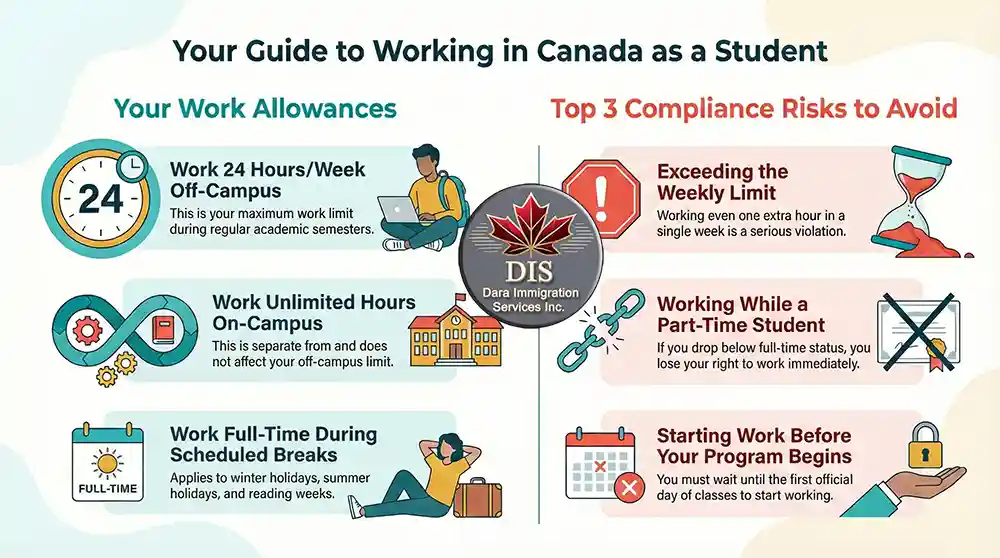
- Hours: Unlimited. You can work as many hours as you wish, in addition to your off-campus hours.
- Condition: You must be a full-time post-secondary student.
2. Off-Campus Work
“Off-campus” refers to any employer outside the boundaries of your school.
- Hours: Strictly limited (see rules below).
- Condition: Your study permit must explicitly state: “May work 20 (now 24) hours per week off-campus or full-time during regular breaks.”
Eligibility Requirements for Working While Studying in Canada
To work off-campus without a work permit, you must meet all of the following requirements:
1. Valid Study Permit
You must hold a valid study permit that includes the condition authorizing work.
2. Full-Time Student Status
You must be enrolled as a full-time student at a Designated Learning Institution (DLI).
- Exception: You may be authorized to work during your final semester, even if you are part-time, provided you only need a few credits to graduate.
3. Eligible Program of Study
Your program must be:
- At least 6 months long.
- Leading to a degree, diploma, or certificate.
- Note: Students in ESL (English as a Second Language) or FSL (French as a Second Language) programs are not eligible to work.
4. Social Insurance Number (SIN)
You cannot be paid legally without a SIN. You must apply for this nine-digit number from Service Canada once you arrive.
Limits and Rules of Working While Studying in Canada
Recent 2025/2026 updates have fundamentally reshaped the regulations for international students working while studying in Canada. Violating these new rules regarding hour limits is a serious offense. IRCC monitors payroll data to ensure compliance.
During Regular Academic Sessions
- The Rule: You may work up to 24 hours per week off-campus.
- Context: This was increased from the previous 20-hour limit to help students manage rising living costs while ensuring studies remain the priority.
During Scheduled Academic Breaks
- The Rule: You may work full-time (unlimited hours).
- Definition of “Scheduled Break”: This includes winter and summer holidays, or Reading Weeks, as defined by your school’s academic calendar.
- Condition: You must be enrolled full-time in the semester before the break and have a letter of enrollment for the semester after the break.
Financial Data and Working Conditions
Note: These figures are estimates and subject to provincial variations.
| Category | Metric / Rule | Notes |
| Minimum Wage | $15.00 – $19.75 CAD/hr | Varies by Province (e.g., BC vs. Ontario). |
| Social Insurance Number (SIN) | Free ($0) | Apply at Service Canada or online. Never pay for this. |
| Off-Campus Limit | 24 Hours / Week | Strictly enforced during semesters. |
| Tax Deduction | ~15% – 20% | Income tax is deducted automatically from your paycheck. |
| Co-op Work Permit Fee | Free ($0) | Only if work is essential to your study program. |
Getting Started: A Step-by-Step Guide to Working While Studying in Canada
Step 1: Verify Your Study Permit Conditions
Check your physical permit document. It should say: “May accept employment on or off campus if meeting eligibility criteria.”
- If missing: If you are eligible but your permit doesn’t say this, you must request an amendment from IRCC.
Step 2: Apply for a Social Insurance Number (SIN)
Visit a Service Canada center with your passport and study permit. You will receive your SIN on the spot.
- Security Tip: Never share your SIN with anyone except your employer, bank, or tax agency.
Step 3: Open a Canadian Bank Account
Most employers pay via “Direct Deposit.” You will need a chequing account to receive your salary.
Step 4: Secure Employment
Use school career boards, LinkedIn, or local job sites.
- Tip: Ensure your employer understands the 24-hour limit. It is your responsibility, not theirs, to track your hours.
The Co-op Work Permit (Mandatory Internships)
Some academic programs require work experience (internships or co-op placements) to graduate.
Requirement for a Separate Permit
Even if your study permit allows you to work off-campus, you must apply for a separate Co-op Work Permit if the employment is part of your curriculum.
- Eligibility: The work must be essential to your program (certified by your school) and cannot exceed 50% of the total program study.
- Fee: This permit is free of charge.
Need help applying for a Co-op Permit? [Link to: Book a Consultation] with Dara Immigration.
Common Compliance Risks
Working illegally is the most common reason for future Post-Graduation Work Permit (PGWP) refusals.
1. Working Before Studies Begin
You cannot work before your program officially starts. Even if you arrive in Canada a month early, you must wait until the first day of classes to begin working.
2. The “Part-Time” Trap
If you drop courses and become a part-time student (for reasons other than being in your final semester), you strictly lose your authorization to work. You must stop working immediately until you regain full-time status.
3. Exceeding the 24-Hour Limit
Working 25 hours in a single week is a violation. IRCC does not average hours over a month. One week over the limit constitutes non-compliance.
Frequently Asked Questions (FAQ)
- Can I work more than 24 hours if I have two jobs?
No. The 24-hour limit applies to the total number of hours worked across all employers combined. You cannot work 15 hours at Job A and 15 hours at Job B in the same week.
- Does “On-Campus” work count toward the 24-hour limit?
No. On-campus hours are separate. You could legally work 10 hours on-campus and 24 hours off-campus in the same week.
- Can I work if I am taking a “gap” semester?
Generally, no. If you take an unauthorized break (a semester off that is not a scheduled school break), you are not considered a full-time student and cannot work.
- What happens if I work illegally?
You may be issued an exclusion order (deportation) and banned from Canada for one year. Furthermore, any future applications for work permits or Permanent Residence will likely be refused.
- Do I pay taxes in Canada as an international student?
Yes. If you earn income in Canada, you must file an income tax return each year. You may be eligible for tax refunds (such as GST credits), so filing is often beneficial.
Professional Immigration Assistance
Balancing work and study is a great way to build your life in Canada, but the regulations are unforgiving. A simple error—like working while studying part-time—can jeopardize your entire immigration journey.
Don’t guess your status. Contact Dara Immigration Services today for a professional review of your eligibility.
Disclaimer: This article provides general information regarding working while studying in Canada as an international student and does not constitute legal advice. Policies change frequently.
Download:
Download the bulletin of Working While Studying in Canada as a PDF.
Download “Working-While-Studying-in-Canada-Bulletin-2026-2027.pdf” Working-While-Studying-in-Canada-Bulletin-2026-2027.pdf – Downloaded 32 times – 1.40 MB