Visit Canada
Visit Canada Overview 2026-2027
To Visit Canada is to explore a land of staggering diversity, from the urban pulse of Toronto to the serene peaks of the Rockies. For the millions of travelers arriving in 2026, obtaining the right entry document—whether a Temporary Resident Visa (TRV), Electronic Travel Authorization (eTA), or Super Visa—is the critical first step.

However, Canadian border regulations have tightened. With higher financial thresholds for Super Visas and stricter scrutiny on “dual intent” (visitors planning to stay permanently), a casual application can easily lead to a refusal. Success requires proving not just that you want to come, but that you have the means and intent to leave.
At Dara Immigration Services, we turn complex travel regulations into a clear path. This guide is your blueprint to entering Canada successfully, ensuring your journey begins at the border, not ends there.
Strategic Overview: The Visitor System
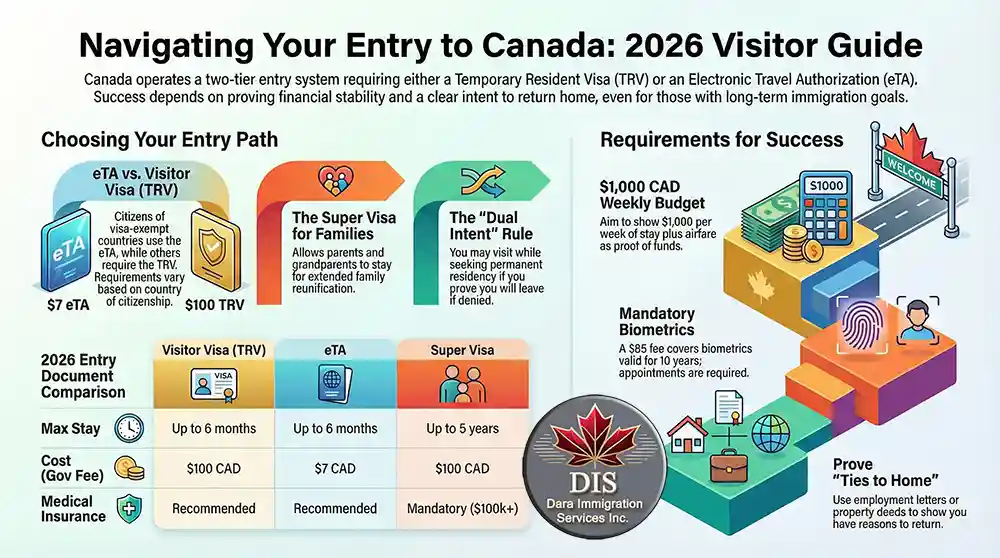
Canada operates a two-tier entry system based on your country of citizenship. You either need a visa (TRV) or an authorization (eTA). There is no “visa on arrival” for the vast majority of travelers.
For prospective immigrants who wish to visit Canada first, a visitor visa is often a strategic tool. It allows you to attend job interviews, explore communities for Provincial Nominee Programs (PNPs), or reconnect with family. However, you must strictly adhere to the conditions of your stay: no unauthorized work and no overstaying.
Quick Facts: Visit Canada at a Glance
- Primary Document: Visitor Visa (TRV) or eTA.
- Standard Stay: Up to 6 months (at officer discretion).
- Application Fee: $100 CAD (Visa) / $7 CAD (eTA).
- Biometrics Fee: $85 CAD (Valid for 10 years).
- Processing Time: Varies significantly (20 – 90+ days).
- Key Requirement: Proof of Funds & Ties to Home Country.
Visa Category Breakdown: Choosing Your Path to Visit Canada
To Visit Canada, you must apply under the stream that matches your intent. Applying for the wrong category is a common cause of delays.
The Tourist Stream (Standard TRV)
This is the most common visa for sightseers, friends, and those exploring future immigration options.
Eligibility & Requirements
- Valid Passport: Must be valid for the duration of your stay.
- Proof of Funds: You must demonstrate financial stability. While there is no fixed minimum, we recommend showing access to $2,500 – $3,000 CAD per person for a 1-week trip, plus airfare.
- Ties to Home: You must prove you will return home (e.g., letter from employer, property deed, family obligations).
The “Dual Intent” Strategy
- It is legal to visit Canada with the intention of eventually becoming a Permanent Resident. However, you must convince the officer that if your permanent residency is denied, you will still leave Canada when your visitor status expires.
The Super Visa (Parents & Grandparents)
A powerful option for families, allowing parents and grandparents to stay in Canada for up to 5 years at a time without renewing their status.
Financial Requirements (2026)
- Income Threshold: The host child/grandchild must meet the Low Income Cut-Off (LICO) minimums.
- 1 Person (Host): ~$30,526
- 2 Persons: ~$38,002
- 3 Persons: ~$46,720
- 4 Persons: ~$56,724
- Medical Insurance: You must purchase private medical insurance from a Canadian company (or designated international provider) with at least $100,000 coverage for 1 year.
The Business Visitor Stream
Designed for international professionals wishing to visit Canada to attend conferences, meetings, or after-sales service.
Limitations
- No Labour Market Entry: You cannot enter the Canadian labour market. Your main source of remuneration and place of business must remain outside Canada.
- Stay Duration: Usually granted for short periods (days or weeks), though the visa itself may be valid for years.
Requirements to Visit Canada: Visa Comparison Table (2026)
Use this table to determine which entry document fits your needs.
| Feature | Visitor Visa (TRV) | Electronic Travel Auth (eTA) | Super Visa |
| Target Audience | Non-Visa Exempt Countries | Visa Exempt Countries (US, EU, etc.) | Parents & Grandparents |
| Max Stay | Up to 6 months | Up to 6 months | Up to 5 years per visit |
| Validity | Up to 10 years (Passport expiry) | 5 years (or Passport expiry) | Up to 10 years |
| Cost (Gov Fees) | $100 CAD | $7 CAD | $100 CAD |
| Processing | Weeks to Months | Minutes to Days | Weeks to Months |
| Insurance | Recommended | Recommended | Mandatory ($100k) |
Note: Processing times for TRVs in 2026 are highly variable. India takes ~88 days, while the US takes ~20 days.
“How-To” Guide: Steps to Visit Canada
In order to visit Canada you must first apply for a visitor visa. Securing a visa involves a strict digital process.
Phase 1: Preparation
- Check Eligibility: Determine if you need a visa or an eTA.
- Gather Documents: Collect bank statements (past 4-6 months), employment letters, and a travel itinerary.
- Invitation Letter: If visiting family or business partners, get a formal letter of invitation detailing their status and financial support.
Phase 2: The Application
- Create IRCC Account: Most applications are submitted online via the IRCC secure portal.
- Upload & Pay: Upload high-quality scans of your documents. Pay the $100 visa fee and $85 biometrics fee.
- Biometrics: Within 24-48 hours, you will receive a Biometrics Instruction Letter (BIL). Book an appointment at a Visa Application Centre (VAC) immediately.
Phase 3: Passport Request
- Submission: Once approved, you will receive a Passport Request Letter. You must send your physical passport to the VAC for stamping.
- Arrival: Upon landing, the border officer (CBSA) has the final say on your entry and how long you can stay.
Barriers to Visit Canada: Why Visas Get Refused
To Visit Canada is a privilege. Refusal rates can be high for certain regions.
Challenge #1: “Vague” Purpose of Travel
- The Reality: Stating “Tourism” without a booked hotel or itinerary is a red flag.
- The Strategy: Provide a detailed day-by-day itinerary. If visiting family, explain the specific occasion (e.g., “Attending my niece’s graduation on June 15th”).
Challenge #2: Insufficient Funds
- The Reality: Showing a large lump-sum deposit the week before applying looks suspicious.
- The Strategy: Show a consistent banking history over 4-6 months. If a parent is paying, provide their bank statements and a signed affidavit of support.
Frequently Asked Questions (FAQ)
- How much money do I need to show for a tourist visa?
While there is no fixed minimum, a safe guideline is $1,000 CAD per week of stay, plus the cost of flights and accommodation. For a 2-week trip, aim to show access to at least $4,000 – $5,000 CAD.
- Can I look for a job while visiting Canada?
Yes, you can search for jobs and attend interviews. However, you cannot start working until you have applied for and received a valid Work Permit. You may need to leave Canada to activate that permit.
- What is the difference between a Single and Multiple Entry Visa?
A Multiple Entry Visa allows you to enter and leave Canada as many times as you want while it is valid (usually up to 10 years). A Single Entry Visa allows you to enter only once. Canada considers all applicants for Multiple Entry automatically.
- Do I need a medical exam to visit?
Generally, no for short visits (under 6 months). However, if you plan to stay longer (Super Visa) or have lived in certain designated countries for 6 months prior to travel, a medical exam may be required.
- Can I extend my stay as a visitor?
Yes. You must apply for a “Visitor Record” to extend your stay at least 30 days before your current status expires. If you stay past your expiry date without applying, you lose your status.
Professional Immigration Assistance
A refused visitor visa remains on your permanent record and makes future applications significantly harder. Whether you are reuniting with grandparents under the Super Visa or planning a strategic business trip, the paperwork must be flawless.
Ensure your entry to Canada is smooth. Contact Dara Immigration Services today for a professional visa assessment.
Disclaimer: This article provides general information regarding visitor visas and travel to Canada. It does not constitute legal advice.
Download:
Download the bulletin of Visit Canada as a PDF.
Download “Visit-Canada-Bulletin-2026-2027.pdf” Visit-Canada-Bulletin-2026-2027.pdf – Downloaded 104 times – 1.60 MB