Work in Canada
Work in Canada Overview 2026-2027
To Work in Canada is to join a labour market defined by high standards, strict protections, and competitive wages. For the thousands of skilled professionals arriving in 2026, the Canadian economy offers stability in sectors ranging from Artificial Intelligence to Healthcare.

However, the “open” market of the past has shifted. In 2026, the federal government tightened the rules for Temporary Foreign Workers (TFWs). Securing the right to Work in Canada now requires navigating complex Labour Market Impact Assessments (LMIAs) or qualifying for specific “innovation stream” work permits. A job offer alone is no longer a guarantee of a visa.
At Dara Immigration Services, we specialize in converting job offers into valid work permits. This guide is your blueprint to navigating the regulations to Work in Canada successfully, ensuring your career move is legal and secure.
Strategic Overview: Pathways to Work in Canada
The Canadian work permit system is bifurcated: “Employer-Specific” and “Open.” Understanding the difference is critical to your strategy.
Most foreign nationals who wish to work in Canada must obtain a Work Permit from Immigration, Refugees and Citizenship Canada (IRCC). Unlike a Visitor Visa, a Work Permit allows you to engage in the labour market and earn a salary. However, getting one usually requires a Canadian employer to prove they cannot find a local Canadian to do the job first (the LMIA process).
Quick Facts: Work in Canada at a Glance
- Unemployment Rate: Approx. 5.8% (National Avg, 2026 Est).
- Standard Work Week: 40 Hours (Overtime applicable after 44 in some provinces).
- Minimum Wage: Varies by Province ($15.00 – $19.00/hr).
- Key Document: Work Permit (LMIA-based or Exempt).
- Vacation: 2 weeks paid vacation (minimum) after 1 year.
- Worker Rights: You have the same labour rights as a Canadian citizen.
Regional Job Opportunities in Canada
To successfully Work in Canada, you must target the region that needs your specific skillset.
Ontario (Central Hub)
Ontario is the economic engine of Canada, hosting the headquarters of most major banks and tech firms.
Economy & Labour Market
- Key Industries: Finance (Toronto), Technology (Waterloo/Ottawa), and Advanced Manufacturing (Windsor).
- Employment Outlook: High demand for senior IT developers, financial analysts, and construction managers. The “Tech Talent Strategy” frequently recruits workers for this region.
- Lifestyle & Culture: Fast-paced and competitive. Professionals work long hours but enjoy world-class amenities in Toronto.
- Cost of Living: High. One-bedroom rents in Toronto average $2,650, meaning you need a high salary to live comfortably.
British Columbia (Pacific Gateway)
A hub for innovation and trade, BC attracts workers who value lifestyle alongside their career.
Economy & Labour Market
- Key Industries: Green Technology, Digital Media/Film, and Logistics (Port of Vancouver).
- Employment Outlook: BC has a critical shortage of healthcare workers and specialized tradespeople. The BC PNP Tech stream offers a fast-track for tech workers.
- Lifestyle & Culture: Health-conscious and outdoorsy. Work-life balance is prioritized more heavily here than in Ontario.
- Cost of Living: Very High. Vancouver rents ($2,896+) are the highest in the country, often termed the “Sunshine Tax.”
Alberta (Energy & Engineering)
The province with the highest average wages, ideal for those looking to Work in Canada to save money.
Economy & Labour Market
- Key Industries: Energy (Oil & Gas), Petrochemicals, and a booming Tech sector in Calgary.
- Employment Outlook: Engineers, heavy equipment operators, and project managers are in constant demand.
- Lifestyle & Culture: Entrepreneurial. The business culture is less formal and more results-oriented.
- Cost of Living: Moderate. With no provincial sales tax and affordable rents (~$1,690 in Calgary), your paycheck goes further.
Atlantic Canada (Emerging Growth)
The east coast is actively recruiting to solve demographic aging issues.
Economy & Labour Market
- Key Industries: Ocean Technology, Shipbuilding (Halifax), and Healthcare.
- Employment Outlook: The Atlantic Immigration Program (AIP) makes it easier for employers to hire foreign workers.
- Lifestyle & Culture: Relaxed and community-focused. Employers often value long-term retention over short-term contracts.
- Cost of Living: Affordable. Rents in cities like Moncton or Halifax are significantly lower than the national average.
Work in Canada: Salary & Cost of Living Data (2026)
Use this table to understand the financial reality of different regions.
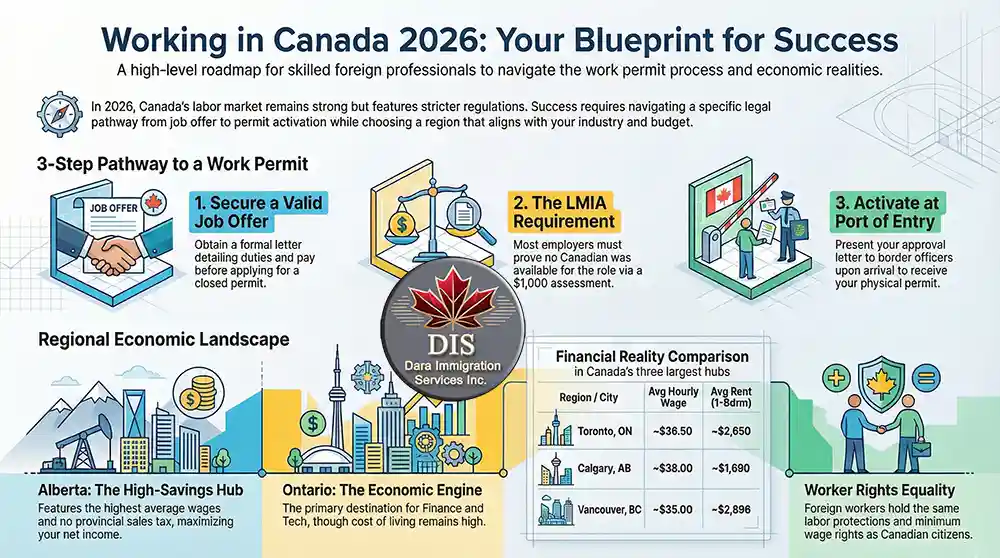
| Region / City | Avg Hourly Wage | Key Industry | Avg Rent (1-Bdrm) | Notes |
| Toronto, ON | ~$36.50 | Finance / Tech | ~$2,650 | Highest Competition |
| Calgary, AB | ~$38.00 | Energy / Eng | ~$1,690 | Highest Net Income |
| Vancouver, BC | ~$35.00 | Film / Trade | ~$2,896 | High Cost of Living |
| Montreal, QC | ~$33.00 | AI / Aero | ~$1,700 | French Required |
| Halifax, NS | ~$31.00 | Ocean Tech | ~$1,700 | AIP Pathway |
Note: Wages are estimates based on 2026 projections for skilled roles. Minimum wage is significantly lower ($15-19/hr).
“How-To” Guide: Necessary Steps to Work in Canada
Securing a work permit is a multi-step legal process. Follow this roadmap.
Pre-Arrival: The Job Offer
- Secure a Valid Job Offer: You cannot apply for a closed work permit without a job offer. The employer must give you a formal letter detailing duties, pay, and duration.
- The LMIA Check: Ask your employer: “Do you have a positive LMIA?” Most jobs require the employer to get this document from Service Canada before you can apply for your visa.
Your First Week: Activation
- Port of Entry: When you land, you present your approval letter to the border officer. They print the actual Work Permit document. Check the expiry date and conditions (e.g., “Not authorized to work in childcare”) immediately.
- Get Your SIN: Visit Service Canada to get your Social Insurance Number. You cannot legally get paid without this.
Long-Term: Maintenance
- Maintain Status: If you lose your job on a closed work permit, you cannot simply start working elsewhere. You must find a new employer willing to sponsor a new permit or leave Canada.
Challenges of Working in Canada
To work in Canada is a great opportunity, but there are hurdles.
Challenge #1: The LMIA Barrier
- The Reality: Many employers do not want to go through the LMIA process because it costs them $1,000 and takes months.
- The Strategy: Target “LMIA-Exempt” streams like the Francophone Mobility Program or International Experience Canada (IEC) if eligible.
Challenge #2: “Canadian Experience”
- The Reality: Employers often hesitate to hire newcomers without local references.
- The Strategy: Treat your first job as a stepping stone. Even a short-term contract gives you the “Canadian Experience” needed to unlock better roles later.
Frequently Asked Questions (FAQs)
- Do I need a job offer to work in Canada?
Yes, usually. Unless you are eligible for an Open Work Permit (e.g., as the spouse of a skilled worker or student, or through the IEC program), you need a specific job offer supported by an LMIA.
- Can I bring my family?
It depends on your skill level. If you have a high-skilled job offer (TEER 0, 1, 2, or 3), your spouse may be eligible for an Open Work Permit, and your children can attend public school for free.
- What is an LMIA?
A Labour Market Impact Assessment (LMIA) is a document an employer gets from the government to prove they couldn’t find a Canadian for the job. You need a copy of this to apply for your work permit.
- Can I change jobs on a Work Permit?
If you have an Open Work Permit, yes. If you have an Employer-Specific (Closed) Work Permit, no. You would need a new job offer and a new work permit application to change employers.
- What is the minimum wage?
It varies by province. In 2026, it generally ranges from $15.00 to $19.00 CAD per hour. However, the cost of living in major cities often requires a wage much higher than the minimum to survive comfortably.
Professional Immigration Assistance
Your career is your most valuable asset. Don’t let a rejected work permit application or a misunderstanding of labour laws derail your future. The rules to Work in Canada—especially regarding LMIAs—are complex and strictly enforced.
Ensure your path to employment is secure. Contact Dara Immigration Services today for a professional assessment.
Disclaimer: This article provides general information regarding employment and work permits in Canada. It does not constitute legal or career advice.
Download:
Download the bulletin of Work in Canada as a PDF.
Download “Work-in-Canada-Bulletin-2026-2027.pdf” Work-in-Canada-Bulletin-2026-2027.pdf – Downloaded 100 times – 1.42 MB