Canadian Open Work Permit
Canadian Open Work Permit Overview 2026-2027
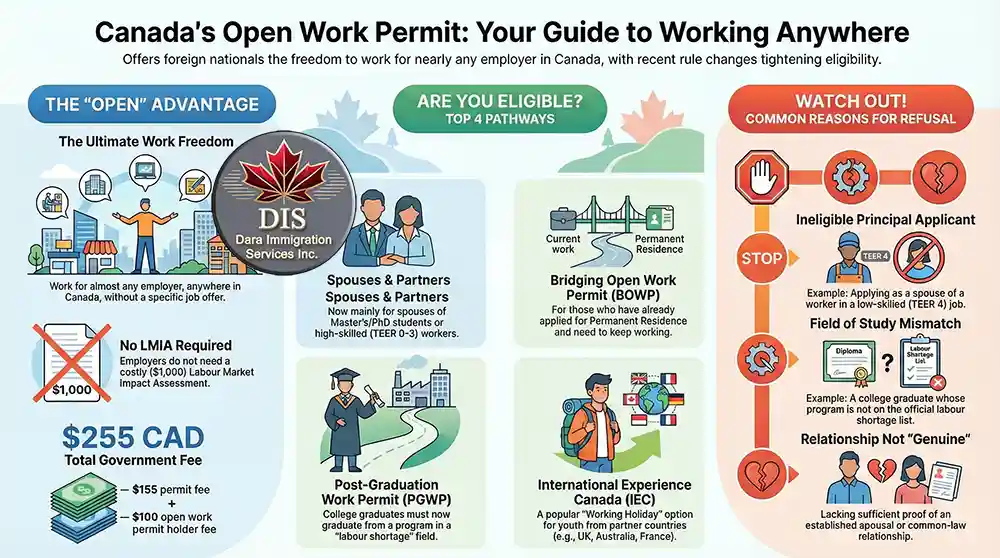
Securing a Canadian Open Work Permit is widely considered the ultimate freedom for international talent, allowing you to work for any employer in Canada without the need for a specific job offer or a Labour Market Impact Assessment (LMIA). Whether you are a recent graduate, the spouse of a skilled worker, or an IEC participant, this document is your key to flexible employment and career growth in the Canadian market.

However, “Open” does not mean “Easy.” As of late 2025, IRCC has significantly tightened the eligibility rules—particularly for spouses—to align with Canada’s housing and infrastructure capacity. A generic application that ignores these new “TEER” and “Field of Study” requirements will result in a refusal.
At Dara Immigration Services, we specialize in identifying the correct open work permit stream for your unique situation. We ensure your application is legally sound, fully compliant, and optimized for approval.
Key Takeaways (Quick Summary):
- Freedom: Work for any employer, in any location (except for ineligible businesses like strip clubs).
- Spousal Restrictions (2026): Spouses of college students and low-wage workers are generally no longer eligible unless in specific shortage fields.
- PGWP Update: College graduates must now study in “labour shortage” fields to qualify; Master’s graduates are exempt.
- Fees: The total government fee is usually $255 CAD ($155 permit fee + $100 open holder fee).
What is a Canadian Open Work Permit?
A Canadian Open Work Permit is an authorization document that allows foreign nationals to work for almost any employer in Canada.
The Two Main Types of Work Permits
It is critical to understand the difference to avoid applying for the wrong one:
- Employer-Specific (Closed) Work Permit: You can only work for one specific employer. If you quit, you lose your status to work.
- Open Work Permit: You can work for multiple employers, switch jobs, or work part-time/full-time without notifying IRCC.
Why Choose an Open Work Permit?
- Flexibility: You are not tied to a boss who mistreats you.
- Cost-Effective: No employer needs to pay a $1,000 LMIA fee.
- Pathway to PR: The experience you gain (in TEER 0, 1, 2, or 3) counts toward the Canadian Experience Class (CEC).
Canadian Open Work Permit Eligibility Requirements
To apply, you must fall into one of the specific “eligibility baskets.” You cannot apply for an open permit just because you want one.
1. Spouses and Common-Law Partners
- Spouse of a Student: The student must be in a Master’s or Doctoral degree program (or a specialized professional degree like Law/Medicine). Note: Spouses of most undergraduate or college diploma students are no longer eligible.
- Spouse of a Worker: The principal worker must hold a valid work permit (valid for at least 6 months) and work in a TEER 0, 1, 2, or 3 job (high-skilled).
- Spousal Sponsorship: Applicants being sponsored for PR from inside Canada can apply for an open work permit while waiting for the decision.
2. Post-Graduation Work Permit (PGWP)
- University Grads: Bachelor’s, Master’s, and PhD graduates are generally eligible.
- College Grads: Must graduate from a program linked to a labour shortage (e.g., Healthcare, Trades, STEM) to qualify.
3. Bridging Open Work Permit (BOWP)
- Status: For workers whose current permit is expiring and who have already submitted a valid Permanent Residence application (e.g., Express Entry).
- Goal: “Bridges” the gap between your temp status and PR.
4. International Experience Canada (IEC)
- Working Holiday Category: Citizens of partner countries (e.g., Australia, UK, France, Japan) can get an open permit to travel and work.
Costs, Fees & Timelines (2026 Estimates)
Note: Processing times vary significantly by country of residence and application type.
| Category | Fee / Metric | Notes |
| Work Permit Processing Fee | $155 CAD | Standard base fee. |
| Open Permit Holder Fee | $100 CAD | Additional fee specific to open permits. |
| Total Government Fee | $255 CAD | The total you will pay upfront. |
| Biometrics Fee | $85 CAD | Required once every 10 years. |
| Processing Time (Online) | 3 – 5 Months | From outside Canada. |
| Processing Time (Inside Canada) | 80 – 120 Days | For extensions or spousal permits. |
Canadian Open Work Permit Step-by-Step Application Process
Securing a Canadian Open Work Permit requires proving you fit into an exemption category.
Step 1: Confirm Your “Anchor” Eligibility
You need a reason to apply.
- Example: “I am the spouse of a Master’s student” OR “I have applied for PR.” Gather the proof (e.g., Spouse’s enrollment letter, PR Acknowledgement of Receipt).
Step 2: Prepare Supporting Documents
- Proof of Relations: Marriage certificate or Statutory Declaration of Common-Law Union.
- Principal’s Status: Copy of your spouse’s study/work permit and their recent paystubs (to prove they are actually working).
- Medical Exam: If you plan to work in healthcare or with children.
Step 3: Create Your GCKey Account
Log in to the IRCC secure portal. When asked “What are you applying for?”, select “Work” and answer the questionnaire carefully to generate the Open Work Permit checklist.
Step 4: Pay the Fees
Ensure you pay both the $155 and the $100 fee ($255 total). Missing the $100 fee is a common reason for delays.
Step 5: Submit and Wait
Once submitted, if you are inside Canada and your current permit expires, you are on Maintained Status and can typically continue working until a decision is made.
Canadian Open Work Permit Risks and Refusals
Open work permits are high-risk because they are discretionary.
Common Reasons for Refusal
1. Ineligible Principal Applicant
- Scenario: You apply as the spouse of a worker, but your spouse is working in a “TEER 4” (low-skilled) job like retail sales or food service.
- Result: Refusal. The principal worker must be high-skilled (TEER 0/1/2/3) or in a specific shortage stream.
2. “Genuineness” of Relationship
- Scenario: You got married last week and immediately applied for the permit with no photos or history.
- Result: Refusal. IRCC suspects a “Marriage of Convenience.”
3. PGWP “Field of Study” Mismatch
- Scenario: A college graduate applies for a PGWP but studied “General Arts,” which is no longer on the shortage list.
- Result: Refusal.
Frequently Asked Questions (FAQ)
- Can I work anywhere on an Open Work Permit?
Yes, with two exceptions:
- You cannot work for an employer listed as “Ineligible” (non-compliant) by IRCC.
- You cannot work in “erotic services” (e.g., strip clubs, massage parlors).
- Does an Open Work Permit require an LMIA?
No. This is the main benefit. You do not need a job offer, and no employer needs to pay the $1,000 LMIA fee.
- Can I extend my Open Work Permit?
Generally, no. Open permits (like PGWP or IEC) are “one-time” deals. However, Spousal Open Work Permits can be extended as long as the principal spouse still has a valid study/work permit.
- How long is the permit valid for?
It depends on the “Anchor.”
- Spouses: Valid for the same duration as the principal spouse’s permit.
- PGWP: Valid for 1 to 3 years depending on study length.
- Can I apply for this permit at the border?
Only if you are from a visa-exempt country (e.g., USA, UK, Australia) or if you are eligible for specific streams like the PGWP (though IRCC is limiting border applications to reduce congestion). Visa-required nationals must apply online.
Professional Immigration Assistance
The rules for the Canadian Open Work Permit have shifted dramatically in the last year. What worked for your friend in 2024 likely will not work for you in 2026.
Don’t gamble with your ability to earn an income. Contact Dara Immigration Services today. We review your eligibility against the latest TEER and spousal rules to ensure your application is approved the first time.
Disclaimer: This article provides general information regarding the Canadian Open Work Permit and does not constitute legal advice. Policies change frequently.
Download:
Download the bulletin of Canadian Open Work Permit as a PDF.
Download “Canadian-Open-Work-Permit-Bulletin-2026-2027.pdf” Canadian-Open-Work-Permit-Bulletin-2026-2027.pdf – Downloaded 38 times – 1.62 MB