Canadian Work Permit Exemptions
Canadian Work Permit Exemptions Overview 2026-2027
Navigating the specific rules for Canadian Work Permit Exemptions can be the fastest, most cost-effective route to conducting business in Canada without the administrative burden of a formal application. For global companies and skilled professionals, utilizing these exemptions allows for immediate deployment to Canada to close deals, perform emergency repairs, or speak at conferences.

However, the line between “working” and “visiting” is thin. Arriving at the border claiming an exemption when you actually need a permit is the quickest way to face an exclusion order.
At Dara Immigration Services, we help you determine definitively if your activities fall under Regulation 186 of the Immigration and Refugee Protection Regulations (IRPR). We prepare the “Port of Entry” packages that give border officers the confidence to stamp you in.
Key Takeaways (Quick Summary):
- The “R186” Rule: Specific activities (like public speaking or business meetings) do not require a work permit.
- Business Visitors: Can enter for international business activities but cannot enter the Canadian labour market.
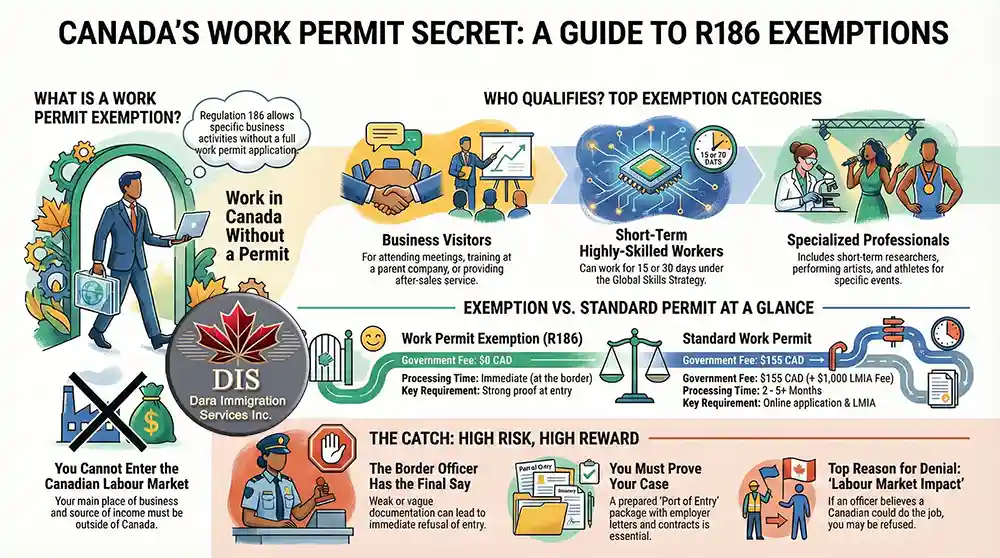
- Global Skills Strategy: Allows highly skilled workers to work for 15 or 30 days without a permit (once every 6/12 months).
- No Application Fee: Exemptions generally require no government work permit fee, only a visitor visa/eTA.
What Are Canadian Work Permit Exemptions?
Canadian Work Permit Exemptions are based on a legal provision that authorizes a foreign national to engage in work-related activities in Canada without obtaining a Work Permit.
The Legal Basis (R186)
Under Canadian immigration law, you are authorized to work without a permit if your activity falls under specific categories listed in Regulation 186.
- The Goal: To facilitate international trade, sports, and arts without bogging down the system with paperwork for short-term, low-risk activities.
- The Constraint: You must still hold valid entry status (eTA or TRV) and cannot “compete” with Canadian workers for jobs.
Primary Exemption Categories
- Business Visitors: Attending meetings, training (at a parent company), or after-sales service.
- Short-Term Highly Skilled Workers: Under the Global Skills Strategy (15 or 30 consecutive days).
- Short-Term Researchers: Up to 120 days at a public research institution.
- Performing Artists: Specific shows or limited engagements.
- Athletes & Team Members: Playing for a foreign team in a Canadian competition.
Canadian Work Permit Exemptions Eligibility Requirements
To claim an exemption, you must arrive at the border with proof. “Thinking” you are exempt is not enough; you must prove it.
1. Proof of “International Scope” (For Business Visitors)
You must demonstrate that your main place of business and source of income is outside Canada.
- Pay Stubs: Showing you are paid by a foreign employer.
- Employer Letter: Confirming you are not entering the Canadian labour market.
2. Specific Activity Compliance
Your planned activity must align strictly with the exemption category.
- Example: A technician coming to install a machine purchased from a foreign company (After-Sales Service) is exempt. A technician coming to operate that machine for 6 months is not exempt.
3. Duration Limits (Global Skills Strategy)
If utilizing the 15-day or 30-day exemption for high-skilled work (NOC 0 or A equivalent):
- 15 Days: You can use this once every 6 months.
- 30 Days: You can use this once every 12 months.
4. Entry Documents
Even if exempt from a work permit, you are not exempt from entry requirements.
- Visa-Required: You need a valid TRV.
- Visa-Exempt: You need a valid eTA.
Exemptions vs. Permits (2026 Comparison)
Note: The cost savings of an exemption are significant, but the risk of refusal at the border is higher if documentation is weak.
| Category | Government Fee | Processing Time | Validity Period |
| Work Permit Exemption | $0 CAD | Immediate (at Border) | Limited to the specific activity (e.g., 15 days). |
| Business Visitor | $0 CAD | Immediate (at Border) | Usually up to 6 months (activity dependent). |
| Standard Work Permit | $155 CAD | 2 – 5 Months | 1 – 3 Years. |
| LMIA Application | $1,000 CAD | 4 – 8 Weeks | Required for most permits (Employer pays). |
Step-by-Step: Claiming Canadian Work Permit Exemptions
Unlike a work permit application, you usually do not “apply” online. You present your case to the Canada Border Services Agency (CBSA) officer upon arrival. They must be convinced that you fall under one of the Canadian Work Permit Exemptions.
Step 1: Confirm Your NOC Code and Regulation
Verify that your job title and planned activity fall explicitly under R186.
- Consultation: [Link to: Book a Consultation] to confirm your specific NOC eligibility.
Step 2: Prepare the “Port of Entry” Package
You need a physical binder of documents to hand to the officer.
- Letter of Introduction: From your foreign employer explaining the trip.
- Letter of Invitation: From the Canadian host company.
- Warranty/Contract: Proof of after-sales service agreement (if applicable).
- Return Ticket: Proof you will leave.
Step 3: Secure Your Entry Visa (eTA or TRV)
Apply for your Visitor Visa or eTA well in advance.
- Tip: On your visa application, truthfully state your purpose is “Business,” not just “Tourism.”
Step 4: Arrive at the Border
Present your passport and your exemption package to the CBSA officer.
- The Interview: Clearly state: “I am seeking entry as a Work Permit Exempt [Category Name] under Regulation 186.”
Step 5: Receive Your Visitor Record (Optional)
For longer stays (e.g., Researchers), the officer may issue a Visitor Record document specifying your authorized activity. Keep this safe.
Risks and Challenges of Canadian Work Permit Exemptions
The CBSA officer has the final say. If they are not convinced, you will be put on the next plane home.
Common Reasons for Denial
1. “Labour Market Impact”
If the officer believes a Canadian could have done the job, you are not exempt.
- Risk: A carpenter coming to help build a set for a movie is likely not exempt. A film producer coming to oversee the budget is exempt.
2. Being Paid in Canada
If the Canadian company is paying you directly, you are generally considered an employee, not a business visitor.
3. “After-Sales Service” Confusion
- Rule: You can install, set up, or repair commercial equipment if it was part of the original sales contract.
- Trap: You cannot perform regular maintenance or operation of the equipment.
Frequently Asked Questions (FAQ)
- Can I be paid by a Canadian company while exempt?
Generally, no. As a Business Visitor, your remuneration must come from outside Canada. However, strict exceptions exist for certain performing artists or guest speakers receiving honorariums.
- Does the 15-day exemption reset?
Yes. Under the Global Skills Strategy, you can use the 15-day exemption once every 6 months. You must wait for the “cooling off” period to pass before using it again.
- Do I need a number (LMIA) for an exemption?
No. Work permit exemptions are completely exempt from the Labour Market Impact Assessment (LMIA) process. This is one of their biggest advantages.
- Can I bring my family?
Yes, but they do not automatically get open work permits. They would enter as visitors. If they wish to work or study, they must apply for their own permits.
- What if the officer refuses my exemption?
You may be allowed to withdraw your application to enter and return home voluntarily. In worse cases, you could receive an Exclusion Order (ban for 1 year). Always carry a prepared legal submission letter.
Professional Immigration Assistance
Using Canadian Work Permit Exemptions is a powerful strategy for global business, but it requires precision. A vague answer at the border can turn a business trip into an immigration nightmare.
Don’t guess with CBSA. Contact Dara Immigration Services to prepare a professional Port of Entry package that clearly proves your eligibility.
Disclaimer: This article provides general information regarding Canadian Work Permit Exemptions (R186) and does not constitute legal advice. Policies change frequently.
Download:
Download the bulletin of Canadian Work Permit Exemptions as a PDF.
Download “Canadian-Work-Permit-Exemptions-Bulletin-2026-2027.pdf” Canadian-Work-Permit-Exemptions-Bulletin-2026-2027.pdf – Downloaded 26 times – 2.15 MB